Mount Elgon National Park
Transboundary park on an ancient volcano with diverse montane habitats.
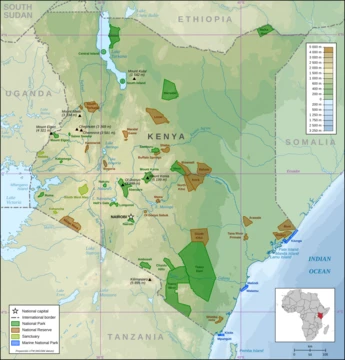
Mount Elgon National Park is a protected area straddling the Kenyan-Ugandan border, approximately 140 km northeast of Lake Victoria. The park covers 1279 km², with the Kenyan portion gazetted in 1968 and the Ugandan portion in 1992. It is notable for its location on an ancient volcano and its diverse montane ecosystems.
Quick Facts
- Location
- Uganda and Kenya
- Nearest city
- Mbale
- Area
- 1,279 km² / 494 sq mi (total)
- Established
- Kenya: 1968, Uganda: 1992
- Governing body
- Kenya Wildlife Service, Uganda Wildlife Authority
Facts from the source article.
Did You Know?
- Mount Elgon is an important water catchment for the Nzoia River, which flows to Lake Victoria, and for the Turkwel River, which flows into Lake Turkana.
- The park is the setting for parts of Richard Preston's book The Hot Zone.
- Henry Rider Haggard's novel King Solomon's Mines may have been inspired by the Mount Elgon caves.
Vegetation
The slopes of Mount Elgon support a range of vegetation types that change with elevation. Lower elevations feature wet montane forest dominated by Elgon olive and Aningeria adolfi-friederici, transitioning to olive and Afrocarpus gracilior forest, then to an Afrocarpus and bamboo zone. Higher still are Hagenia abyssinica forest and moorland with heaths, tussock grasses, and giant lobelias and groundsels. Notable species include African juniper, pillarwood, and orchids. Several plants, such as Ardisiandra wettsteinii and Ranunculus keniensis, occur only in high-elevation broadleaf montane forest.
Wildlife
Elephants and buffalo frequent the lower slopes, while small antelope, duiker, and forest monkeys such as black-and-white colobus and blue monkey are also present. Red-tailed monkey has been reported after being thought locally extinct. Leopard and hyena occur in the park. At least 144 bird species have been recorded, including Jackson's spurfowl, eastern bronze-naped pigeon, Hartlaub's turaco, Tacazze sunbird, and the endangered lammergeier. The endangered dragonfly Maathai's longleg was discovered here in 2005.
Conservation management
Before colonial administration, the upper elevations of Mount Elgon were managed under indigenous rules that restricted excessive resource use, with demand met sustainably due to a much smaller human population. The Uganda Protectorate gazetted its side as a Forest Reserve in 1929, with a boundary survey completed in 1937, though parcels were repeatedly degazetted for local settlement. In 1940 it became Mount Elgon Crown Forest and in 1951 a Central Forest Reserve. In 1983, 6000 ha were opened for settlement by the Benet-Ndorobo group, with an additional 1500 ha settled illegally; this area remained legally part of the reserve until 2002. Management disintegrated during civil wars, and the reserve became a national park in January 1994, though timber harvesting continued in some areas.
Attractions
The park offers cliffs, caves, waterfalls, gorges, mesas, calderas, hot springs, and mountain peaks. Four large explorable caves—Kitum, Chepnyali, and Mackingeny—are frequently visited at night by elephants and buffalo that lick natural salt from the walls. Kitum Cave extends 200 m into the mountain. Endebess Bluff provides panoramic views of escarpments, gorges, mesas, and rivers. Koitoboss Peak, at 4155 m, is reachable in about two hours from the road's end. Activities include vehicle circuits, self-guided walking trails, hiking to Endebess Bluff and Koitoboss Peak, primate and bird watching, cave explorations, camping, and photography. Other attractions include ancient cave paintings near the Budadiri trailhead, hot springs in the volcano's crater reaching 48°C, and Jackson's Pool at 4050 m, a shallow natural pool near Jackson's Peak, a volcanic plug named after explorer Frederick Jackson, who first climbed Mount Elgon in 1889.
More in National Parks of Kenya
Spotted an error? Know more?
Reader corrections go straight into our review queue. Suggest an edit · How this site is sourced