Vikos–Aoös National Park
A Greek national park with deep gorges and rich biodiversity, not a UNESCO Geopark.
Last updated
Where it is
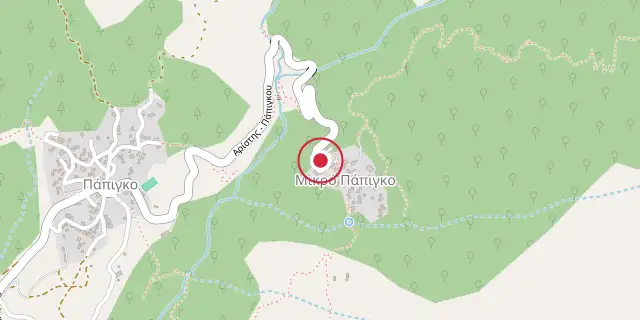
Coordinates: 39°58′08″N 20°43′41″E (39.9690, 20.7280) · Open in OpenStreetMap
Coordinates and connected clubs: the infobox of Wikipedia: Vikos–Aoös National Park (CC BY-SA 4.0). Map: drawn by Codexery from OpenStreetMap tiles.
It covers 12,600 ha of mountainous terrain and is named after its two major gorges.[1] Elevations within the park range from 550 m to 2,497 m, and it belongs to both the Natura 2000 network and the UNESCO Geoparks program.[1]
Last updated 2026-10-18 from the source article.
Geography and history
The park lies 30 km north of Ioannina in the northern Pindus mountain range.[1] The park's climate is Mediterranean transitioning to continental, with a mean annual temperature of 11.9 °C and annual precipitation of 1,100.9 mm.[2] From the 17th to the 19th century, the local Zagori communities enjoyed autonomous status under Ottoman rule and flourished economically through trade.[3][4] The Voidomatis River has carved the Vikos Gorge, which lies within a 3,400 ha core zone.[5]
The gorge's primary section extends 12 km in length, plunges to a depth of 1,000 m, and its breadth fluctuates between 2,500 m and just a few meters.[6] In 1973 the Greek government designated the park with the aim of protecting its animals, plants, and geological features.[5]
What the cited sources add
A 2005 paper by Petrakis et al. notes that the park's extreme geophysical conditions make road infrastructure difficult to construct and maintain.[7][8] The same study states that remote sensing is the only practical means for monitoring human activities and their ecosystem impact in the vast, road-poor park.[7][8] According to the same paper, Alpine newts (Triturus alpestris) inhabiting the Tymphe alpine lakes are linked to local dragon folklore.[9][10]
References
- Wikipedia, "Vikos–Aoös National Park" (CC BY-SA 4.0), which cites: Trakolis 2001, p. 3; Papadopoulou 2008, p. 20 (original not read by us) en.wikipedia.org
- Wikipedia, "Vikos–Aoös National Park" (CC BY-SA 4.0), which cites: Amanatidou 2005, pp. 23–24; Paschos, Nikolaou, Papanikos 2004, p. 5 (original not read by us) en.wikipedia.org
- Wikipedia, "Vikos–Aoös National Park" (CC BY-SA 4.0), which cites: Vokou, Katradia, Kokkini 1993, p. 1; Amanatidou 2005, p. 41 (original not read by us) en.wikipedia.org
- Wikipedia, "Vikos–Aoös National Park" (CC BY-SA 4.0), which cites: Amanatidou 2005, p. 34; Sakelarriou, M. V., "Epirus, 4000 years of Greek history and civilization", Ekdotikē Athēnōn, 1997, p. 342 (we also read that source) en.wikipedia.org
- Wikipedia, "Vikos–Aoös National Park" (CC BY-SA 4.0), which cites: Trakolis 2001, p. 3 (original not read by us) en.wikipedia.org
- Wikipedia, "Vikos–Aoös National Park" (CC BY-SA 4.0), which cites: Spanopoulou 2001, p. 16; Natura 2000, p. 8; Amanatidou 2005, p. 28; Papageorgiou 2001, p. 3 (original not read by us) en.wikipedia.org
- Michael Petrakis, "Evaluation of forest fire risk and fire extinction difficulty at the mountainous park of Vikos-Aoos, Northern Greece: use of remote sensing and GIS techniques", International Journal of Risk Assessment and Management (2005), doi:10.1504/ijram.2005.006612. OpenAlex metadata CC0; paper not read. doi.org
- Wikipedia, "Vikos–Aoös National Park" (CC BY-SA 4.0), which cites: Petrakis, "Evaluation of forest fire risk and fire extinction difficulty at the mountainous park of Vikos-Aoos, Northern Greece: use of remote sensing and GIS techniques", International Journal of Risk Assessment and Man (we also read that source) en.wikipedia.org
- Mathieu Denoël, "Resource partitioning in two heterochronic populations of Greek Alpine newts, Triturus alpestris veluchiensis", Acta Oecologica (2003), doi:10.1016/s1146-609x(03)00043-2. OpenAlex metadata CC0; paper not read. doi.org
- Wikipedia, "Vikos–Aoös National Park" (CC BY-SA 4.0), which cites: Natura 2000: p. 9; "The world's great adventure treks", New Holland Publishers, 2003, p. 114; Denoël, "Resource partitioning in two heterochronic populations of Greek Alpine newts, Triturus alpestris veluchiensis", Acta Oecologica, 2003, p. 55–64; Trakolis 2001, p. 3; Amanatidou 2005, p. 29 (we also read that source) en.wikipedia.org
Each numbered sentence above was checked against the source it cites before publication. Sentences citing Wikipedia adapt text from the English Wikipedia article Vikos–Aoös National Park (contributors), used under CC BY-SA 4.0; this entry is available under the same licence. Other sources were used for facts only; no text or images are copied from them.
More in National parks of Greece
Sources
Compiled from Wikipedia and the sources listed below. Text from Wikipedia is available under CC BY-SA 4.0; this entry is adapted from it.
- Wikipedia: Vikos–Aoös National Park (CC BY-SA 4.0).
Spotted an error? Know more?
Reader corrections go straight into our review queue. Suggest an edit · How this site is sourced