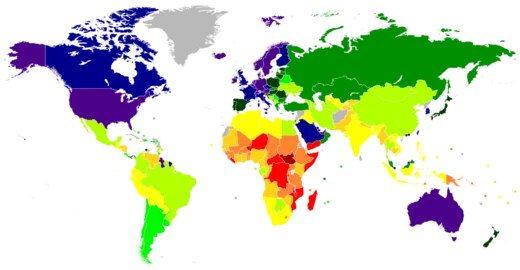
Economy of the European Union
Third largest nominal economy, second by PPP, about one-seventh global output.
The European Union's economy integrates the national economies of its member states into a single internal market, characterized by mixed economies that blend free-market principles with advanced social welfare models. As the world's second-largest economy in nominal terms after the United States, and the third-largest by purchasing power parity, it accounts for roughly one-sixth of global output. Within the bloc, Germany, France, Italy, and Spain are the four largest national economies. The EU is a major global trading entity, with Germany and France acting as primary hubs for both exports and imports. Its largest trading partners include China, the United States, the United Kingdom, Switzerland, and Russia. Many member states participate in the Eurozone, using the euro—the world’s second most-traded reserve currency after the U.S. dollar. The EU’s banking system totals over $38 trillion, with managed assets exceeding $12 trillion as of 2020. Major stock exchanges include Euronext Paris and the Frankfurt Stock Exchange. Economic output and wealth distribution vary significantly across the region, particularly between Western and Eastern Europe. Paris is the EU’s economically strongest city, with a GDP over $1 trillion. In 2024, social welfare expenditure across the EU averaged 27.3% of GDP. Public debt stood at 81.7% of GDP in 2026, ranging from Estonia’s low of 24.1% to Greece’s high of 146.1%. The services sector dominates the economy, contributing 64.7% of GDP, followed by manufacturing at 23.8% and agriculture at just 1.5%.
- Eurozone members
- 20 EU states use the euro
- Public debt (2026)
- Figure not yet available
- Largest trading partners
- China, U.S., United Kingdom, Switzerland
Lore & Background
The European Union’s economy is a composite of the national economies of its member states, forming the second-largest economy in the world by nominal value after the United States, and the third-largest by purchasing power parity, generating roughly one-sixth of global output. It is built on an internal market of mixed economies that blend free-market principles with advanced social models. Germany, France, Italy, and Spain are the four largest national economies within the bloc. The EU is a major global trading entity, with Germany and France serving as primary powerhouses for both exports and imports; its largest trading partners include China, the United States, the United Kingdom, Switzerland, and Russia. Many member states operate within the Eurozone, using the euro as their official currency, which is the second-largest and second-most-traded reserve currency worldwide after the U.S. dollar. The EU banking system totals over $38 trillion, with managed assets exceeding $12 trillion as of 2020. The two largest stock exchanges are Euronext Paris and the Frankfurt Stock Exchange. Economic output per capita varies significantly across the region, especially between Western and Eastern Europe. Paris is the economically strongest city in the EU, with a GDP exceeding $1 trillion. In 2024, social welfare expenditure across the EU stood at 27.3% of GDP. Public debt in 2026 averaged 81.7% of GDP, with wide disparities: Estonia had the lowest rate at 24.1%, while Greece had the highest at 146.1%. The services sector dominates the economy, accounting for 64.7% of GDP, followed by manufacturing at 23.8% and agriculture at 1.5%.
Reader's Guide
The European Union's economy is significant as a major global economic bloc, combining the resources and markets of its member states. Its internal market and common currency, the euro, facilitate trade and investment, though disparities in wealth and output persist across regions. The EU's long-term budgets, such as the Multiannual Financial Framework and the Next Generation EU recovery fund, support member states during crises like the COVID-19 pandemic. The services sector dominates GDP at 64.7%, followed by manufacturing at 23.8% and agriculture at 1.5%. The EU also faces challenges, including sovereign debt crises in several eurozone states and varying public debt levels, from Estonia's 24.1% to Greece's 146.1% of GDP. Its agricultural policy, the Common Agricultural Policy, has undergone reforms to reduce trade-distorting subsidies.
Did You Know?
- The EU economy generates about one-seventh of global economic output by purchasing power parity.
- Paris is the economically strongest city in the EU.
Global Standing and Internal Architecture
The European Union's economy represents the combined output of its member states, positioning it as the world's second-largest economy by nominal value, trailing only the United States. When measured by purchasing power parity, the bloc ranks third globally and accounts for roughly one-sixth of all economic production on the planet. Within its borders, Germany, France, Italy, and Spain stand as the four dominant national economies. The EU operates an internal market built on a blend of free-market principles and advanced social welfare models, creating a mixed-economy framework that distinguishes it from purely liberal or state-directed systems. The result is a vast economic entity that functions as a single trading bloc while preserving significant national policy diversity.
Trade, Banking, and the Euro
As one of the globe's most significant trading entities, the EU channels enormous volumes of goods and services through its member states, with Germany and France acting as the principal engines of both exports and imports. Its largest external trading partners include China, the United States, the United Kingdom, Switzerland, and Russia. Euronext Paris and the Frankfurt Stock Exchange serve as the two largest exchanges within the bloc. Denmark holds a special opt-out, and the remaining six non-euro states remain treaty-committed to eventual adoption.
The Debt Crisis and Fiscal Disparities
Greece, Ireland, Portugal, Spain, and Cyprus all required substantial bailout packages and undertook sweeping structural reforms. By the late 2010s, all five had successfully exited their bailout programmes and emerged from the acute phase of the crisis. The shock did not stop at the eurozone border: Hungary, Romania, and Latvia—none of which used the euro at the time—also faced debt distress and went through their own successful bailout programmes. The crisis left deep fiscal scars that persist today. Estonia carried the lowest burden at just 24.1% of GDP, while Greece bore the heaviest at a staggering 146.1%. This gap underscores how the same monetary union can produce radically different fiscal positions among its members, a tension that continues to shape EU economic policy.
Services Dominance and the Pandemic Reckoning
The services sector forms the backbone of EU economic activity, contributing 64.7% of GDP, far outpacing manufacturing at 23.8% and agriculture at a mere 1.5%. Financial services are particularly well developed within the Single Market, though EU firms historically relied more heavily on bank lending than their American counterparts. Without government assistance, 35% of small and medium-sized enterprises in manufacturing and services said they would not have survived.
Frequently Asked Questions
What is the Economy of the European Union?
It is the combined economic output of all EU member states operating within a single internal market. The system blends free-market competition with advanced social welfare models across its member nations.
How big is the EU economy compared to the rest of the world?
In nominal terms it ranks third behind the United States and China, while by purchasing power parity it sits second behind only China. EU member states together produce roughly one-seventh of all global economic output.
Which countries anchor the EU economy?
Germany, France, Italy, and Spain form the four largest national economies inside the bloc. Twenty EU states also share the euro, deepening monetary integration across a majority of member nations.
Who are the EU economy's biggest trading partners?
China, the United States, the United Kingdom, and Switzerland lead the list of the EU's largest external trade counterparts. These relationships drive the bulk of the bloc's cross-border goods and services flows.
What kind of economic system does the EU run?
The internal market is built on mixed economies that pair free-market competition with robust social safety nets. This hybrid structure sets it apart from both purely laissez-faire and centrally planned models.
More in National Economies 1-24
Spotted an error? Know more?
This is a living reference — every entry is fact-audited, and reader corrections feed straight into our audit queue. Suggest an edit · See this site's audit record