Last Roman Emperor
Medieval Christian legend of a final emperor before the Antichrist.
Last updated

via Wikipedia: Last Roman Emperor · see source
The Last Roman Emperor, also called the Last World Emperor or Emperor of the Last Days, is a figure from medieval legend rooted in Christian eschatology. The legend holds that in the end times, a final Roman or Christian emperor will defeat the enemies of Christianity and then surrender his crown, dissolving the Roman Empire and allowing the Antichrist to appear. It first emerged in the 7th-century Apocalypse of Pseudo-Methodius and was further developed through the Tiburtine Sibyl and other sources, becoming especially prominent in the 15th century.
Quick Facts
- First appearance
- 7th century
- Notable later writer
- Adso of Montier-en-Der
- Related concept
- Great Catholic Monarch
Facts from the source article.
Foundations
The legend is grounded in the Apocalypse of Pseudo-Methodius, which after the Book of Daniel and the Book of Revelation was the most widespread apocalypse story in Europe. Written in Syriac in the late seventh century, it describes a Last Emperor who will fight Christianity's enemies, especially the "sons of Ishmael"—the Arab rulers of the Middle East after the Early Muslim conquests. He will go out against them from the Sea of the Kushites and cast sword and desolation upon the desert of Yathrib, among the abodes of their ancestors.
After conquering his enemies, he would travel to Jerusalem and relinquish his power on Golgotha. The figure was further developed in Latin writings by Adso of Montier-en-Der, whose Libellus de Antichristo (ca. 954) presented a biography of the Antichrist preceded by a Frankish ruler—the continuation of the Roman Empire—who would voluntarily give up his power on the Mount of Olives. Another impetus came from the oracles of the Tiburtine Sibyl, first recorded in Latin around the year 1000, whose adaptable list of emperors and kings leading to the Last Emperor remained influential into the fifteenth century.
Catholic tradition
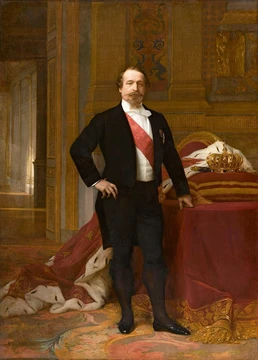
The idea of a final, great king appears in folklore, mystical writings, and the works of those believed to have received prophecies or divine visits. The Great Catholic Monarch was a common figure in folk tradition until the Enlightenment of the 1700s. It returned in 1800s prophecy when French legitimists thought Henri, Count of Chambord, would become king. A book from 1871, Future Career of Napoleon, promoted Napoleon III as Roman Emperor ruling a new ten-kingdomed Roman Empire.
The Catechism of the Catholic Church only mentions Christ as the king who will appear in the last days, recognized by all Israel and preceded by the Church's final trial—a religious deception that offers false solutions and leads to apostasy, with the Antichrist as the ultimate deception. It says nothing about a Great Catholic Monarch. Traditionalist Catholic writer Yves Dupont believed this monarch would restore European Catholic royalty, defeat heretics and atheists, and convert many Muslims and Jews.
More in Napoleon III
Sources
Compiled from Wikipedia and the sources listed below. Text from Wikipedia is available under CC BY-SA 4.0; this entry is adapted from it.
- Wikipedia: Last Roman Emperor (CC BY-SA 4.0).
Spotted an error? Know more?
Reader corrections go straight into our review queue. Suggest an edit · How this site is sourced