Great Comet of 1556
A comet linked to Emperor Charles V's abdication and a failed return prediction.
Last updated
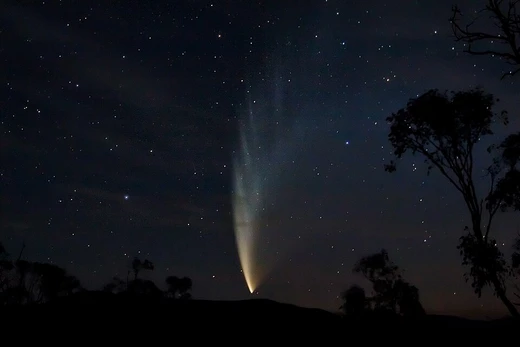
The Great Comet of 1556, known in modern records as C/1556 D1, was first spotted in February of that year and seen across much of Europe. While some places reported it before the end of February, most observations began in the middle of the first week of March.
Its apparent diameter measured half that of the Moon, and its tail was likened to "the flame of a torch agitated by the wind." Cornelius Gemma, son of Gemma Frisius, noted that the comet's head initially appeared as large as Jupiter and had a color similar to Mars. The mathematician and physician Paul Fabricius, who served at the court of Holy Roman Emperor Charles V, tracked its course. According to NASA, the first report came on 27 February 1556; the comet reached perigee on 13 March and perihelion on 22 April.
Charles V comet
This comet is also called the comet of Charles V. Upon seeing it, the emperor stood stunned and declared, "By this dread sign my fates do summon me." Having long considered withdrawing from the world after his conquests, he took the comet as a heavenly command and hurried to the monastery of St. Juste in Placentia. An anonymous English treatise from 1618, Blazing Stares, recounted that Charles, gazing intently at the star and deeply pondering its meaning, fell into great astonishment. He summoned a philosopher named Eginard and debated the star's significance, concluding that it threatened some dire calamity.
Contemporary religious interpretation
The Portuguese Dominican friar Gaspar da Cruz, who visited Guangzhou in 1556, linked the comet to the devastating Shaanxi earthquake that same year. In his 1569 book, he speculated that the comet might signal calamities not only for China but for the entire world, possibly even the birth of the Antichrist.
Alleged connection to the Great Comet of 1264
In the 19th century, John Russell Hind, building on calculations from Conrad Wolfhardt's chart and other old records, compared his results to an account by Friar Giles of Cambridge of a grand comet in 1264. Following Richard Dunthorne’s earlier lead, Hind concluded that the comet of 1556 was the same as that of 1264, finding a high probability of identity.
He predicted a return to perihelion around 1848 to 1850. That prediction failed, and as of 2009, no observed comet matched the orbital elements of either. David A. Sargent later wrote that available evidence suggests no connection between the comets of 1264 and 1556.
More in Named Comets
Sources
Compiled from Wikipedia and the sources listed below. Text from Wikipedia is available under CC BY-SA 4.0; this entry is adapted from it.
- Wikipedia: Great Comet of 1556 (CC BY-SA 4.0).
- Word definitions: the , each quoted from its Wikipedia article.
Spotted an error? Know more?
Reader corrections go straight into our review queue. Suggest an edit · How this site is sourced