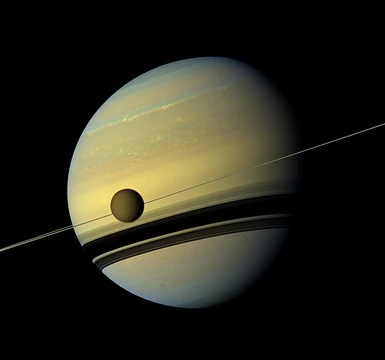
Magnitude (astronomy)
Logarithmic scale measuring stellar brightness, with lower values for brighter objects.
Last updated
In astronomy, magnitude is a measure of the brightness of an object, usually within a defined passband. The scale is logarithmic and dimensionless, defined so that a star of magnitude 1 is exactly 100 times brighter than a star of magnitude 6, with each step of one magnitude representing a factor of approximately 2.512 in brightness. Brighter objects have lower magnitude values, and the brightest can reach negative numbers; for example, the Sun has an apparent magnitude of −27, Sirius is −1.46, Venus at its brightest is −5, and the International Space Station can reach −6. Astronomers use two primary definitions: apparent magnitude, which measures an object's brightness as seen from Earth and depends on its intrinsic luminosity, distance, and extinction; and absolute magnitude, which describes intrinsic luminosity by defining the apparent magnitude the object would have if placed at a standard distance—10 parsecs for stars, or one astronomical unit from both observer and Sun for planets and small Solar System bodies.
Apparent magnitude is essentially a measure of illuminance, which can also be expressed in photometric units like lux. The system originated with the Greek astronomer Hipparchus in the second century BCE, who catalogued stars by brightness, and was formalized in the second century CE by Ptolemy, who classified stars on a six-point scale and coined the term magnitude. Early astronomers, including Tycho Brahe, mistakenly thought magnitude corresponded to a star’s physical size, measuring first-magnitude stars as 2 arc minutes in diameter, but telescopes later revealed these were spurious disks. Amateur astronomers often use limiting magnitude—the faintest star visible to the naked eye—to describe sky darkness, with a dark site allowing sight of 6th-magnitude stars or fainter.
Quick Facts
- Field
- Astronomy
- Known for
- Measuring stellar brightness on a logarithmic scale
- Introduced by
- Hipparchus (ancient times)
Facts from the source article.
Lore & Background
The Greek astronomer Hipparchus produced a catalogue noting the apparent brightness of stars in the second century BCE. In the second century CE, Ptolemy classified stars on a six-point scale and originated the term magnitude. To the unaided eye, a more prominent star such as Sirius or Arcturus appears larger than a less prominent star such as Mizar, which in turn appears larger than a truly faint star such as Alcor.
Tycho Brahe attempted to measure star 'bigness' in angular size, concluding first magnitude stars measured 2 arc minutes in apparent diameter, with subsequent magnitudes decreasing. The development of the telescope showed these sizes were illusory, but early telescopes produced spurious disk-like images, leading astronomers into the eighteenth century to continue thinking of magnitude in terms of physical size. By the mid-nineteenth century, astronomers understood stars as point sources of light, and the magnitude system shifted to measuring brightness.
Reader's Guide
The magnitude system is fundamental to observational astronomy, providing a standardized way to quantify the brightness of celestial objects. Its ancient origins in the work of Hipparchus and Ptolemy established a six-class system based on naked-eye appearance, which persisted for centuries despite subjective variations. This allowed for consistent measurement and the inclusion of objects brighter than first magnitude, such as Sirius at magnitude −1.46 and the Sun at −27. Astronomers distinguish between apparent magnitude, which depends on an object's intrinsic luminosity, distance, and extinction, and absolute magnitude, which measures intrinsic luminosity at a standard distance of 10 parsecs for stars.
The system's reverse scale—where brighter objects have lower or negative values—remains a distinctive feature. Amateur astronomers use limiting magnitude to describe sky darkness, typically seeing stars of 6th magnitude or fainter at dark sites. The magnitude scale's legacy lies in its continuous use from ancient times to modern photometry, bridging subjective observation and quantitative measurement.
Frequently Asked Questions
What is magnitude in astronomy?
Magnitude is a unitless logarithmic scale that quantifies how bright an astronomical object appears, usually within a defined wavelength band. It is one of the oldest quantitative tools in the field and remains central to observational astronomy today.
Why do brighter objects get lower numbers instead of higher ones?
That counterintuitive ordering is inherited directly from the ancient Greek convention, where 'first magnitude' meant the brightest stars visible to the unaided eye. The modern logarithmic framework simply preserved that original ranking, so lower values always signal greater brightness.
More in Astronomy & Space
Sources
Compiled from Wikipedia and the sources listed below. Text from Wikipedia is available under CC BY-SA 4.0; this entry is adapted from it.
- Wikipedia: Magnitude (astronomy) (CC BY-SA 4.0).
- Word definitions: the Codexery glossary, each quoted from its Wikipedia article.
Spotted an error? Know more?
Reader corrections go straight into our review queue. Suggest an edit · How this site is sourced