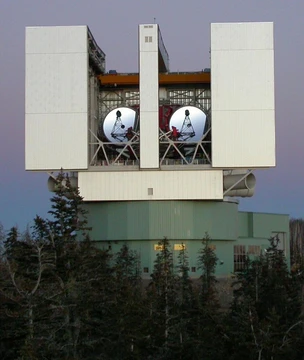
Pan-STARRS
Surveying the sky for moving or variable objects continually.
Last updated
Its primary mission is detecting Near-Earth Objects that threaten impact events.[1] On Maui, Hawaii, at the Haleakalā summit, the Pan-STARRS Observatory operates two 1.8-meter Ritchey–Chrétien telescopes.[2][3]
Quick Facts
- Location
- Haleakalā Observatory, Hawaii, US
- Telescopes
- Two 1.8-m Ritchey–Chrétien telescopes (PS1 and PS2)
- Primary mission
- Detect Near-Earth Objects that threaten impact events
Facts from the source article.
Key facts and history
First light for Pan-STARRS 2 was achieved in 2013.[4] In 2017, Pan-STARRS detected the first known interstellar object, 1I/2017 U1 'Oumuamua.[5] The U.S. Air Force Research Laboratory provided a large portion of the funding for building Pan-STARRS.[1] On 6 December 2008, the first telescope, PS1, became operational under the University of Hawaiʻi.[6]
Full-time science observations with PS1 commenced on 13 May 2010.[6] The Minor Planet Center credited Pan-STARRS 2 in March 2018 for its first minor planet discovery, a potentially hazardous Apollo asteroid, which was detected on 13 May 2015.[7]
What the cited sources add
The Sci News report states that Pan-STARRS was the first survey to observe the entire sky visible from Hawai’i multiple times in many colors of light.[3] The Pan-STARRS data have been used to produce the best map of our Galaxy’s dust by analyzing the colors and brightnesses of stars.[3] The four years of Pan-STARRS data comprise 3 billion separate sources, including stars, galaxies, and various other objects.[3] Pan-STARRS DR2 provides, for the first time, access to all of the individual exposures at each epoch of time.[3]
References
- Wikipedia, "Pan-STARRS" (CC BY-SA 4.0), which cites: Wainscoat, "The Pan-STARRS search for Near-Earth Objects", 13-17 April 2015 (original not read by us) en.wikipedia.org
- Wikipedia, "Pan-STARRS" (CC BY-SA 4.0), which cites: "The Pan-STARRS Search for Near-Earth Objects: Ten Years Old and Still Going Strong" (original not read by us) en.wikipedia.org
- "Pan-STARRS Astronomers Issue Largest Astronomical Data Release Ever", Sci News, 30 January 2019. facts only, no text reused. sci-news.com
- Wikipedia, "Pan-STARRS" (CC BY-SA 4.0), which cites: Wen-Ping Chen, "Current Status of the Pan-STARRS Project and Beyond", 16 October 2013 (original not read by us) en.wikipedia.org
- Wikipedia, "Pan-STARRS" (CC BY-SA 4.0), which cites: Timmer, "First-known interstellar visitor is a bizarre, cigar-shaped asteroid", Ars Technica, 20 November 2017 (original not read by us) en.wikipedia.org
- Wikipedia, "Pan-STARRS" (CC BY-SA 4.0), which cites: "Watching and waiting", The Economist, 2008-12-04; Robert Lemos, "Giant Camera Tracks Asteroids", MIT Technology Review, 2008-11-24; "Pan-STARRS 1 Telescope Begins Science Mission", Institute for Astronomy, 16 June 2010 (original not read by us) en.wikipedia.org
- Wikipedia, "Pan-STARRS" (CC BY-SA 4.0), which cites: "(515767) 2015 JA2", Minor Planet Center (original not read by us) en.wikipedia.org
Each numbered sentence above was checked against the source it cites before publication. Sentences citing Wikipedia adapt text from the English Wikipedia article Pan-STARRS (contributors), used under CC BY-SA 4.0; this entry is available under the same licence. Other sources were used for facts only; no text or images are copied from them.
More in Optical Telescopes
Sources
Compiled from Wikipedia and the sources listed below. Text from Wikipedia is available under CC BY-SA 4.0; this entry is adapted from it.
- Wikipedia: Pan-STARRS (CC BY-SA 4.0).
Spotted an error? Know more?
Reader corrections go straight into our review queue. Suggest an edit · How this site is sourced