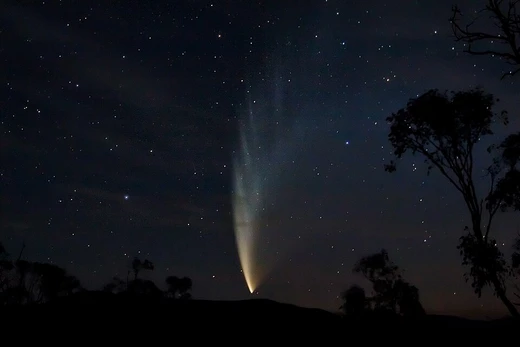
C/1939 H1 (Jurlof–Achmarof–Hassel)
Long-period comet discovered April 1939 with two associated meteor showers.
Last updated
C/1939 H1 (Jurlof–Achmarof–Hassel) is a long-period comet discovered in April 1939 by multiple independent observers, with the first reports reaching astronomical authorities from Olaf Hassel, Achmarof, and Jurlof. It is notable for its close approach to Earth, bright naked-eye visibility, and association with two meteor showers.
Background
C/1939 H1 (Jurlof–Achmarof–Hassel) is a long-period comet first spotted on April 15, 1939. Several observers found it independently, but the earliest report to reach astronomers came from Olaf Hassel, who saw it on the evening of April 16 from Hokksund, Norway. On April 20, Sergey Belyavsky announced that amateur astronomers Achmarof and Jurlof had also discovered it independently on the evening of April 15. At that point, the comet was near its closest approach to Earth, 0.68 AU away, and five days past perihelion, with a solar elongation of 31 degrees.
On April 18, its apparent magnitude was estimated between 3 and 4. Vinter Hansen described it as large and diffuse, with a tail. Visually, the tail stretched about 1 degree, but photographs showed it extending 16 degrees.
By April 20, the comet reached its northernmost declination of +44 degrees, and U. S. Lyons reported it was visible to the naked eye. On April 21, the mean apparent magnitude was 4, with the tail photographically spanning 8.5 degrees, though Waterfield noted the next day that the tail had nearly vanished. On May 1, the magnitude was 5 visually and 5.8 photographically.
The comet achieved its maximum solar elongation of 43 degrees on May 4, with a magnitude between 5.6 and 6.5. On May 7, its photographic magnitude was 6, the coma measured about 3 arcminutes across, and the tail extended 2.7 degrees. By May 20, it had faded to magnitude 7.5–7.8. H. Hirose at Tokyo Observatory made the last detection on May 27, when the comet was at low latitude.
Ranked in
More in Named Comets
Sources
Compiled from Wikipedia and the sources listed below. Text from Wikipedia is available under CC BY-SA 4.0; this entry is adapted from it.
- Wikipedia: C/1939 H1 (Jurlof–Achmarof–Hassel) (CC BY-SA 4.0).
- Word definitions: the Codexery glossary, each quoted from its Wikipedia article.
Spotted an error? Know more?
Reader corrections go straight into our review queue. Suggest an edit · How this site is sourced