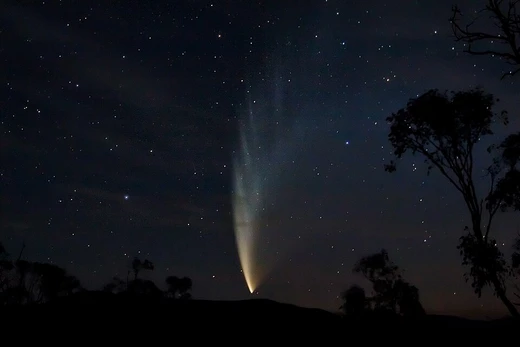
41P/Tuttle–Giacobini–Kresák
Jupiter-family comet known for dramatic outbursts and a small, elongated nucleus.
Last updated
41P/Tuttle–Giacobini–Kresák is a Jupiter-family comet with a 5.43-year orbit around the Sun. It is notable for its dramatic outbursts, including a double outburst in 1973 that brightened from magnitude 14 to naked-eye visibility at magnitude 4. The comet's nucleus is relatively small, with an effective radius of 440–560 m, and it has exhibited rapid changes in rotation rate due to outgassing torques.
Background
The comet was discovered by Horace Parnell Tuttle on May 3, 1858, and later independently rediscovered by Michel Giacobini in 1907 and Ľubor Kresák in 1951. It is a member of the Jupiter family of comets.
In May and July 1973, the comet underwent two separate outbursts, brightening from magnitude 14 to apparent magnitude 4, making it easily visible to the naked eye. During its 2017 apparition, the comet passed 0.142 AU from Earth on April 1, 2017, and was expected to reach magnitude 7. Observations revealed rapid changes in the nucleus rotation rate, attributed to strong outgassing torques near perihelion.
Ranked in
More in Named Comets
Sources
Compiled from Wikipedia and the sources listed below. Text from Wikipedia is available under CC BY-SA 4.0; this entry is adapted from it.
- Wikipedia: 41P/Tuttle–Giacobini–Kresák (CC BY-SA 4.0).
- Word definitions: the Codexery glossary, each quoted from its Wikipedia article.
Spotted an error? Know more?
Reader corrections go straight into our review queue. Suggest an edit · How this site is sourced