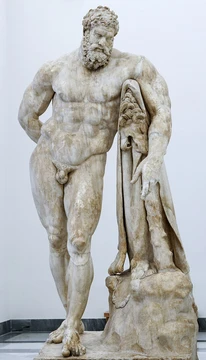
Labours of Hercules
Twelve tasks performed by Heracles in service to King Eurystheus.
The Labours of Hercules, also known as the Labours of Heracles, are a series of tasks performed by the greatest of Greek heroes in service to King Eurystheus. The fixed cycle of twelve labours, called the Dodekathlos, was attributed by the Greeks to a lost epic poem by Peisander. Heracles undertook these labours after being driven mad by Hera and killing his wife and children, then seeking atonement at the Oracle of Delphi.
Quick Facts
- Hero
- Heracles (Hercules)
- King served
- Eurystheus of Mycenae
- Number of labours
- 12
- Oracle consulted
- Delphi
- Duration of service
- Ten years (later twelve years in some accounts)
- Mother
- Alcmene
Facts from the source article.
Background
Heracles was the son of the mortal woman Alcmene, conceived after her rape by Zeus, who had disguised himself as her husband Amphitryon. Not recognizing him, Hera nursed the child out of pity; when he sucked so strongly that she pushed him away, her milk sprayed across the heavens, forming the Milky Way. The divine milk gave Heracles supernatural strength. He was originally named Alcides but later called Heracles, meaning 'Hera's pride' or 'glory', in an attempt to mollify Hera.
At eight months old, Hera sent two giant snakes into his chamber; his twin Iphicles cried, but Heracles strangled both snakes. The seer Tiresias prophesied that the boy would vanquish many monsters. Heracles later married Megara, daughter of King Creon of Thebes, but in a fit of madness induced by Hera, he killed her and their children. After recovering his sanity, he was purified by King Thespius and traveled to Delphi. Heracles, though loathing to serve an inferior man, submitted to his father Zeus's will.
The twelve labours
Of the twelve labours, six took place in the Peloponnese, culminating with the rededication of Olympia; the other six were set in locations that were strongholds of Hera or entrances to the Netherworld. In each case, Heracles was sent to kill, subdue, or fetch a magical animal or plant for Eurystheus. A famous sculptural depiction of the labours appears on the metopes of the Temple of Zeus at Olympia, dating to the 460s BC. According to Apollodorus, the oracle originally told Heracles to perform ten labours, but Eurystheus refused to recognize two: the slaying of the Lernaean Hydra (because Iolaus helped) and the cleansing of the Augean stables (because Heracles accepted payment).
Eurystheus then set two more tasks—fetching the golden apples of the Hesperides and capturing Cerberus—bringing the total to twelve. The order given by Apollodorus is: Nemean lion, Lernaean Hydra, Ceryneian Hind, Erymanthian Boar, Augean stables, Stymphalian birds, Cretan Bull, Mares of Diomedes, belt of Hippolyta, cattle of Geryon, apples of the Hesperides, and Cerberus. Diodorus Siculus gives a similar sequence but swaps the order of the third and fourth, fifth and sixth, and eleventh and twelfth labours.
Aftermath
After finishing his twelve labours, some accounts say Heracles joined Jason and the Argonauts to find the Golden Fleece, though Herodorus around 400 BC argued he never sailed with them. Another tradition, seen in the Argonautica, has Heracles with the Argonauts but not reaching Colchis. In Euripides's play Herakles, after the labours end and he returns home, Heracles goes mad and murders his wife and children, resulting in his exile from Thebes. Other stories tell of Heracles becoming an army general, sacking cities, and taking a princess. His wife, fearing he would take a lover, soaked his clothes in what she believed was a love potion made from centaur's blood, but it was poison. In agony, Heracles begged Iolaus to set him on a funeral pyre.
More in Mythology of Heracles
Spotted an error? Know more?
Reader corrections go straight into our review queue. Suggest an edit · How this site is sourced