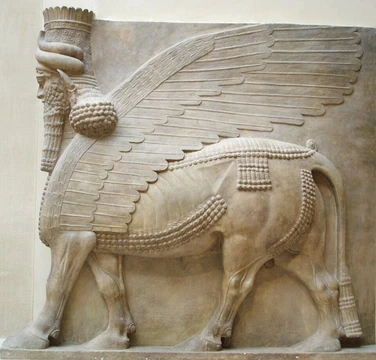
Longma
A dragon-scaled winged horse from Chinese myth.
The longma is a mythical creature from Chinese folklore, a winged horse covered in dragon scales. Its arrival was a sign that a wise and legendary ruler, like one of the Three Sovereigns and Five Emperors, would soon appear.
Quick Facts
- Chinese name
- longma (龍馬)
- Associated mythical objects
- Hetu (Yellow River Map) and Luoshu (Lo River Writing)
- Associated rulers
- Fu Xi
- Shun
- Yu
- Yao
- Japanese loanword
- ryūma or ryōma (龍馬/竜馬)
- Shogi piece
- promoted bishop (also pronounced ryūme)
Facts from the source article.
Name
The Chinese term longma is formed from the characters for dragon and horse. It can also denote a distinguished person, appearing in a four-character idiom. An early classical text classifies horses by height using the chi, a unit roughly 23 to 33 centimeters. Horses reaching eight chi are called one name, those seven chi another, and those six chi yet another. Han dynasty scholar Wang Chong observed that people depict dragons with a horse’s head and a snake’s tail. Edward H. Schafer noted the horse’s critical role for Tang rulers in military strategy, diplomacy, and aristocratic status. The Japanese loanword ryūma or ryōma refers to the legendary Chinese dragon horse and also names a shogi piece, translated as promoted bishop.
Classical references
Many Chinese classic texts refer to the longma. The most famous occurrences are connected with the mythical Hetu and Luoshu, ancient magic square arrangements of the Bagua and Wuxing. These are traditionally linked with prehistoric Chinese rulers: a longma revealed the Hetu to Fu Xi or Shun, and the shell of a tortoise revealed the Luoshu to Yu. The Great Treatise commentary to the Yijing explains that heaven creates divine things and the holy sage takes them as models, noting that the Yellow River brought forth a map and the Lo River brought forth a writing. The Baihutong and other texts also reference the creature. Kong Anguo's Shujing commentary describes the longma as the vital spirit of Heaven and Earth, with a horse's body and dragon scales, eight ch'ih five ts'un in height, wings at its sides, and the ability to walk upon water without sinking; it emerges from the Ming river carrying a map on its back when a holy man is on the throne. The Bamboo Annals describe the longma in a context of Yao conveying the throne to Shun, with spirits of the five planets appearing on the Yellow River and predicting the river scheme.
Comparative mythology
The longma connects with other creatures in Chinese folklore. While it sometimes applies to the Qilin, its closest relative is the legendary heavenly horse or Chinese Pegasus, metaphorically identified with the Ferghana horse. A poem attributed to Emperor Wu of Han celebrates a victory over Western tribes, describing heavenly horses coming from the Far West, crossing the Flowing Sands, and drawing the emperor to the Holy Mountain of K'un-lun. In Chinese astrology, the Dragon and Horse are two of the twelve animals. Some mythic elements of the longma are culturally widespread. Edward H. Schafer notes that legends of water-born horses were known in various parts of Turkestan; in Kucha, a lake of dragons was said to produce dragon-horses by coupling with mares, a story that likely originated in Iranian lands where winged horses were familiar. The Chinese longma is not culture-specific, as mythological hybrid animals combining dragons and horses are known worldwide. In Greek mythology, the Hippocamp has the head and front legs of a horse and the hindquarters of a dragon or fish. In Babylonian mythology, dragon-horse is a title of the goddess Tiamat. Among prehistoric hill figures in Oxfordshire, Dragon Hill is below the Uffington White Horse.
More in Mythological Hybrids
Spotted an error? Know more?
Reader corrections go straight into our review queue. Suggest an edit · How this site is sourced