Music video game
Where gameplay meets the beat: the definitive guide to music video games.

A music video game, often called a music game, is a type of video game where the core gameplay revolves around the player's interaction with a musical score or specific songs. These games come in many forms and are frequently categorized alongside puzzle games because they rely on "rhythmically generated puzzles." Unlike purely audio games, music video games provide visual feedback that guides the player through the soundtrack.
In these games, the gameplay typically involves some form of interaction with the music. This can mean the music is generated based on what the player does, or the player responds to the beats and notes of the music. As the genre has grown, it has become quite broad, supporting many different gameplay styles. For instance, a game like *Rayman Legends* includes endless runner levels where players score higher by syncing their actions to musical cues, which could classify it as a music video game.
A clearer way to understand the genre is by looking at its sub-genres, which are based on how the player interacts with the music. Michael Austin, director of the School of Music at Louisiana Tech University, describes four main types: matching, making, mixing, and metonymy. Some music games include multiple modes; for example, *Frequency* is mainly a scored rhythm-matching game but also offers a music-mixing feature for players to create their own mixes of the songs.
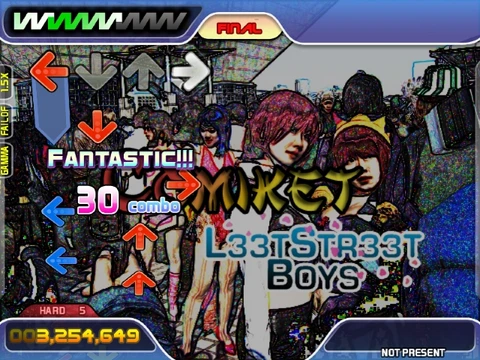
The most common sub-genre is rhythm-matching games, or simply rhythm games. These require the player to respond in time to the music as it plays, usually by pressing specific controls with precise timing to emphasize the song's rhythm. Players are scored on both hitting the right control and how accurately they time it. To improve, players often memorize the required actions to anticipate difficult sections. The variety of input methods has led to many different rhythm games, such as *Dance Dance Revolution* (using a dance mat), *Donkey Konga* (using a conga drum controller), and the *Guitar Hero* series (using a guitar-shaped controller). This also includes singing games like *Karaoke Revolution*, where players are scored on matching the pitch of the vocal track. The earliest example of a rhythm game is the electronic game *Simon*. Early games that defined the rhythm-matching aspect include *Dance Aerobics* and *PaRappa the Rapper*. More recent titles include *Guitar Hero*, *Rock Band*, *Rhythm Heaven Fever*, *Beat Saber*, and *Friday Night Funkin'*.
Another class is hybrid rhythm games, or music reactive games. Unlike standard rhythm games where matching is the main focus, reactive games use background music to guide the player's actions, making rhythm gameplay secondary to the main game. In these games, the player plays normally but can use the music to time actions for a better score, affecting the interaction between player and game dynamics. In *Rez*, a simple rail shooter, the player’s actions create sound effects that integrate with the soundtrack, aiming to create a synaesthetic experience. Other similar games include *Pteranodon*, *Rhyme Rider Kerorican*, and *iS – internal section*. Some of these games let users provide their own music, which the game processes dynamically to create challenges, so players aren't limited to the game's built-in songs. Examples include *Vib-Ribbon*, *Audiosurf*, *Dance Factory*, and *Dance Fabulous*.
Music-making games, or freeform music games, prioritize music creation over gameplay. They are often similar to non-game music synthesizers like the Tenori-on. Players can create their own music from various sounds, instruments, or voices, usually without any goals or objectives. These games sit between generative hybrid music games and non-game utilities, depending on how much their gameplay relies on a plot. They are closely related to sandbox games in non-musical gaming. Examples include *SimTunes* and the music composition tool in *Mario Paint*.
Music-mixing games involve players taking pre-made sounds, music, or audio tracks and interacting with them in the game to create something new.
- Earliest example
- Simon (1978) is often cited as an early precursor or earliest example of a rhythm game, though it is primarily a memory game with musical tones. Dance Aerobics (1987) is sometimes recognized as an ear
Lore & Background
Music video games are games where there is typically some type of interactivity of the gameplay with the game's music. This may be where the music is generated in response to the player's actions, or where the player reacts to the beats and notes of the music. As the genre has gained popularity and expanded, music video games have demonstrated the ability to support a range of various styles of gameplay, making the genre itself rather diffuse. A game such as Rayman Legends features levels that are based on endless runners but where the player scores better by matching their actions to the musical cues, which could make this a music video game. Instead, it is easier to consider the sub-genres of music video games based on how the player interacts with the music in the game, of which there are four main types as described by the concepts of 'matching, making, mixing, and metonymy' as described by Michael Austin, the director of the School of Music at Louisiana Tech University. These ideas correlate to the subgenres as described below. Music games may feature multiple modes; for example, Frequency is primarily a scored rhythm matching game but also includes a music mixing gameplay feature for players to make their own mixes of the available songs.
Reader's Guide
Rhythm-matching games or simply rhythm games require the player to respond in some fashion in time to music as it is played and shown via the game, all generally to emphasize the rhythm of the song being played. This may be by performing specific actions on a controller with precision timing as the note is played. Players are generally scored by not only hitting the right control but how precisely they hit it in time with the music. To improve in such games, players often begin to learn the required actions to memory as to be able to anticipate difficult sections or areas where high scoring is possible. The wide variety of possible player input has created a range of rhythm games, from Dance Dance Revolution where players input moves on a dance mat, Donkey Konga in which players beat on a conga drum-like controller, and the Guitar Hero series where players simulate the fingering and strumming on a guitar-shaped controller. This concept also extends to singing games like Karaoke Revolution, with players scored for how well they match the pitch of the vocal track. Rhythm games are the most dominant form of the music game genre. The electronic game Simon is considered the earliest example of a rhythm game, while early games that defined the rhythm-matching aspects include Dance Aerobics (1987) and PaRappa the Rapper (1996). More recent titles include the Guitar Hero (2005) and Rock Band (2007), Rhythm Heaven Fever (2011), Beat Saber (2019), and Friday Night Funkin'. Hybrid rhythm games or music reactive games let the background music guide the player action, leaving the rhythm gameplay elements secondary to the main gameplay form. In Rez, for example, the game takes the form of a simple rail shooter; however, by integrating sound effects created by the actions of the player with the soundtrack as a whole, the game is intended to permit the player's direct interaction with the soundtrack and to encourage the creation of a synaesthetic experience. Other similar games include Pteranodon, Rhyme Rider Kerorican, or iS – internal section. A further class of these games allow for users to provide music that is then processed dynamically by the game to create challenges for that song, such as Vib-Ribbon, Audiosurf, Dance Factory, or Dance Fabulous.
Did You Know?
- Michael Austin, director of the School of Music at Louisiana Tech University, described four main subgenres: matching, making, mixing, and metonymy.
- Rayman Legends features levels based on endless runners where the player scores better by matching actions to musical cues, which could make it a music video game.
Origins, Scheduling & Cultural Reach
The MTV Video Music Awards first took the stage in 1984 at Radio City Music Hall in New York City, launching what would become one of the most anticipated annual events in popular culture. The ceremony is typically staged in late August or mid-September, just before summer's end, and has been broadcast live on CBS. While New York City and Los Angeles serve as the most frequent host cities, the show has also found homes in Miami, Las Vegas, Newark, New Jersey, and Elmont on Long Island. Over the decades, the event earned the nickname "the Super Bowl for youth," a testament to its power to pull in millions of viewers ranging from teenagers to those in their twenties. By the early 2000s, the VMA had solidified its status as a genuinely coveted honor in the music world. A significant shift came in 2006, when MTV opened the voting process to the general public, allowing viewers to cast ballots for their favorite videos across all general categories—a move that deepened fan engagement with the ceremony.
The Moonman Trophy & Its Design Heritage
The trophy handed to VMA winners is a small statue depicting an astronaut standing on the lunar surface, a direct nod to one of MTV's earliest visual identities. The design traces back to the network's original debut identification animation, which drew on Apollo 11 mission footage. That animation was created by Fred Seibert and produced by Alan Goodman and Buzz Potamkin at Buzzco Associates. The physical statue itself was conceived by Manhattan Design, the same firm responsible for the original MTV logo. For years the award was colloquially known as a "moonman," though beginning with the 2017 ceremony, MTV officially adopted the more inclusive term "moon person." Production of the trophy has since shifted to Society Awards, a New York City-based firm that handles its manufacturing. The astronaut-on-the-Moon image has become one of the most recognizable symbols in music television, instantly signaling to fans that the annual ceremony is underway and that the night's biggest honors are about to be bestowed.
Iconic Performances & Defining Moments
The VMAs have produced some of the most talked-about live performances in television history. At the inaugural 1984 ceremony, Madonna stunned the audience with "Like a Virgin," rolling across the floor in a bustier-wedding gown and her "Boy Toy" belt. In 1987, Peter Gabriel claimed a record ten Moonmen in a single night, including Video of the Year for "Sledgehammer." The 1988 show marked Michael Jackson's first VMA appearance, delivered through a pre-recorded performance of "Bad," and he also received the Video Vanguard Award. The 1989 ceremony delivered a stripped-down acoustic set from Jon Bon Jovi and Richie Sambora that many credit with inspiring the format of MTV Unplugged, while Madonna's "Express Yourself" performance previewed her Blond Ambition tour. In 1990, Madonna returned in an 18th-century French theme for "Vogue." The 1991 ceremony featured Prince on a Caligula-esque set in a revealing yellow mesh outfit, alongside Van Halen's television debut and Metallica's "Enter Sandman."
Record-Breaking Artists & the Vanguard Award
Taylor Swift stands as the most decorated solo artist in VMA history, accumulating 30 trophies between 2009 and 2024. Her record includes a staggering five Video of the Year wins for "Bad Blood," "You Need To Calm Down," "All Too Well: The Short Film," "Anti-Hero," and "Fortnight." Before her, Peter Gabriel held the single-night record with ten Moonmen in 1987. The Video Vanguard Award, the ceremony's highest honor for lifetime contribution, was first presented in 1984 to David Bowie, the Beatles, and director Richard Lester for pioneering the music video form. In 1988, Michael Jackson received the award, and in 1991 it was permanently renamed the Michael Jackson Video Vanguard Award to recognize his role in transforming music videos from simple promotional clips into narrative-driven short films. This evolution—from a promotional tool featuring musicians playing instruments to a cinematic medium with storylines—reflects the broader cultural shift the VMAs have tracked since their inception.
Frequently Asked Questions
What is a music video game?
A music video game is a genre in which the central gameplay revolves around how a player interacts with a musical score or specific songs. These titles come in many forms and are often grouped alongside puzzle games because they rely on rhythmically generated challenges.
What is the earliest known music video game?
Dance Aerobics, released in 1987, is widely cited as the first example of a music video game. It established the genre's foundation by centering gameplay on direct musical interaction.
How do music video games differ from purely audio-based games?
Music video games provide visual feedback that guides the player through the soundtrack, whereas purely audio games rely only on sound. This visual layer helps players track timing and patterns alongside the music.
Why are music video games sometimes categorized with puzzle games?
They are frequently grouped with puzzle games because their core mechanics depend on rhythmically generated puzzles rather than traditional puzzle logic. The player solves timing-based challenges in sync with the music being played.
What is the core gameplay loop of a music video game?
The core loop involves some form of direct interaction with the game's music, whether responding to a soundtrack or generating music in real time. The player's input is fundamentally tied to the musical score driving the experience.
More in Music video games 1-24
Spotted an error? Know more?
Reader corrections go straight into our review queue. Suggest an edit · How this site is sourced