Be-Music Source
The definitive rhythm game file format for Beatmania-style play.

Be-Music Source (BMS) is a rhythm game file format created by Urao Yane in 1998. It was first made for BM98, a fan-made simulator of Konami's *Beatmania*, but the term BMS has since come to refer broadly to any *Beatmania*-style music data system. Yane himself confirmed the acronym's meaning in the official format specification.
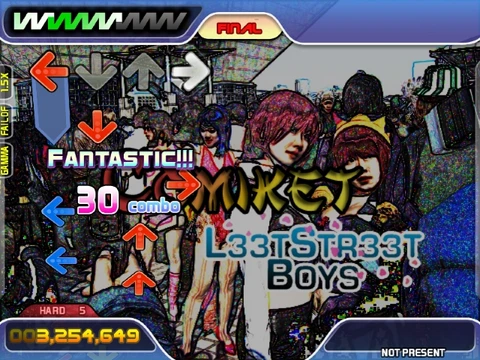
**Gameplay** Players hit notes that scroll down the screen, much like in *Beatmania* and *Beatmania IIDX*. Correctly timed hits fill a gauge, while misses drain it. Besides normal notes, there are long notes that must be held and mine notes that explode and drain the gauge if struck. The player clears a song if the gauge reaches a certain level by the end.
**BMS events** Most BMS files today are shared through events where artists release songs and compete for high scores. The biggest such event, BMS of Fighters (BOF), has been run by AOiRO_MANBOW since 2004 and features over 250 songs each year.
**BMS songs** Because the format requires music to be split into separate tracks, most BMS songs are original compositions made specifically for it. Using pre-existing songs is difficult unless isolated stems are available.
**Basic format** A BMS file is a plain text file that tells the game how notes are arranged and how to respond to player actions. It uses directive lines starting with `#`, written as `#[definition_setter] [definer]` (the space is required). The file has a header field and a main data field. For example: ``` #PLAYER 1 #GENRE Sample #TITLE Sample #ARTIST Sample #BPM 120 #PLAYLEVEL 5 #TOTAL 100 #RANK 2 #bmp00 miss.bmp #bmp01 1.bmp #wav01 1.wav #00111:01010101 #00211:0101010001010100 ``` Common header commands come from the original BM98, with later additions that became popular. Main data lines follow the pattern `#XXXYY:ZZZZZZ`, where XXX is the measure number, YY is the channel, and ZZ is a base-36 two-digit code for the measure's contents. The colon between the definer and components is required.
**Expansion of BMS format** As *Beatmania* evolved into *Beatmania IIDX*, new BMS variants appeared. The Be-Music Extend format (.bme) added 7 lanes and a turntable. The Be-Music Long note format (.bml) added hold notes. A .pms extension was made for simulating *Pop'n Music* with 9 lanes. There is also .mdm, used in the fan-made Muse Dash Melon Loader, which uses 4 lanes for each of the game's two tracks plus extra lines for effects and boss movement.
Fan-made simulators also expanded the format. Yane's original BM98 could handle only 256 sound and image files, with 5 lanes and one scratch per side. Delight Delight Reduplication supports .bme for 7-lane play. nazoBMplay increased the sound and picture limit by switching from base-16 to base-36 numbering, and a patch added .ogg support. The most widely used BMS player was Lunatic Rave 2 by lavalse, which had its own online ranking site until it shut down on 31 May 2026. Later simulators offered better performance and features, but none replaced Lunatic Rave 2 as the standard, mainly due to its backward compatibility and the lack of an online ranking system in alternatives.
**bmson** bmson is a JSON-based format created by wosderge as an easier-to-implement alternative to BMS. It has no limit on the number of key sounds per chart, unlike BMS's hard cap of 1,296. Version 0.26 was adopted by players like Bemuse and raindrop. After that, developers from those games and others collaborated on the bmson 1.0 technical specification.
Quick Facts
- Extension
- .bms
- Owner
- Urao Yane, NBK
- Genre
- Music
- Container For
- Pattern data
- Extended From
- Text files
- Extended To
- BME, BML, PMS
Facts from the source article.
Lore & Background
Similar to the Beatmania and Beatmania IIDX series, the purpose of the game is to hit notes as they descend from the top of the screen. When the player hits notes with the proper timing, a gauge will fill up. When the player misses a note, the gauge will drain. In addition to normal notes, there are also long notes that must be held, and mine notes that will explode and drain the gauge if hit. To clear the game, the player's gauge must be filled to a specified level at the end of the song.
Reader's Guide
The BMS file describes how notes are arranged and how the game responds when the player takes a specific action. It is a plain text file with "directive" lines starting with the # character. Each directive line is formatted as #[definition_setter] [definer]. A BMS file is generally composed of a header field and the main data field. Main field data is written in the form of #XXXYY:ZZZZZZ. XXX defines the number of the measure, YY defines the channel, and ZZ defines the components of the measure using a base 36 2-digit number. The colon separating the definer and components is required. Expansions include the Be-Music Extend format (.bme) allowing 7 lines and 1 turntable, the Be-Music Long note format (.bml) for long notes, .pms for simulating Pop'n Music with 9 lines, and .mdm used in Muse Dash Melon Loader with 4 lines for both lanes plus lines for special effects and boss movement. Yane's original BM98 simulator supported only 256 sound and image files, and only 5 lanes plus one scratch per playside. Delight Delight Reduplication supports .bme for 7-line play. nazoBMplay increased sound/picture limits by using base 36 instead of base 16, and a patch allowed .ogg files. The most widely used BMS player was Lunatic Rave 2 by lavalse, which had its own online ranking website before it shut down on 31 May 2026. bmson is a JSON-based format initially developed by wosderge, with no limit on key sounds, unlike BMS's hard limit of 1296 key sounds.
Did You Know?
- The largest BMS event is the BMS of Fighters (BOF) held by AOiRO_MANBOW, where more than 250 songs are presented each year. It has been held since 2004.
- Most BMS songs are original compositions because the format requires music to be separated into various tracks, making it hard to use pre-existing songs unless isolated stems are available.
- The original BMS format supported 5 lanes plus one scratch per playside in BM98; later expansions allowed 7 lines and 1 turntable, 9 lines, and 4 lines for both lanes.
Origins & the Architecture of the Format
BMS was born in 1998 when Urao Yane created a file format to power BM98, a fan-made simulator of Konami's Beatmania. Yane later confirmed in the official specification that the acronym stands for "Be-Music Source," a name that has since become the umbrella term for the entire Beatmania-style charting ecosystem. At its core, a BMS file is nothing more than a plain text document structured around directive lines that begin with a hash symbol. Each line pairs a definition setter with a definer, separated by a mandatory space, and the file is divided into two logical regions: a header that stores metadata like title, artist, BPM, and play level, and a main data field that encodes the actual note patterns. The main field uses a compact notation where a measure number, a channel identifier, and a base-36 two-digit value are joined by a required colon. This deliberately simple, human-readable design made it easy for hobbyists to author charts with a basic text editor, a feature that proved essential to the format's long-term survival and community growth.
Gameplay Mechanics & the Demand for Original Music
The BMS gameplay loop mirrors the Beatmania and Beatmania IIDX series: notes fall from the top of the screen, and the player must strike them with precise timing. Successful hits build up a gauge, while missed notes drain it. Beyond standard taps, the format introduces two additional note types that add strategic depth. Long notes require the player to hold a key until the note's tail passes, and mine notes are traps that, if struck, explode and subtract from the gauge. A song is cleared only if the gauge reaches a predetermined threshold by the final measure. Because the BMS format mandates that audio be split into individual tracks for each lane, most BMS songs are composed from scratch specifically for the format. Adapting a pre-existing commercial track is difficult unless the producer already has isolated stems for every channel, which means the BMS catalog is overwhelmingly populated by original compositions created by the community's own artists and producers.
Format Expansions & the Simulator Ecosystem
As Beatmania evolved into Beatmania IIDX, the original BMS spec grew stale, prompting a wave of community-driven extensions. The .bme format added a seventh line and a turntable to mirror IIDX's layout, while .bml introduced the long-note mechanic. A .pms variant targeted Pop'n Music with nine lines, and .mdm was crafted for the fan-made Muse Dash Melon Loader, using four lanes per side plus extra channels for special effects and boss movement. On the player side, Yane's original BM98 was limited to 256 media files and five lanes plus one scratch per side. Delight Delight Reduplication brought .bme support, and nazoBMplay expanded the encoding to base 36 and later accepted .ogg audio. Lunatic Rave 2, built by lavalse, became the most widely used BMS player and ran an online ranking service until its shutdown on 31 May 2026. No successor has filled its niche, largely because of its backward compatibility and the absence of a comparable ranking system. More recently, wosderge proposed bmson, a JSON-based chart format with no hard cap on key sounds (BMS tops out at 1,296), which was adopted by players like Bemuse and raindrop before a collaborative version 1.0 specification was finalized.
BMS Events & the Competitive Community
Since 2004, the BMS scene has been anchored by recurring events in which multiple artists submit original songs and players compete for the highest scores across a shared set of charts. These gatherings have turned what began as a solitary hobby into a collaborative, competitive culture. The flagship event is BMS of Fighters, organized by AOiRO_MANBOW, which has grown to feature more than 250 songs in a single edition, making it the largest BMS event in the community. The event model encourages both musical and technical creativity: composers must write tracks that fit the format's multi-track requirement, while chart designers craft note patterns that test timing, endurance, and the ability to navigate mine notes and long holds. The competitive scoring system, where a gauge must be filled to a set level to clear a song, gives every performance a measurable benchmark. Together, the events, the open file format, and the ever-expanding roster of simulators have sustained a vibrant ecosystem that continues to attract new musicians, chart authors, and players well into the 2020s.
Frequently Asked Questions
What is Be-Music Source?
BMS is a community-driven file format for storing rhythm-game chart data, originally designed by Urao Yane in 1998 to power BM98, a fan-made Beatmania simulator. Over the years the name broadened to cover the entire family of Beatmania-style charting systems built on that underlying structure.
What does the acronym BMS actually stand for?
Urao Yane confirmed in the official format specification that BMS is short for "Be-Music Source." Despite the somewhat vague name, the format became the de facto standard for sharing custom songs across the Beatmania-style rhythm-game community.
How does a BMS chart work during actual gameplay?
Notes scroll down from the top of the screen and the player must hit each one in time to fill a gauge, while misses drain it. The format also supports long notes that require a sustained key-hold and mine notes that punish the player if accidentally struck.
What file extensions do BMS chart files use?
Depending on the variant or feature set, chart files typically carry the extensions .bms, .bme, .bml, .pms, or .mdm. The different suffixes generally indicate small structural or capability differences between chart versions.
What is BMS of Fighters (BOF)?
BOF is the largest annual competitive tournament dedicated to BMS-based rhythm games and has been held continuously since 2004. It draws players from around the world to compete across a wide range of chart difficulties.
More in Music video games 1-24
Spotted an error? Know more?
Reader corrections go straight into our review queue. Suggest an edit · How this site is sourced