Orthopedic surgery
Branch of surgery treating musculoskeletal conditions.

Whitman, Royal, 1857- · No restrictions
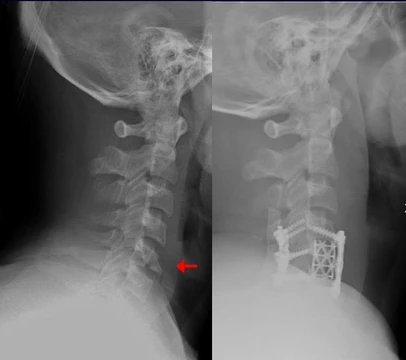
The musculoskeletal system is the focus of the surgical specialty known as orthopedic surgery.[1] Practitioners in this field address a wide range of conditions—including trauma to muscles and bones, spinal disorders, athletic injuries, degenerative illnesses, infections, growths, and birth defects—through both operative and non-operative methods.[1]
Quick Facts
- Field
- Surgery
- Known for
- Treatment of musculoskeletal conditions
- including fractures
- deformities
- and joint replacements
- Etymology
- Coined by Nicolas Andry in 1741 from Greek orthos ('correct') and paidion ('child')
Facts from the source article.
Key facts and history
Andry published the first textbook on the subject, titled Orthopædia: Or the Art of Correcting and Preventing Deformities in Children, in 1741.[2] The modern total hip replacement was pioneered by Sir John Charnley in England in the 1960s.[3] In 1741, a University of Paris medical professor named Nicolas Andry created the word "orthopédie" by combining Greek roots for "correct" and "child."[2][4] He promoted the treatment of childhood deformities through physical activity, manual adjustments, and the application of splints.[5]
Wartime experiences have significantly advanced the field of orthopedic surgery.[6] During medieval battles, caregivers applied bandages that had been soaked in equine blood to wounds; once dry, these bandages created a rigid, though unhygienic, support.[6] The double-inclined plane, a device for managing fractures of the lower limbs, was created in 1790 by the English orthopedist Robert Chessher.[7] A plaster of Paris cast was introduced in 1851 by the Dutch military surgeon Antonius Mathijsen.[7]
Two distinct bearing systems—one fixed and one mobile—were employed in the knee replacements designed for osteoarthritis during the 1970s.[8] The initial orthopedic residency training program in the United States was established in 1887 at the Hospital for Special Surgery.[9]
What the cited sources add
A 2014 HCUP Statistical Brief reported that in 2012, the most common inpatient OR procedures involved the musculoskeletal system.[10] The brief noted that knee arthroplasty, laminectomy, hip replacement, and spinal fusion were among the most frequent procedures.[10] Hospital stays involving knee arthroplasty increased from 421,700 in 2003 to 700,100 in 2012.[10] The American Osteopathic Board of Orthopedic Surgery 2012 Candidate Handbook outlines eligibility criteria and required exams for board certification.[11]
Except for infants and individuals 85 years or older, spinal fusion ranked among the five most frequent operating-room procedures for all other age groups.[10]
References
- Wikipedia, "Orthopedic surgery" (CC BY-SA 4.0), which cites: "Orthopedic Surgeons: Seven Things You Need to Know", Penn Musculoskeletal and Rheumatology Blog, 4 December 2019 (original not read by us) en.wikipedia.org
- Wikipedia, "Orthopedic surgery" (CC BY-SA 4.0), which cites: "Orthopædia, or, The art of correcting and preventing deformities in children", Classics of Medicine Library, 2 November 1980 (original not read by us) en.wikipedia.org
- Wikipedia, "Orthopedic surgery" (CC BY-SA 4.0), which cites: "Professor Sir John Charnley (1911–1982)", Rheumatology, July 2002, p. 824–825 (original not read by us) en.wikipedia.org
- Wikipedia, "Orthopedic surgery" (CC BY-SA 4.0), which cites: "Orthopedic surgery", Harbin Howell Medical Apparatus and Instruments Co., LTD (original not read by us) en.wikipedia.org
- Wikipedia, "Orthopedic surgery" (CC BY-SA 4.0), which cites: "Sugar-Tong Forearm Splinting Technique: Application of Sugar-Tong Splint, Postprocedural Care, Complications", Medscape, 28 July 2021 (original not read by us) en.wikipedia.org
- Wikipedia, "Orthopedic surgery" (CC BY-SA 4.0), which cites: "Extremity Injury and War: A Historical Reflection", Clinical Orthopaedics and Related Research, September 2015, p. 2771–2776 (original not read by us) en.wikipedia.org
- Wikipedia, "Orthopedic surgery" (CC BY-SA 4.0), which cites: Valentin, "Robert Chessher (1750–1831): An English Pioneer in Orthopaedics", Medical History, October 1958, p. 308–313 (original not read by us) en.wikipedia.org
- Wikipedia, "Orthopedic surgery" (CC BY-SA 4.0), which cites: "The history of mobile-bearing total knee replacement systems", Orthopedics, September 2006, p. S7-12; Schwechter, "Design rationale for customized TKA: a new idea or revisiting the past?", Current Reviews in Musculoskeletal Medicine, 2012, p. 303–308 (original not read by us) en.wikipedia.org
- Wikipedia, "Orthopedic surgery" (CC BY-SA 4.0), which cites: Shookster, "The role of Theodore Roosevelt's family in the founding of the New York Orthopedic Hospital", Theodore Roosevelt Assoc J, 2007, p. 8 (original not read by us) en.wikipedia.org
- "Most Frequent Operating Room Procedures Performed in U.S. Hospitals, 2003–2012", HCUP Statistical Brief No. 186, December 2014. facts only, no text reused. hcup-us.ahrq.gov
- "AOBOS 2012 Candidate Handbook", American Osteopathic Board of Orthopedic Surgery, 2012. facts only, no text reused. aobos.org
Each numbered sentence above was checked against the source it cites before publication. Sentences citing Wikipedia adapt text from the English Wikipedia article Orthopedic surgery (contributors), used under CC BY-SA 4.0; this entry is available under the same licence. Other sources were used for facts only; no text or images are copied from them.
More in Musculoskeletal System And Orthopedics
Spotted an error? Know more?
Reader corrections go straight into our review queue. Suggest an edit · How this site is sourced