
Fitz Roy
A Patagonian peak first climbed in 1952, symbol of Santa Cruz Province.
Last updated

Lionel Terray · via Wikipedia: Fitz Roy · CC0
Where it is
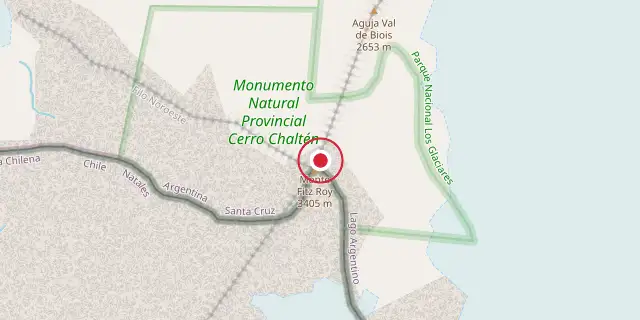
Coordinates: 49°16′16″S 73°02′35″W (-49.2710, -73.0430) · Open in OpenStreetMap
Coordinates and connected clubs: the infobox of Wikipedia: Fitz Roy (CC BY-SA 4.0). Map: drawn by Codexery from OpenStreetMap tiles.
Monte Fitz Roy—also called Cerro Chaltén, Cerro Fitz Roy, or simply Mount Fitz Roy—sits on the Argentina–Chile border in Patagonia, within the Southern Patagonian Ice Field near the village of El Chaltén and Viedma Lake. Its first recorded ascent was in 1952, accomplished by French climbers Lionel Terray and Guido Magnone. The mountain serves as the emblem of Argentina’s Santa Cruz Province, appearing on both its flag and coat of arms.
First European encounter
The first Europeans to see it were Spanish explorer Antonio de Viedma and his party, who reached the shores of Viedma Lake in 1783. Argentine explorer Francisco Moreno spotted the peak on March 2, 1877, and named it Fitz Roy after Robert FitzRoy, the captain of HMS Beagle, who had charted large stretches of the Patagonian coast and traveled up the Santa Cruz River in 1834. The Spanish word cerro means ridge or hill, while Chaltén comes from a Tehuelche (Aonikenk) term meaning “smoking mountain,” referencing the cloud that often forms around the summit. Fitz Roy is one of several peaks the Tehuelche called Chaltén.
Geography
Argentina and Chile have agreed that their international border bends eastward to cross the main summit, but much of the border south of the peak, down to Cerro Murallón, remains undefined. On February 27, 2014, Chile’s National Forestry Corporation established the Chaltén Mountain Range Natural Site, covering the Chilean side of Fitz Roy and the surrounding range.
Notable ascents include the first in 1952 via the Southeast Ridge (Franco-Argentine Ridge) by Lionel Terray and Guido Magnone; the second in 1965 by Argentines Carlos Comesaña and José Luis Fonrouge via Supercanaleta; and the third in 1968 via the Southwest Ridge (the Californian Route) by the “Fun Hogs”—Yvon Chouinard, Dick Dorworth, Chris Jones, Lito Tejada-Flores, and Douglas Tompkins. Other ascents followed in 1972 (Southeast Ridge, fourth ascent), 1980 (Col Americano route), 1983 (first west face ascent, “Slovak Way”), 1984 (Polish Route, still unrepeated, and Franco Argentina Route), the first winter ascent in 1986 by three Argentines via Supercanaleta, and the first winter solo ascent in 1990 by Yasushi Yamanoi. Dean Potter made the first free solo in 2002 via Supercanaleta. In 2009, Colin Haley and Matthew McCarron each soloed different routes.
Between February 12 and 16, 2014, Tommy Caldwell and Alex Honnold completed the first full Fitz Roy Traverse, a 5-kilometer ridge line with about 4,000 meters of cumulative gain and technical climbing up to 5.11d, earning them a Piolet d’Or. Jim Reynolds free soloed in 2019. In 2021, Sean Villanueva O’Driscoll made the second ascent and first solo ascent of the traverse in reverse (the Moonwalk Traverse), earning a Piolet d’Or in 2022. Colin Haley completed the first solo winter ascent of the Supercanaleta Route in 2022.
History
After the 1881 Treaty between Argentina and Chile, boundary surveyors Francisco Pascasio Moreno and Diego Barros Arana defined the border in 1898, with Huemul declared a landmark. No differences arose in the area between Fitz Roy and Cerro Stokes, unlike other territories later arbitrated in 1902.
The boundary followed mountain landmarks including Fitz Roy, Torre, Huemul, Campana, Agassiz, Heim, Mayo, and Stokes (now Cervantes). Chile has defended Fitz Roy as a border landmark. A 1998 agreement between the two countries defined section A and part of section B of the boundary from Fitz Roy to Cerro Daudet, but the area between Fitz Roy and Murallón remains unresolved.
Tourism
Fitz Roy is a popular hiking destination. A viewpoint between Laguna de Los Tres and Laguna Sucia is reachable on foot from El Chaltén. The round-trip trek is about 20 kilometers, doable in a single day, and passes the Poincenot campground, run by a local association for those wanting a longer stay.
Lore & Background
The first Europeans recorded as seeing Mount Fitz Roy were the Spanish explorer Antonio de Viedma and his companions, who reached the shores of Viedma Lake in 1783. Argentine explorer Francisco Moreno saw the mountain on 2 March 1877; he named it Fitz Roy in honour of Robert FitzRoy who, as captain of HMS Beagle, had travelled up the Santa Cruz River in 1834 and charted large parts of the Patagonian coast. Cerro is a Spanish word meaning ridge or hill, while Chaltén comes from a Tehuelche (Aonikenk) word meaning 'smoking mountain', because a cloud usually forms around the mountain's peak. Fitz Roy is one of several peaks the Tehuelche called Chaltén.
After the signing of the 1881 Treaty between Argentina and Chile, the boundary in the area was defined in 1898 by the boundary surveyors, Francisco Pascasio Moreno from Argentina and Diego Barros Arana from Chile. Huemul was declared a border landmark. The boundary was defined by the following mountain landmarks and their natural continuity: Mount Fitz Roy, Torre, Huemul, Campana, Agassiz, Heim, Mayo, and Stokes (nowadays Cervantes). In 1998, the 'Agreement between the Republic of Chile and the Republic of Argentina to determine the boundary line from Mount Fitz Roy to Cerro Daudet' was signed, defining section A and a small part of section B, with the area between Fitz Roy and the Murallón still pending.
Reader's Guide
Argentina and Chile have agreed that their international border detours eastwards to pass over the main summit, but a large part of the border to the south of the summit, as far as Cerro Murallón, remains undefined. On February 27, 2014, Chile's National Forestry Corporation created the Chaltén Mountain Range Natural Site by Resolution No. 74, which covers the Chilean side of Mount Fitz Roy and the surrounding mountain range.
Fitz Roy is a popular tourist destination for hikers, as a viewpoint between the Laguna de Los Tres and the Laguna Sucia can be reached by foot from the town of El Chaltén. The total trek is around 20 kilometers for the round trip, making it possible to do the out-and-back hike within a single day, while also passing by the Poincenot campground that is run by a local association, for people who want to take more time. Notable ascents include the first ascent on 2 February 1952 by Lionel Terray and Guido Magnone via Southeast Ridge; the second ascent in 1965 by Carlos Comesaña and José Luis Fonrouge via Supercanaleta; the third ascent in 1968 via Southwest Ridge by the 'Fun Hogs' including Yvon Chouinard, Dick Dorworth, Chris Jones, Lito Tejada-Flores, and Douglas Tompkins; the first winter ascent in July 1986 by Argentines Eduardo Brenner, Sebastián De La Cruz and Gabriel Ruiz via Supercanaleta; and the first full traverse in February 2014 by Tommy Caldwell and Alex Honnold, who were awarded the Piolet d'Or.
Frequently Asked Questions
Who first summited Fitz Roy and when?
French alpinists Lionel Terray and Guido Magnone put their boots on the summit on 2 February 1952. Their success ended a long string of failed attempts and put the mountain firmly on the alpine climbing map.
Why is Fitz Roy such a big deal in mountaineering?
Since the 1952 first ascent the peak has become one of Patagonia's most iconic and demanding objectives for serious climbers. It also draws a steady stream of tourism, anchoring the El Chaltén area as a major destination in the region.
Ranked in
More in Mountains And Mountain Ranges
Sources
Compiled from Wikipedia and the sources listed below. Text from Wikipedia is available under CC BY-SA 4.0; this entry is adapted from it.
- Wikipedia: Fitz Roy (CC BY-SA 4.0).
Spotted an error? Know more?
Reader corrections go straight into our review queue. Suggest an edit · How this site is sourced