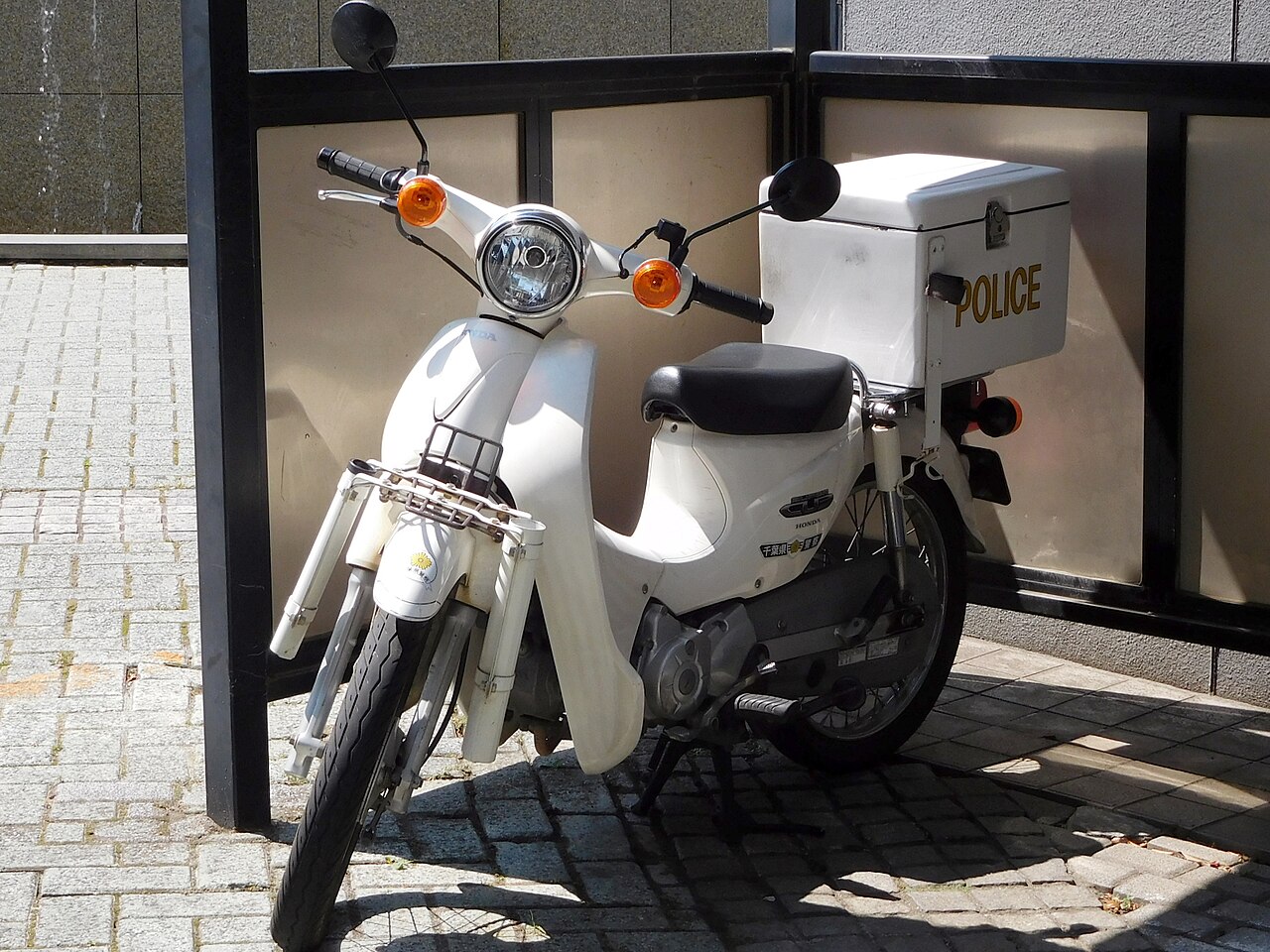
Honda Super Cub
You meet the nicest people on a Honda.
Last updated

via Wikipedia: Honda Super Cub · see source
The Honda Super Cub is a lightweight motorcycle that has been in continuous manufacture since 1958, with production surpassing 100 million units by 2017.[1] It is the most produced motor vehicle in history.[1]
How it changed
Its 17 inch wheels were more stable than the typical 10 inch scooter wheels, particularly on rough roads.[2] By 2002 in Vietnam, "Honda" had become a genericized trademark for any motorcycle taxi.[3] In 2014, the Super Cub became the first vehicle in Japan to be granted a three-dimensional trademark.[4] During a 1956 tour of Germany, Soichiro Honda and Takeo Fujisawa observed the widespread use of mopeds and light motorcycles, which led to the conception of a new 50 cc machine.[5]
For inexperienced riders, the centrifugal clutch and semi-automatic transmission made the motorcycle less intimidating, an effect described as taking "the terror out of motorcycling."[6] Honda constructed a new factory in Suzuka, Mie, which upon its 1960 completion was the world's largest motorcycle plant; it was designed to produce 30,000 Super Cubs per month, and with two shifts, up to 50,000.[7] The "You meet the nicest people on a Honda" advertising campaign, which began in 1963, significantly altered Honda's public perception and changed how Americans viewed motorcycling.[8][9]
What the maker and period sources say
Honda's official history states the Super Cub was created from the perspective of the customer, directly resulting from Honda's philosophy of "customer satisfaction first"[10] The concept was a motorcycle that "the buckwheat-noodle shop delivery boy can balance his tray on one hand and operate the bike with the other" and that it could be ridden by "customers wearing skirts"[10] The advertising campaign "You Meet the Nicest People on a Honda" was mounted by Grey Advertising in 1962 and depicted housewives, a parent and child, and young couples riding Honda 50s.[11] By 1964, the ads had made a major impact on American society and were credited with winning recognition for the motorcycle as a socially acceptable product.[11]
Annual sales of Honda motorcycles jumped from 40,000 units a year to 200,000 units per year following the campaign.[11]
References
- Wikipedia, "Honda Super Cub" (CC BY-SA 4.0), which cites: "Honda Celebrates 100 Million-Unit Global Production Milestone for Super Cub Series Motorcycles", Honda, October 19, 2017; Edstrom, "To Save the Polar Bears, Ride a Cub", New York Times, November 30, 2007, p. 24 (original not read by us) en.wikipedia.org
- Wikipedia, "Honda Super Cub" (CC BY-SA 4.0), which cites: Brown, "Honda: the complete story", Crowood, 1991, p. 17–18 (we also read that source) en.wikipedia.org
- Wikipedia, "Honda Super Cub" (CC BY-SA 4.0), which cites: Colet, "Vietnam handbook", Footprint Travel Guides, 2002, p. 309; Bacon, "Honda: The Early Classic Motorcycles: All the Singles, Twins and Fours, Including Production Racers and Gold Wing—1947 to 1977", Niton Publishing, 1996, p. 164–191; Ayton, "The Great Japanese Motorcycles", Galahad Books, 1993, p. 16; Vara-Orta, "L.A. base fuels Honda's drive into U.S.; Japanese car maker marks 50 years in SoCal", Los Angeles Business Journal, June 8, 2009, p. 1 (we also read that source) en.wikipedia.org
- Wikipedia, "Honda Super Cub" (CC BY-SA 4.0), which cites: Joseph, "Honda Super Cub first vehicle to receive 3D trademark in Japan", June 3, 2014 (original not read by us) en.wikipedia.org
- Wikipedia, "Honda Super Cub" (CC BY-SA 4.0), which cites: Sakiya, "Honda Motor: the men, the management, the machines", Kodansha, 1982; Brown, "Honda: the complete story", Crowood, 1991, p. 17–18 (we also read that source) en.wikipedia.org
- Wikipedia, "Honda Super Cub" (CC BY-SA 4.0), which cites: Falloon, "The Honda Story", Haynes, 2005; Bacon, "Honda: The Early Classic Motorcycles: All the Singles, Twins and Fours, Including Production Racers and Gold Wing—1947 to 1977", Niton Publishing, 1996, p. 164–191 (we also read that source) en.wikipedia.org
- Wikipedia, "Honda Super Cub" (CC BY-SA 4.0), which cites: Sakiya, "Honda Motor: the men, the management, the machines", Kodansha, 1982; Alexander, "Japan's Motorcycle Wars: An Industry History", UBC Press, 2008, p. 197–211; Alexander, "Japan's Motorcycle Wars: An Industry History", UBC Press, 2008, p. 197–211; Sakiya, "Honda Motor: the men, the management, the machines", Kodansha, 1982; Alexander, "Japan's Motorcycle Wars: An Industry History", UBC Press, 2008, p. 197–211; Sakiya, "Honda Motor: the men, the management, the machines", Kodansha, 1982; Alexander, "Japan's Motorcycle Wars: An Indu en.wikipedia.org
- Wikipedia, "Honda Super Cub" (CC BY-SA 4.0), which cites: Frank, "Honda Motorcycles", MotorBooks International, June 11, 2007, p. 42 (original not read by us) en.wikipedia.org
- Wikipedia, "Honda Super Cub" (CC BY-SA 4.0), which cites: "You meet the nicest people on a Honda (advertisement)", 1963-06-14, p. 22–23; ""You Meet the Nicest People..."", Cruise The Ozarks; "A look at Honda in the US over the last 50 years", Seattle Times, June 10, 2009; "1966 Honda: Meet The Nicest People, French Horn; Print Ad;", Amazon.com; "Establishing American Honda Motor Co. / 1962", History; "Fifty Years of Honda in America", July 2009; Montville, "Evel Knievel", Random House, 2011, p. 70; Garson, "The Harley-Davidson Reader", MotorBooks/MBI Publishing Company, 2006, p. 129–134; "The en.wikipedia.org
- "Chapter III: Unique Technologies and Products Section 1: Motorcycles Part 1-1: The Invention of the Super Cub|75 Years of Honda History|Honda's History|Honda Global Corporate Website", global.honda. facts only, no text reused. global.honda
- Rau, "Motorcycle Advertising Part One; Wildly successful ad campaign of the Sixties", June 11, 2007. facts only, no text reused. motorcycle.com
Each numbered sentence above was checked against the source it cites before publication. Sentences citing Wikipedia adapt text from the English Wikipedia article Honda Super Cub (contributors), used under CC BY-SA 4.0; this entry is available under the same licence. Other sources were used for facts only; no text or images are copied from them.
More in Iconic Motorcycles
Sources
Compiled from Wikipedia and the sources listed below. Text from Wikipedia is available under CC BY-SA 4.0; this entry is adapted from it.
- Wikipedia: Honda Super Cub (CC BY-SA 4.0).
Spotted an error? Know more?
Reader corrections go straight into our review queue. Suggest an edit · How this site is sourced