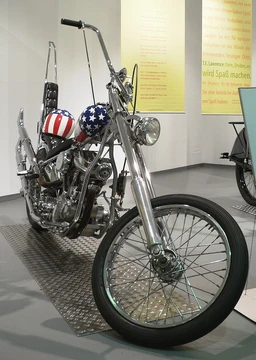
Honda CB750
The original Universal Japanese Motorcycle that popularized the transverse inline-four.
Last updated

Rachel.dicerbo · CC BY-SA 4.0
The bike's value was enhanced by its electric starter, kill switch, dual mirrors, flashing turn signals, and overall smoothness.[1] Honda limited its initial investment in production dies by using permanent mould casting, often erroneously called sandcasting, rather than diecasting.[2] Development of the CB750 took one year, resulting in a transverse straight-four engine with a single overhead camshaft and a front disc brake; these features had not previously been offered on an affordable mainstream production motorcycle.[3] Honda produced an initial batch of 7,414 motorcycles using permanent mould casting before switching to die casting, and those early examples became highly sought after by collectors.[2]
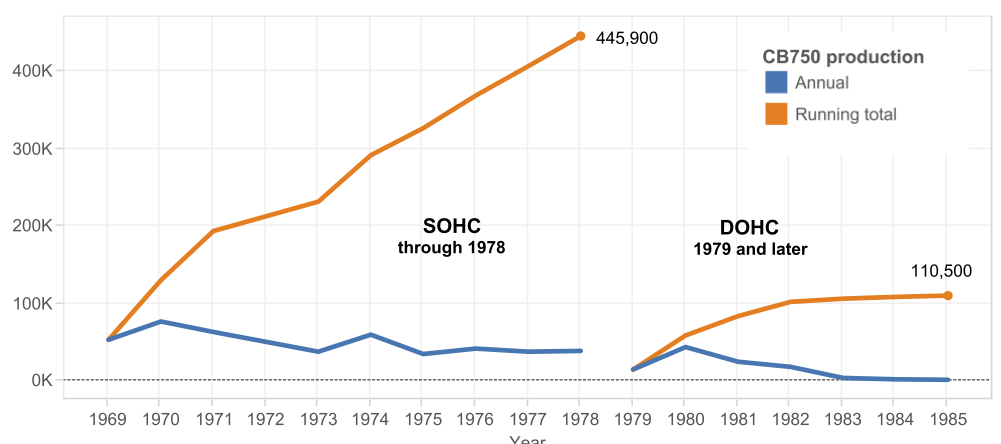
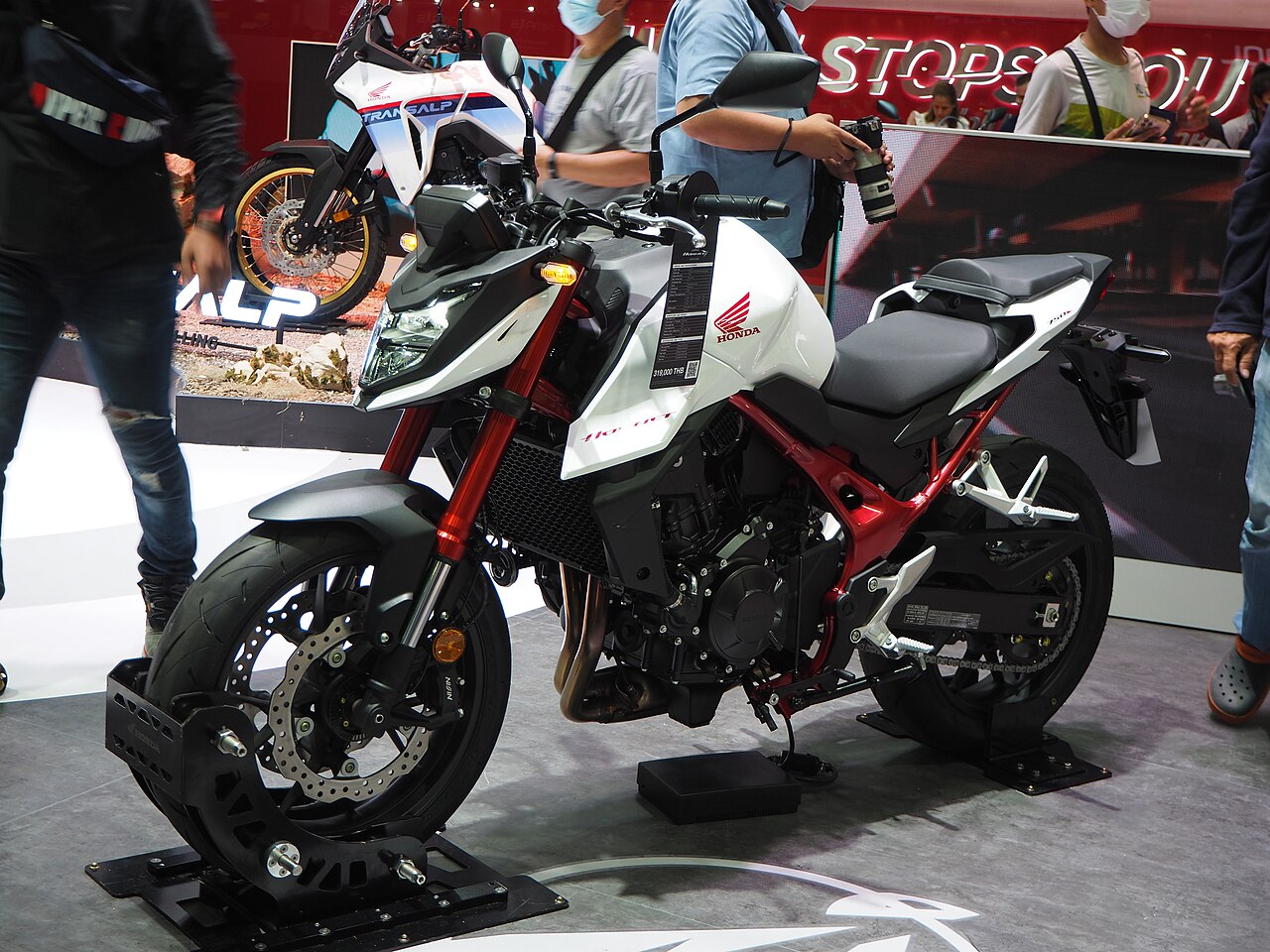
Production of the bike spanned ten years in the Honda lineup, with total output exceeding 400,000 units.[2] In 1976, Honda launched the CB750A in the United States, where the "A" indicated "Automatic" due to its automatic transmission; however, the transmission does not shift gears automatically for the rider.[4] Honda manufactured a CB750 variant called the Nighthawk 750 from 1982 through 2003, though not in every year during that span.[5]
What the maker and period sources say
Landon Hall's 2006 article in Motorcycle Classics states that the CB750 was unlike anything Honda had produced for the public, with the first mass-production in-line four-cylinder engine.[6] The same article notes that the first CB750s had engine cases with a wrinkly finish from sand castings, and roughly 7,414 sandcast CB750s were manufactured.[6] Hall also reports that the CB750 became an immediate success as soon as it went on sale.[6] A 2000 Motorcycle.com shootout described the Nighthawk 750 as "the quintessential standard in the city" and "incredibly easy to ride"[7]
The Canadian Biker Magazine's history of Honda cruisers states that Honda was dominant in the street standard segment with the revolutionary CB750.[8] The same source notes that Honda's early forays into the cruiser segment only tested the perimeter.[8]
References
- Wikipedia, "Honda CB750 and CR750" (CC BY-SA 4.0), which cites: Wilson, H., "The Encyclopedia of the Motorcycle", Dorling Kindersley Limited, 1995, p. 88–89; Walker, "Motorcycle: Evolution, Design, Passion", JHU Press, 2006, p. 150; "The Dawn of the Superbike: Honda's Remarkable CB750", AMA Motorcycle Hall of Fame (we also read that source) en.wikipedia.org
- Wikipedia, "Honda CB750 and CR750" (CC BY-SA 4.0), which cites: "Employing an Idle Facility to Produce a Large Motorcycle"; Hagery.com: Why do collectors pay double for a Honda CB750 engine cast in sand?, James Hewitt, 02 October 2020; Alexander, "Japan's Motorcycle Wars: An Industry History", UBC Press, 2009, p. 206 (original not read by us) en.wikipedia.org
- Wikipedia, "Honda CB750 and CR750" (CC BY-SA 4.0), which cites: "Honda's Fabulous 750 Four; Honda Launches the Ultimate Weapon in One-Upmanship – a Magnificent, Musclebound, Racer for the Road", January 1969, p. 36–39 (original not read by us) en.wikipedia.org
- Wikipedia, "Honda CB750 and CR750" (CC BY-SA 4.0), which cites: Bacon, "Honda: The Early Classic Motorcycles : All the Singles, Twins and Fours, Including Production Racers and Gold Wing-1947 to 1977", Niton Publishing, 1996, p. 110, 112, 185, 192; Ker, "Classic Japanese Motorcycle Guide", Haynes Publishing, 2007, p. 81 (we also read that source) en.wikipedia.org
- Wikipedia, "Honda CB750 and CR750" (CC BY-SA 4.0), which cites: "Requiem for a Cruiser : A Brief History of Honda Cruisers", Canadian Biker Magazine (we also read that source) en.wikipedia.org
- Landon Hall, "Honda CB750 Four: A Classic for the Masses", Motorcycle Classics, July–August 2006. facts only, no text reused. motorcycleclassics.com
- MO Staff, "2000 Valuebike Shootout", motorcycle.com. facts only, no text reused. motorcycle.com
- "Requiem for a Cruiser : A Brief History of Honda Cruisers", Canadian Biker Magazine. facts only, no text reused. cdnbkr.ca
Each numbered sentence above was checked against the source it cites before publication. Sentences citing Wikipedia adapt text from the English Wikipedia article Honda CB750 and CR750 (contributors), used under CC BY-SA 4.0; this entry is available under the same licence. Other sources were used for facts only; no text or images are copied from them.
More in Iconic Motorcycles
Sources
Compiled from Wikipedia and the sources listed below. Text from Wikipedia is available under CC BY-SA 4.0; this entry is adapted from it.
- Wikipedia: Honda CB750 and CR750 (CC BY-SA 4.0).
Spotted an error? Know more?
Reader corrections go straight into our review queue. Suggest an edit · How this site is sourced