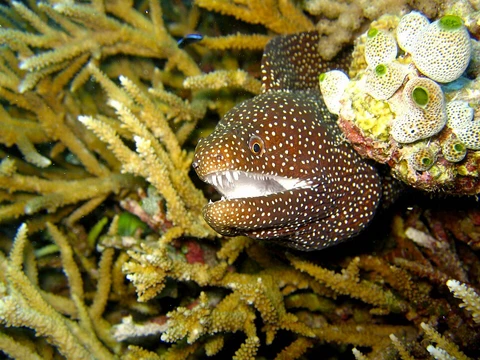
Spotted moray
A solitary, day-active moray with a dangerous bite.
Last updated

NOAA Photo Library · via Wikipedia: Spotted moray · CC BY 2.0
The spotted moray (Gymnothorax moringa) is a medium to large moray eel found in the Western Atlantic Ocean and around Mid- and Eastern Atlantic islands. It is notable for its distinctive white or pale yellow body covered with small overlapping reddish brown to dark-brown spots, and for its solitary, daytime-active behavior.
Scientific classification
- KingdomAnimalia
- PhylumChordata
- ClassActinopterygii
- DivisionTeleostei
- OrderAnguilliformes
- FamilyMuraenidae
- GenusGymnothorax
- SpeciesGymnothorax moringa
Named by Cuvier, 1829
Close relatives
Other species of Gymnothorax with a Codexery entry.
- Abbott's moray eel Gymnothorax eurostus
- Blackcheek moray eel Gymnothorax breedeni
- Brown speckled eel Gymnothorax steindachneri
- California moray Gymnothorax mordax
- Fimbriated moray Gymnothorax fimbriatus
- Geometric moray Gymnothorax griseus
- Giant moray Gymnothorax javanicus
- Green moray Gymnothorax funebris
Sources: Wikipedia taxobox: Spotted moray (CC BY-SA 4.0) · order, family and genus agree with WoRMS AphiaID 158584 (CC BY 4.0)
Conservation status
Least Concern (LC)
- LC▲ this species
- NT
- VU
- EN
- CR
- EW
- EX
Source: IUCN Red List assessment · GBIF copy of the Red List category
How big is it?
Largest length in the source, 2 m, next to a 1.8 m person.
Diagram: drawn by Codexery, schematic shapes to scale (not a likeness). Length: Wikipedia: Spotted moray
Where the spotted moray has been recorded
Each dot is a place where the species has been observed and reported (26,846 records, half-degree grid) — not a modelled range. 18 inland records left out (institution coordinates).
Map: drawn by Codexery. Data: GBIF occurrence search (records CC0 / CC BY) · Natural Earth basemap (public domain) · place coordinates: Wikipedia (CC BY-SA 4.0)
Background
The spotted moray is a solitary animal that typically hides in narrow crevices and holes in reef structures, with only its head peeking out. It is active during the day, feeding on crustaceans, molluscs, and fish at or near the sea bottom. Its bite can be dangerous to humans due to the damage caused by the pull-back effect of the bite itself, as well as potential toxins that may be released into the wound.
More in Moray Eels
Sources
Compiled from Wikipedia and the sources listed below. Text from Wikipedia is available under CC BY-SA 4.0; this entry is adapted from it.
- Wikipedia: Spotted moray (CC BY-SA 4.0).
- Classification: the source article's taxobox; order, family and genus checked against WoRMS, the World Register of Marine Species (CC BY 4.0).
- Conservation status: IUCN Red List assessment.
- Occurrence records: GBIF (CC0 / CC BY). Basemap: Natural Earth (public domain).
- Word definitions: the Codexery glossary, each quoted from its Wikipedia article.
Spotted an error? Know more?
Reader corrections go straight into our review queue. Suggest an edit · How this site is sourced