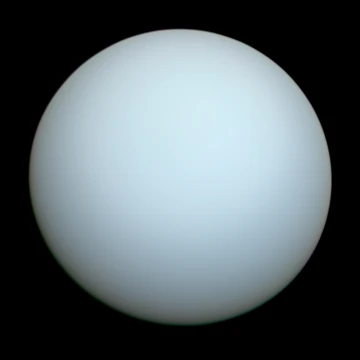
Triton (moon)
Neptune's largest moon, captured from the Kuiper belt, with a retrograde orbit.

Triton is the largest natural satellite of Neptune and the only moon of the planet massive enough to be rounded under its own gravity. It is notable for its retrograde orbit—the only large moon in the Solar System to orbit in the opposite direction to its planet's rotation—and is thought to have once been a dwarf planet from the Kuiper belt, captured by Neptune's gravity. At 2,710 kilometers in diameter, it is the seventh-largest moon in the Solar System and larger than all known dwarf planets.
Quick Facts
- Note
- yes
- Mpc Name
- Neptune I
- Pronounced
- ˈ · t · r · aɪ · t · ən (TRY · tən)
- Adjectives
- Tritonian (t · r · aɪ · ˈ · t · oʊ · n · i · ə · n)
- Named After
- Τρίτων Trītōn
- Discoverer
- William Lassell
- Discovered
- October 10, 1846
- Inclination
- 129.812° (to the ecliptic) / 156.885° (to Neptune's equator) / 129.608° (to Neptune's orbit)
- Satellite Of
- Neptune
Facts from the source article.
Lore & Background
Triton was discovered by British astronomer William Lassell on October 10, 1846, just 17 days after the discovery of Neptune, using a self-built 61 cm aperture metal mirror reflecting telescope. Lassell had been prompted by John Herschel to search for possible moons. The moon was named after the Greek sea god Triton, son of Poseidon, a name first proposed by Camille Flammarion in 1880 and officially adopted decades later. Until the discovery of Nereid in 1949, Triton was commonly called 'the satellite of Neptune.'
Triton's retrograde orbit is unique among large moons, with an inclination of 157° relative to Neptune's rotation. Its orbit is nearly circular (eccentricity 0.000016) and precesses with a period of about 678 Earth years. The moon is tidally locked to Neptune, keeping one face toward the planet, and its rotational axis is about 40° from Neptune's orbital plane, causing seasonal changes as each pole takes turns facing the Sun. Tidal interactions are gradually decaying its orbit; predictions suggest it will pass within Neptune's Roche limit in 3.6 billion years, though a 2025 study indicates 28 billion years.
Triton is thought to have originated in the Kuiper belt and been captured by Neptune. Its capture may explain the eccentric orbit of Nereid and the scarcity of Neptunian moons. The moon is differentiated, with a crust of ice, a probable subsurface ocean, and a rocky-metallic core. Its surface is geologically young (less than 100 million years old), covered by frozen nitrogen, and features cryovolcanic and tectonic terrains. The thin, hazy atmosphere is primarily nitrogen with minor methane and carbon monoxide, and its surface pressure varies by up to a factor of three.
Reader's Guide
Triton holds significant scientific importance as the only large moon in the Solar System with a retrograde orbit, supporting the theory that it was a Kuiper belt object captured by Neptune. Its geological activity, young surface, and subsurface ocean make it a prime target for astrobiology and planetary science. The 1989 Voyager 2 flyby remains the only up-close visit, studying only about 40% of the surface. Multiple concept missions—including Trident, Triton Ocean Worlds Surveyor, and Nautilus—have been developed to revisit it. Triton's atmosphere, with nitrogen ice clouds and organic haze, and its variable surface pressure, offer insights into dynamic planetary processes. Its capture history helps explain the structure of the Neptunian system, including the eccentric orbit of Nereid and the lack of regular moons. The moon's eventual fate—either collision with Neptune or breakup into a ring system—underscores its role in the evolution of the planet's environment. Triton's similarity to Pluto in size and composition suggests a shared origin in the outer Solar System, further supported by a 2024 study of their chemical compositions.
Did You Know?
- Its surface is geologically young, with an estimated average age of less than 100 million years.
- Triton's atmosphere supports clouds of nitrogen ice crystals and organic haze.
- The moon was discovered just 17 days after Neptune was found, on October 10, 1846.
Discovery and the Naming of Neptune's Giant Moon
Triton came to light on October 10, 1846, a mere seventeen days after Neptune itself was first identified. The discovery belonged to William Lassell, a brewer by profession who had constructed his own 61-centimeter metal mirror reflector—colloquially called the "two-foot" telescope—before using it to sweep the skies around the newly found planet. The impetus came from John Herschel, who, upon hearing of Neptune, wrote to Lassell urging him to look for accompanying satellites. Eight days after that letter, Lassell found Triton. He also briefly claimed to have seen rings around Neptune, though the real rings are so faint and dark that most astronomers doubt he actually observed them. The name "Triton" was not Lassell's choice; it was proposed decades later by Camille Flammarion in his 1880 popular astronomy book, Astronomie Populaire, and was only officially adopted much afterward. Until Nereid was found in 1949, the moon went simply by the generic label "the satellite of Neptune." Lassell's telescope was eventually donated to the Royal Observatory at Greenwich in the 1880s but was later dismantled.
A Retrograde Orbit and Tidal Destiny
Among all the large moons in the Solar System, Triton is the only one that circles its planet in the opposite direction to that planet's spin. Jupiter and Saturn do host small, distant irregular satellites on retrograde paths, but none rival Triton's scale; the largest, Phoebe, spans just eight percent of Triton's diameter and holds 0.03 percent of its mass. Triton's orbital geometry involves two tilts: Neptune's axis leans 30 degrees from its orbital plane, while Triton's orbital plane sits at 157 degrees relative to Neptune's rotation—well past the 90-degree mark that signals retrograde motion. The orbit precesses forward over roughly 678 Earth years, making its Neptune-relative inclination oscillate between 127 and 173 degrees; it currently hovers near 130 degrees, close to maximum departure from coplanarity. Because of its ex situ origin and retrograde path, Triton is usually labeled an irregular satellite, yet its close-in orbit is governed primarily by Neptune rather than the Sun, a trait more typical of regular satellites. This tension has led many to place Triton in a category of its own. Tidal interactions are steadily shrinking the orbit, and projections suggest that in roughly 3.6 billion years Triton will pass inside Neptune's Roche limit.
A Young, Active Surface and a Shifting Atmosphere
Triton ranks among the most geologically active bodies in the Solar System, with an estimated average surface age under 100 million years. Its face is blanketed in frozen nitrogen and bears very few impact craters, a testament to ongoing resurfacing. Young, intricate cryovolcanic and tectonic terrains dot the landscape, hinting at a complex geological history still unfolding. Beneath this icy crust, a probable subsurface ocean of liquid water likely persists, fed in part by obliquity tides that generate internal heating even though the orbit's eccentricity is vanishingly small at 0.000016. Above the surface, a thin and strongly variable atmosphere—composed mainly of nitrogen with traces of methane and carbon monoxide—supports clouds of nitrogen ice crystals and a layer of organic haze. Remarkably, the atmospheric surface pressure has fluctuated by as much as a factor of three over the past three decades, making Triton's sky one of the most dynamically changing in the outer Solar System.
Internal Architecture and a Kuiper Belt Heritage
At 2,710 kilometers in diameter, Triton is the seventh-largest moon in the Solar System and the second-largest planetary moon relative to its primary after Earth's Moon, surpassing every known dwarf planet. Its mean density of 2.061 grams per cubic centimeter points to a composition of roughly 30 to 45 percent water ice by mass, with the remainder being predominantly rock and metal. The moon is fully differentiated: a crust of primarily ice caps a probable liquid-water ocean, which in turn rests atop a solid rocky-metallic core. This layered internal structure, combined with its retrograde orbit and large size, strongly suggests that Triton was once a free-floating dwarf planet in the Kuiper belt before Neptune's gravity snared it into orbit. The capture event would have initially placed Triton on a highly elliptical path; gas drag from a prograde debris disc is thought to have played a substantial role in circularizing that orbit to the near-perfect circle it follows today, with an eccentricity of almost zero.
Frequently Asked Questions
What is Triton?
Triton is Neptune's largest natural satellite and the only one massive enough to have pulled itself into a rounded shape under its own gravity. It measures roughly 2,710 kilometers across, making it the seventh-largest moon in our Solar System.
What makes Triton's orbit so unusual?
Triton circles Neptune in the opposite direction to the planet's spin, a retrograde path no other large moon in the Solar System shares. Its orbital inclination sits at about 157 degrees relative to Neptune's equator, confirming this backward motion.
Where did Triton originally come from?
Astronomers believe Triton was once a free-floating dwarf planet drifting through the Kuiper belt before Neptune's gravity snared it into orbit. That violent capture event is thought to explain its odd retrograde trajectory.
Who discovered Triton and when?
Scottish astronomer William Lassell spotted Triton on October 10, 1846, just seventeen days after Neptune itself had been identified. Finding such a faint, distant object so quickly was a remarkable feat of 19th-century observational astronomy.
How does Triton compare in size to other moons and dwarf planets?
At 2,710 kilometers in diameter, Triton outstrips every known dwarf planet, including Pluto. Its mean density of roughly 2.061 grams per cubic centimeter suggests a rocky core beneath a thick icy outer layer.
More in Moons of Uranus and Neptune, Part 2 1-24
Spotted an error? Know more?
Reader corrections go straight into our review queue. Suggest an edit · How this site is sourced