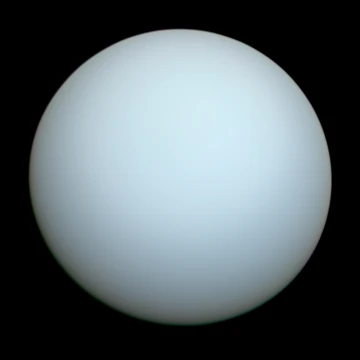
Trident (spacecraft)
A proposed flyby mission to Neptune's moon Triton.

Trident was a space mission concept proposed in 2019 to NASA's Discovery Program, designed to explore Neptune's largest moon Triton via flybys of Jupiter and Neptune. It was notable for aiming to capitalize on a rare gravity assist alignment of Jupiter and Neptune that occurs once every 13 years, and for its potential to provide a near-complete map of Triton and assess changes since the Voyager 2 flyby in 1989.
Quick Facts
- Mission Type
- Reconnaissance, flyby of outer planets
- Operator
- NASA
- Mission Duration
- 13 years (planned)
- Launch Date
- Proposed: 25 October 2025 / (with a backup in October 2026)
- Programme
- Discovery Program
- Previous Mission
- Psyche
Facts from the source article.
Lore & Background
Trident was proposed in March 2019 to NASA's Discovery Program, supported by NASA's Ocean Worlds Exploration Program. The concept aimed to answer questions generated by Voyager 2's 1989 flyby, which discovered several cryovolcanoes on Triton and revealed a geologically active moon with a young surface and thin atmosphere. Voyager 2 observed only about 40% of Triton's surface.
The mission would have taken advantage of a once-every-13-years gravity assist alignment of Jupiter and Neptune, with a proposed launch in October 2025 (backup October 2026). The spacecraft would use Jupiter's gravity as a slingshot to reach Triton for a 13-day encounter in 2038. During the flyby, Trident would pass within 500 km of Triton's surface, sampling its ionosphere with a plasma spectrometer and performing magnetic induction measurements to assess the potential existence of an internal ocean.
In 2020, Trident was selected along with three other Discovery proposals for further study, with two expected to be selected as Discovery 15 and 16. On 2 June 2021, NASA selected the Venus missions DAVINCI+ and VERITAS over Trident and the Io Volcano Observer.
Reader's Guide
Trident's significance lies in its potential to build on the limited observations of Triton made by Voyager 2 in 1989. The mission concept was designed to address key unknowns about Triton's geology, plume activity, and the possibility of an internal ocean, using advanced high-resolution imaging and a unique orbital configuration in 2038 to map nearly the entire surface. The rare gravity assist window, occurring only once every 13 years, made the timing critical. Although Trident was not selected for flight, it was one of four finalists in the Discovery Program competition, highlighting the scientific interest in Triton as a geologically active moon with cryovolcanoes and a thin atmosphere. The concept also underscored the value of efficient planetary alignments for outer solar system exploration, as well as the ongoing quest to understand ocean worlds beyond Earth. The mission's legacy includes informing future proposals for Triton exploration, such as the Triton Hopper lander concept and the Chinese Shensuo probe.
Did You Know?
- Trident was proposed in 2019 to NASA's Discovery Program and selected for further study in 2020.
- Trident would have passed within 500 km of Triton's surface to sample its ionosphere and measure magnetic induction.
- The principal investigator was Louise Prockter, director of the Lunar and Planetary Institute in Houston, Texas.
Frequently Asked Questions
What is Trident (spacecraft)?
Trident is a proposed NASA Discovery Program mission concept, first submitted in 2019 under principal investigator Louise Prockter, intended to send a small probe on a series of planetary flybys culminating in a close pass of Triton, Neptune's largest moon.
What is Trident's main scientific goal?
The mission aims to produce a near-complete surface map of Triton and to document any geological or atmospheric changes that have occurred since Voyager 2's single 1989 flyby, which remains the only close-up data we have on the moon.
How does Trident get to Triton?
The spacecraft would use a gravity-assist trajectory that threads through Jupiter and then Neptune, exploiting a rare alignment of those two giants that recurs roughly every thirteen years, before making its final flyby of Triton at a distance of under 500 km (about 310 mi).
When is Trident scheduled to launch and arrive?
The proposed launch window is October 2025, with a backup slot in October 2026, and the Triton encounter is projected for 2038, giving the probe more than a decade of cruise time between the planetary assists.
Why do fans consider Trident important for Uranus and Neptune moon science?
Because no dedicated mission has targeted either ice giant's moon systems since Voyager 2 in 1989, Trident would represent the first purpose-built probe to revisit that region, filling a thirty-year observational gap and potentially reshaping our understanding of Triton's active geology and thin atmosphere.
More in Moons of Uranus and Neptune, Part 2 1-24
Spotted an error? Know more?
Reader corrections go straight into our review queue. Suggest an edit · How this site is sourced