Melancholia
Last updated
Melancholia, derived from the Greek term for black bile, is a historical concept in European medicine describing a condition of depressed mood, bodily complaints, and sometimes hallucinations or delusions. It was also understood as a mood or temperament, and occasionally as a description of the human condition itself. Its significance lies in its long-standing influence on medical, cultural, and literary thought from antiquity through the premodern era.
Early history
The term melancholia originates from the ancient medical theory of the four humours, where disease resulted from an imbalance of bodily liquids. An excess of black bile was believed to cause melancholia, and a person with a preponderance of this humour had a melancholic disposition. This humour was associated with the element earth, the season autumn, the spleen, and the qualities cold and dry; astrologically, it reflected Saturn's influence. Hippocrates, in the 5th and 4th centuries BC, described melancholia as a distinct disease with symptoms including persistent fears, despondency, poor appetite, abulia, sleeplessness, irritability, and agitation.
His clinical description overlaps significantly with modern diagnostic criteria for major depressive disorder. In ancient Rome, Galen added fixed delusions to the symptom list and believed melancholia could cause cancer. Aretaeus of Cappadocia viewed melancholia as involving both anguish and delusion. The 10th-century Persian physician Al-Akhawayni Bokhari described it as a chronic illness from black bile affecting the brain, with initial manifestations such as unexplained fear, inability to answer questions, self-laughing, self-crying, and meaningless speech without fever.
During the Middle Ages in Europe, the humoral understanding of sustained sadness gave way to a religious perspective, where sadness was considered a vice and demonic possession was seen as a potential cause when patients could not be cured.
English cultural movement
In the late 16th and early 17th centuries, a cultural and literary cult of melancholia emerged in England. Art historian Roy Strong traced its origins to the Neoplatonist and humanist Marsilio Ficino, who transformed melancholia from a vice into a mark of genius. Robert Burton's The Anatomy of Melancholy, first published in 1621, became a defining literary monument to this fashion. Sir Thomas Browne also expressed extensively on the melancholic disposition in his Religio Medici.
Edward Young's long poem Night-Thoughts, published between 1742 and 1745, was hugely popular in several languages and influenced early Romantics in England, France, and Germany. In visual arts, fashionable intellectual melancholy appeared in portraiture, with sitters posed as the lover or the scholar, often set outdoors or in gloomy interiors. In music, the cult is associated with John Dowland, whose motto was Semper Dowland, semper dolens. The melancholy man, or malcontent, is epitomized by Shakespeare's Prince Hamlet.
Modern connotations
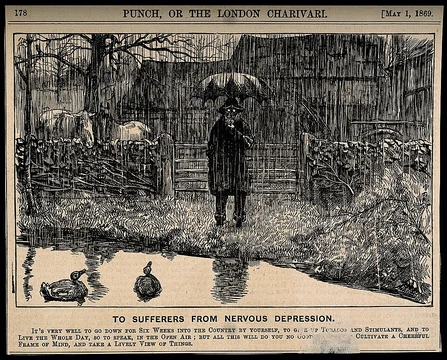
Until the 18th century, writings on melancholia mainly concerned abnormal beliefs rather than affective symptoms. In the 18th century, the well-to-do, sedentary, and studious were especially liable to be placed in the melancholia category. In the 20th century, melancholia lost its attachment to abnormal beliefs and became a synonym for depression. Sigmund Freud published a paper on Mourning and Melancholia in 1918.
In 1907, Emil Kraepelin proposed involutional melancholia to explain more frequent depression among the elderly, though by 1913 he returned to his earlier view linking age-related depression to manic-depressive illness. In 1996, Gordon Parker and Dusan Hadzi-Pavlovic described melancholia as a specific disorder of movement and mood, attaching it to the concept of endogenous depression. In 2006, Michael Alan Taylor and Max Fink defined melancholia as a systemic disorder identifiable by depressive mood rating scales and abnormal cortisol metabolism, characterized by depressed mood, abnormal motor functions, and abnormal vegetative signs, with forms including retarded depression, psychotic depression, and postpartum depression.
In modern diagnostic classification, melancholia and melancholic are used in ICD-11 and DSM-5 to specify features in major depression, such as severely depressed mood, pervasive anhedonia, lack of emotional responsiveness, terminal insomnia, and marked psychomotor retardation or agitation.
Frequently Asked Questions
What are the symptoms of Melancholia?
Symptoms of Melancholia include low mood, low self-esteem, fatigue, insomnia, anorexia, anhedonia and lack of mood reactivity.
What causes Melancholia?
Listed causes of Melancholia include Genetic, environmental and and psychological factors.
How is Melancholia treated?
Treatment of Melancholia includes Counseling, antidepressant medication and electroconvulsive therapy.
More in Mood Disorders
Sources
Compiled from Wikipedia and the sources listed below. Text from Wikipedia is available under CC BY-SA 4.0; this entry is adapted from it.
- Wikipedia: Melancholia (CC BY-SA 4.0).
- Word definitions: the Codexery glossary, each quoted from its Wikipedia article.
Spotted an error? Know more?
Reader corrections go straight into our review queue. Suggest an edit · How this site is sourced