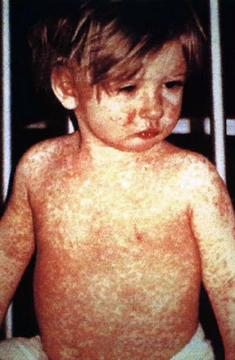
Letterer–Siwe disease
Severe multisystem Langerhans cell histiocytosis in young children.
Last updated
Letterer–Siwe disease is the most severe form of Langerhans cell histiocytosis, a disorder marked by monoclonal proliferation of dendritic cells. It primarily affects children under three years old and involves multiple organ systems, including the skin, bone marrow, spleen, liver, and lungs. The condition is historically eponymous, named after Erich Letterer and Sture Siwe.
Quick Facts
- Prevalence
- 1:500,000
- Proportion of lch cases
- 10%
- Typical age of onset
- Children less than 3 years old
- Five-year survival rate
- 50%
Facts from the source article.
Cause
The cause of Langerhans cell histiocytosis, including Letterer–Siwe disease, is unknown. The condition involves abnormal proliferation and accumulation of immature Langerhans cells, macrophages, lymphocytes, and eosinophils, forming granulomatous lesions.
It is an oncogene-driven cancer of myeloid lineage with activation of the RAS-RAF-MEK-ERK signaling pathway in all patients. Oncogenic BRAFV600E mutations occur in 50–60% of cases, and MAP2K1 mutations in 10–15%. No clear hereditary or familial tendency has been identified.
Diagnosis
Diagnosis requires a complete work-up due to non-specific symptoms that mimic benign conditions. It is established by biopsy, with immunohistochemical staining for CD1a, CD207, and S-100 to identify Langerhans cells. Tumor tissue should be tested for BRAFV600E and other MAPK pathway mutations.
Electron microscopy reveals racket-like Langerhans cell granules, which confirm the diagnosis in atypical cases. Additional tests evaluate organ involvement, and a work-up for congenital or acquired immunodeficiency syndromes and infectious etiologies is recommended. LSD should be considered in cases refractory to antibiotics.
Prognosis
Letterer–Siwe disease carries a grim prognosis: half of patients survive five years. Outcomes are worse for those under two, with widespread disease, low platelets, or liver, spleen, or bone marrow involvement. The strongest predictor of survival is how well the disease responds to an initial six-to-twelve-week course of vinblastine and steroids—more important than age. For infants, the illness is almost always fatal, sometimes before birth or within the first few weeks of life.
Treatment
Chemotherapy is indicated for multisystem involvement. Patients not responding to aggressive chemotherapy may consider reduced-intensity hematopoietic stem cell transplantation, experimental chemotherapy, or immunomodulatory therapy targeting identified mutations. Those with BRAFV600E mutations may be candidates for BRAF inhibitors such as vemurafenib. Early dermatology consultation for skin manifestations is key, as early diagnosis and treatment can be life-saving.
Did You Know?
- A purpuric rash or bruise may appear right before death in patients with a hemorrhagic tendency.
- The same electron microscopic structures are characteristic of Hand–Schüller–Christian disease and eosinophilic granuloma.
- LSD has no clear association with hereditary or familial tendencies.
More in Monocyte- and Macrophage-related Cutaneous Conditions
Sources
Compiled from Wikipedia and the sources listed below. Text from Wikipedia is available under CC BY-SA 4.0; this entry is adapted from it.
- Wikipedia: Letterer–Siwe disease (CC BY-SA 4.0).
- Word definitions: the Codexery glossary, each quoted from its Wikipedia article.
Spotted an error? Know more?
Reader corrections go straight into our review queue. Suggest an edit · How this site is sourced