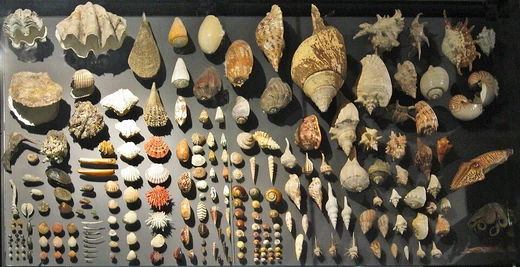
Mollusc shell
A calcareous exoskeleton produced by molluscs for protection and support.
Last updated
A mollusc shell is a calcareous exoskeleton that encloses, supports, and protects the soft parts of animals in the phylum Mollusca, including snails, clams, and tusk shells. Over 100,000 living species bear a shell, though some groups like squid and octopus have lost or reduced it. The study of shells is called conchology, a branch of malacology.
Quick Facts
- Living shell-bearing species
- over 100,000
- Earliest fossil appearance
- Cambrian period
- Classes with external shells
- monoplacophora
- gastropods
- bivalves
- scaphopods
- chitons
- nautiloids
Facts from the source article.
Formation
A mollusc shell is formed, repaired, and maintained by the mantle. The mantle edge secretes a shell with two components: an organic constituent mainly of polysaccharides and glycoproteins, and calcium carbonate crystals. The organic framework controls crystal formation, dictating when and where crystals start and stop growing, how fast they expand, and which polymorph is deposited. Shell formation occurs within the extrapallial space, sealed from the environment by the periostracum, a leathery outer layer around the rim where growth happens.
The periostracum acts as a framework for carbonate deposition and allows ion accumulation for crystallization. Ion pumps in the calcifying epithelium drive ion accumulation; calcium ions are obtained from the environment through gills, gut, and epithelium, transported by haemolymph, and stored as granules. The organic matrix scaffolds crystallization, and deposition is controlled by hormones produced by the mollusc. When the animal encounters harsh conditions limiting food supply, the mantle ceases shell production, and a growth line forms when conditions improve.
Structure
The calcium carbonate layers in a shell are generally of two types: an outer prismatic layer and an inner nacreous layer, which incorporate conchiolin to bind crystals together. The periostracum and prismatic layer are secreted by a marginal band of cells, so the shell grows at its outer edge, while the nacreous layer comes from the main mantle surface. Shells contain pigments such as pyrroles and porphyrins, accounting for colors and patterns. Shells are almost always composed of calcite or aragonite; different layers may use different polymorphs.
In a few hydrothermal vent species, iron sulfide is used. Phosphate is never used except possibly in Cobcrephora. Shells are composite materials of calcium carbonate and organic macromolecules, with ultrastructural motifs including crossed-lamellar, prismatic, homogeneous, foliated, and nacre. In most shelled molluscs, the shell is large enough for retraction of soft parts, but in some gastropods the shell is reduced, offering protection only to the visceral mass.
Some gastropods have no shell or only an internal shell, known as slugs; semi-slugs have a greatly reduced external shell.
Evolution
The fossil record indicates that all molluscan classes evolved about 500 million years ago from a shelled ancestor resembling a modern monoplacophoran, with shell modifications leading to new classes and lifestyles. However, molecular and biological data suggest that certain shell features, including nacre, have evolved many times independently. The nacreous layer is a complex structure that has arisen convergently; under 10% of the genes expressed in gastropod nacre are also found in bivalve nacre, and most shared genes occur in deuterostome mineralizing organs.
Crystallographic differences between clades further support independent origins: the orientation of aragonite 'bricks' in nacre differs among monoplacophorans, gastropods, and bivalves. Mollusc shells are durable and outlast the soft-bodied animals; most marine shells fossilize easily, and fossil shells date to the Cambrian. Large amounts of shell can form sediment and become compressed into limestone. The fossil record consists mostly of shells, preserved as calcium carbonate, with aragonite often pseudomorphed by calcite; aragonite older than the Carboniferous is practically unknown unless protected by carbonaceous material or phosphatic molds.
Varieties
The nacreous layer of monoplacophoran shells has undergone modification: in some species, the aragonite crystals are layered sheets rather than bricks, with the c-axis perpendicular to the shell wall and the a-axis parallel to growth direction. This foliated aragonite is presumed to have evolved from the nacreous layer. Chiton shells consist of eight overlapping calcareous valves surrounded by a girdle. In some marine gastropods, periodic resting stages produce thickened lips called varices, typical in families such as Bursidae, Muricidae, and Ranellidae.
Gastropods with determinate growth may create a single terminal lip at maturity, as seen in cowries (Cypraeidae), helmet shells (Cassidae), true conchs (Strombidae), and many land snails. Nautiluses are the only extant cephalopods with an external shell; extinct cephalopods with external shells include other nautiloids and ammonoids.
Cuttlefish, squid, spirula, vampire squid, and cirrate octopuses have small internal shells. The shell of Bivalvia has two hinged valves joined by a ligament. Scaphopod shells resemble miniature elephant tusks, hollow and open at both ends.
Did You Know?
- Pattern formation in mollusc shells has been modeled using one-dimensional reaction–diffusion systems, particularly the Gierer-Meinhardt system based on the Turing model.
- Mollusc shells in storage or display are vulnerable to acidic fumes, a condition known as Byne's disease or Bynesian decay.
- Females of the octopus genus Argonauta secrete a paper-thin eggcase popularly regarded as a shell, though it is not attached to the animal's body.
More in Mollusc Shells
Sources
Compiled from Wikipedia and the sources listed below. Text from Wikipedia is available under CC BY-SA 4.0; this entry is adapted from it.
- Wikipedia: Mollusc shell (CC BY-SA 4.0).
- Word definitions: the , each quoted from its Wikipedia article.
Spotted an error? Know more?
Reader corrections go straight into our review queue. Suggest an edit · How this site is sourced