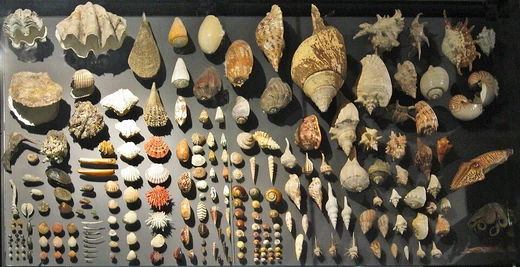
Bivalve shell
Two hinged valves form the protective shell of bivalve molluscs.
Last updated
A bivalve shell is the two-part exoskeleton of a bivalve mollusc, consisting of a right valve and a left valve joined by a ligament. These shells are common in saltwater, brackish water, and freshwater environments, often washing ashore as separate valves. They are collected by conchologists and harvested for commercial uses such as glue, chalk, and varnish.
Quick Facts
- Number of microsection categories
- eight
- Institution of first author
- Duke University
Facts from the source article.
Shell anatomy, structure and composition
The bivalve shell is composed of two calcareous valves secreted by the mantle, a thin membrane that also produces the ligament and hinge teeth. The mantle attaches to the shell via retractor muscles, leaving a visible pallial line on the interior of each valve, which runs from the anterior adductor muscle scar to the posterior adductor muscle scar. In species with fused mantle edges forming siphons, a pallial sinus indentation appears on the pallial line, indicating the pocket where siphons retract.
The valves consist of calcite or both calcite and aragonite, with aragonite often forming an inner nacreous layer, as in the Pteriida. The outermost layer, the periostracum, is a horny organic substance that may peel off when dried.
Shell growth occurs by adding material at the open edge and by gradual thickening throughout life. The ligament, composed of tensilium and resilium, holds the valves together at the dorsum and opens the shell; the adductor muscles close it. Upon death, the adductor muscles relax and the resilium pushes the valves open.
Mechanical properties
The mechanical properties of bivalve shells were first studied in 1969 by Stephen Wainwright at Duke University, leading to eight microsection categories: simple prismatic, composite prismatic, sheet nacreous, lenticular, foliated, crossed-lamellar, complex crossed-lamellar, and homogenous. Common structures include sheet nacreous, crossed-lamellar, and complex crossed-lamellar. Twinning occurs at both microscale and nanoscale, with nanotwinning featuring incoherent twin boundaries growing preferentially in the (110) and (1-10) directions.
Research on Cerastoderma edule using scanning electron microscopy and nanoindentation found no strong correlation between high carbon dioxide exposure and shell hardness, but confirmed that larger microstructures yield poorer properties. The outermost shell has lower porosity and lower strength, while inner parts are stronger. Defects at scales from millimeters to nanometers can reduce porosity and prevent cracking; waviness in lamellar planes increases toughness, and greater interfacial area promotes strength.
Orientation
The beak is the oldest point of a bivalve shell, with the raised umbo around it; the hinge area is the dorsum, and the lower margin is ventral. The anterior holds the byssus and foot, while the posterior houses the siphon if present. In sinopalliate shells, the pallial sinus points posteriorly. Integripalliate shells lack a sinus and often have a byssal notch on the anterior right valve, with anterior auricles larger than or equal to posterior ones; a comb-like ctinoleum may appear in the notch.
Valves without notch, comb, or sinus and with equal auricles are likely left valves. The umbo usually points anteriorly. In anisomyarian bivalves, the posterior adductor scar is larger; isomyarian scars are equal; monomyarian valves have one scar. The external ligament typically lies posterior to the umbo on both valves.
Age estimation
The age of bivalve molluscs can be estimated by counting annual growth rings on the exterior of the valves, though extra rings from growth spurts and worn early rings near the umbones can cause confusion. Annual pallial line scars on the interior are clearer in dark shells but may be overgrown.
Growth lines in acetate peel replicas from the umbonal region provide another method. The most accurate approach is microscopic examination of sections through the outer prismatic layer. Using multiple methods increases accuracy.
Did You Know?
- A few bivalve groups, such as scallops, are active swimmers.
- Some bivalves, like blue mussels, attach to hard substrates using a byssus.
- Cemented bivalves, such as jewel boxes, permanently fix their lower valve to a hard substrate using shell material.
More in Mollusc Shells
Sources
Compiled from Wikipedia and the sources listed below. Text from Wikipedia is available under CC BY-SA 4.0; this entry is adapted from it.
- Wikipedia: Bivalve shell (CC BY-SA 4.0).
- Word definitions: the Codexery glossary, each quoted from its Wikipedia article.
Spotted an error? Know more?
Reader corrections go straight into our review queue. Suggest an edit · How this site is sourced