Oil immersion
Oil immersion boosts resolution by matching refractive index between lens and specimen.
Last updated
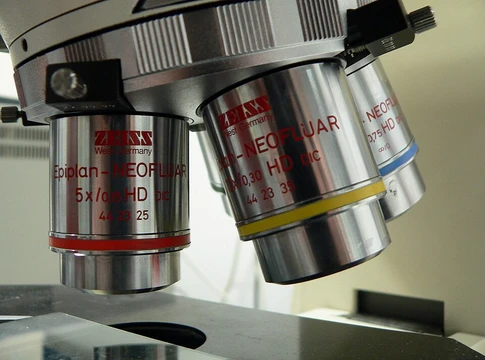
Oil immersion is a technique in light microscopy that increases resolving power by placing a transparent oil of high refractive index between the objective lens and the specimen. This raises the numerical aperture of the objective, allowing finer detail to be resolved. The oil's refractive index is similar to that of glass, reducing light refraction and image distortion.
Theoretical background
Lenses reconstruct light scattered by an object, and to do so successfully they must ideally collect all diffraction orders. This capability relates to the lens's opening angle and its refractive index. Resolution is defined as the minimum separation δ needed for two objects to be seen as separate; if they are closer than δ, they appear as one. Resolving power (R.P.) is given by the numerical aperture (NA), where δ = λ / (2 NA) and λ is the wavelength of light.
Good resolution (small δ) thus requires high NA. The numerical aperture is defined as NA = n sin α₀, where α₀ is half the angle spanned by the objective from the sample and n is the refractive index of the medium between lens and specimen (≈1 for air). State-of-the-art objectives in air can reach NA up to 0.95. Because sin α₀ ≤ 1, NA cannot exceed 1 in air, but filling the space with oil, which has a refractive index greater than 1, allows NA values above 1.
Oil-immersion objectives
Oil between the specimen and objective improves resolving power by a factor of 1/n. Objectives designed for this purpose are called oil-immersion objectives and are used only at very large magnifications requiring high resolving power. High-power objectives have short focal lengths, which facilitates oil use. In conventional microscopes, oil is applied to the specimen and the stage is raised to immerse the objective; in inverted microscopes, oil is applied to the objective.
The refractive indices of the oil and the first lens element are nearly the same, so light refraction upon entering the lens is small. Using incorrect immersion oil or no oil causes spherical aberration, the strength of which depends on the refractive index mismatch. Oil immersion is generally limited to rigidly mounted specimens, as surface tension can move the coverslip and sample; this also occurs on inverted microscopes because the coverslip is below the slide.
Immersion oil
Before synthetic immersion oils were developed in the 1940s, cedar tree oil was widely used. Cedar oil has a refractive index of approximately 1.516, and objectives using it typically have a numerical aperture around 1.3. Cedar oil has several disadvantages: it absorbs blue and ultraviolet light, yellows with age, has sufficient acidity to potentially damage objectives by attacking lens cement, and can change viscosity when diluted with solvent, altering its refractive index and dispersion.
It must be removed immediately after use to prevent hardening, as removing hardened cedar oil can damage the lens. Synthetic immersion oils are now more common and eliminate most of these problems. NA values of 1.6 can be achieved with different oils. Synthetic oils do not harden on the lens and can typically be left on the objective for months, though daily removal is best for maintenance; over time, oil can enter the front lens or seep into the barrel and damage the objective.
Different types exist: Type A and B are general-purpose oils with different viscosities—Type A traps fewer air bubbles, while Type B suits serial imaging of multiple slides with one application. Type F is for fluorescent imaging at room temperature (23 °C), and Type N for live-cell imaging at body temperature (37 °C). All have an nD of 1.515, similar to cedar oil.
More in Microscope Components
Sources
Compiled from Wikipedia and the sources listed below. Text from Wikipedia is available under CC BY-SA 4.0; this entry is adapted from it.
- Wikipedia: Oil immersion (CC BY-SA 4.0).
Spotted an error? Know more?
Reader corrections go straight into our review queue. Suggest an edit · How this site is sourced