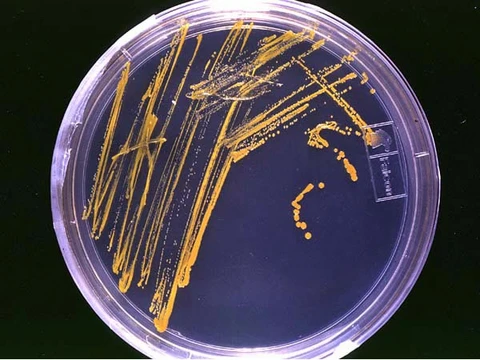
Spore
A reproductive unit adapted for dispersal and survival.

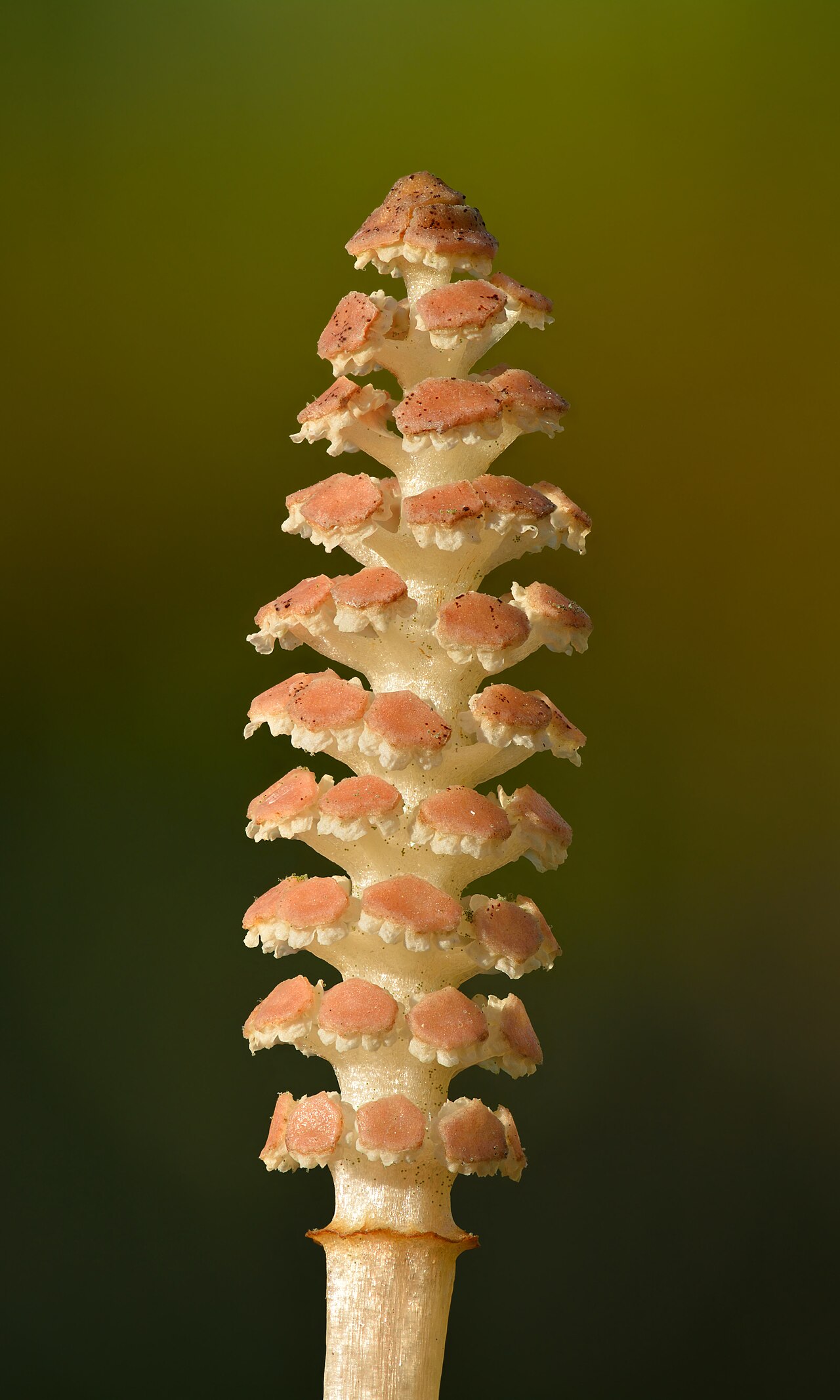
Ivar Leidus · CC BY-SA 4.0
A spore is a reproductive cell used by many organisms, capable of growing into a new individual without fusing with another cell. In fungi, spores can be part of either sexual or asexual reproduction, while in bacteria, they are not involved in reproduction at all but are tough, dormant structures that help the organism survive harsh conditions. Spores appear in the life cycles of plants, algae, fungi, and protozoa, and fossil evidence suggests they first evolved in early land plants around the mid-to-late Ordovician period.
The word "spore" comes from the Greek *spora*, meaning "seed" or "sowing." Unlike a gamete, which must combine with another gamete to form a zygote before developing further, a spore can germinate directly into a new organism (a sporeling). Spores are also distinct from seeds: spores are typically unicellular and give rise to a haploid gametophyte, while seeds contain a multicellular embryo (the next generation's sporophyte) and develop into a diploid plant.
In plants, spores are usually haploid and produced by meiosis inside a sporangium of a diploid sporophyte. Under good conditions, a spore divides by mitosis to form a multicellular gametophyte, which later produces gametes. Two gametes fuse to create a zygote, which grows into a new sporophyte—a cycle called alternation of generations. Some algae and fungi can produce diploid spores, but this is rare.
Vascular plant spores are always haploid. Homosporous plants produce spores of one size and type, while heterosporous plants (such as seed plants, spikemosses, quillworts, and certain ferns) produce two sizes: larger megaspores that grow into female gametophytes and smaller microspores that grow into male gametophytes. These two spore types come from separate sporangia—megasporangia and microsporangia. In flowering plants, these structures are found inside the carpel and anthers, respectively.
Fungi commonly produce spores during both sexual and asexual reproduction. Fungal spores are usually haploid and grow into mature haploid individuals through mitosis. Some, like the urediniospores and teliospores of rusts, are dikaryotic (having two haploid nuclei). Dikaryotic cells form when two haploid gamete cells fuse. Later, karyogamy (fusion of the two nuclei) produces a diploid cell, which then undergoes meiosis to create haploid spores.
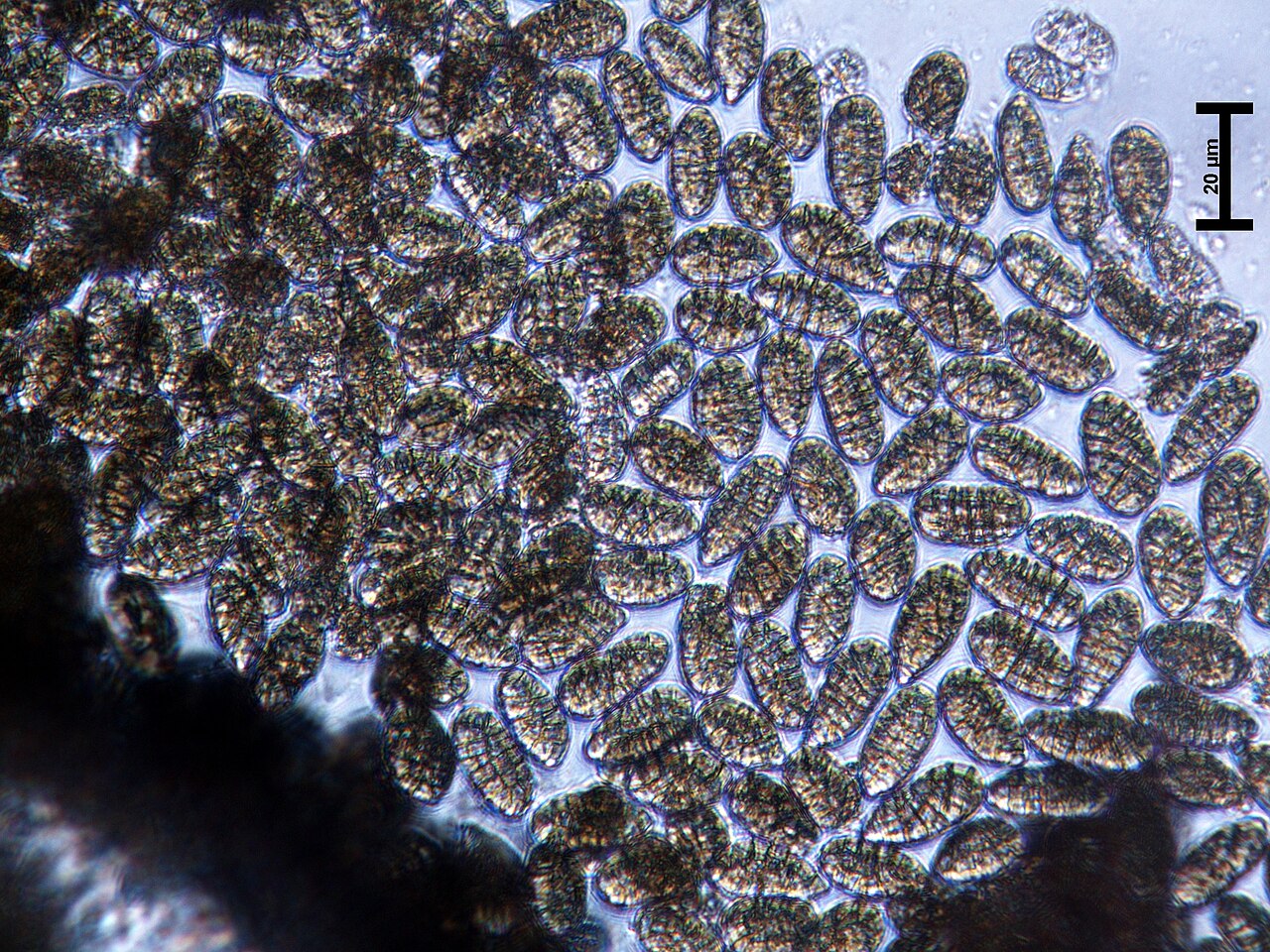
Spores can be classified by their structure, function, origin in the life cycle, or mobility. Their external surfaces often show complex patterns or ornamentation, with specialized terms for these features. Some markings are apertures—places where the tough outer coat can open for germination. Alete spores have no lines. Monolete spores have a single narrow line (laesura) from when two spores were once in contact. Trilete spores have three radiating lines from a central point, showing that four spores originally formed a tetrahedron. A wider groove-like aperture is called a colpus; the number of colpi helps distinguish major plant groups—for example, eudicots have tricolpate spores (three colpi).
Envelope-enclosed spore tetrads are the earliest evidence of land plants, dating from the mid-Ordovician (about 470 million years ago), before any macrofossils appear. Individual trilete spores, similar to those of modern cryptogamic plants, first show up in the fossil record at the end of the Ordovician.
In fungi, many spores (both asexual and sexual, including sporangiospores) are actively ejected from their reproductive structures. This forcible discharge helps them exit the structure and travel through the air over long distances. Fungi use specialized mechanical and physiological mechanisms, along with spore-surface structures like hydrophobins, to achieve this. For example, ascospores are forcibly discharged by the structure of the ascus and the buildup of osmolytes inside it.
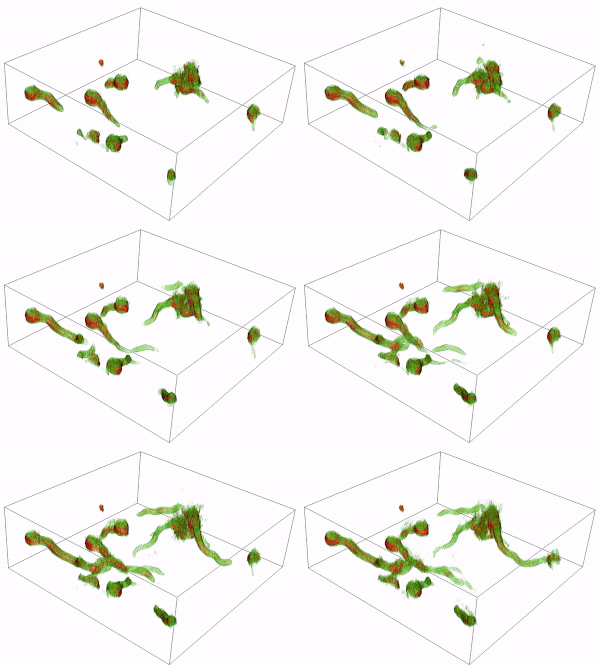
In seed plants, spores are produced internally. Megaspores form inside ovules, and microspores are involved in creating pollen grains and seeds—complex dispersal units. Myxozoan spores release amoeboid infectious germs (called "amoebulae") into hosts for parasitic infection. Inside the host, the amoebula develops into a plasmodium, where two nuclei pair up to reproduce.
- first_appearance
- Silurian period (vascular plant spores); earlier cryptospores from Ordovician
Lore & Background
The term spore derives from Greek σπορά (spora), meaning 'seed, sowing'. In common parlance, a spore germinates into a sporeling, while a gamete must combine with another to form a zygote. Spores are often unicellular and are the first cell of a gametophyte, though some fungal spores (e.g., conidia) can be multicellular. Seeds contain a developing embryo. Spores germinate to give rise to haploid gametophytes; seeds germinate to give rise to diploid sporophytes. In plants, spores are usually haploid and unicellular, produced by meiosis in the sporangium of a diploid sporophyte. Under favourable conditions, the spore develops into a multicellular gametophyte via mitotic division, which produces gametes; two gametes fuse to form a zygote that develops into a new sporophyte—a cycle known as alternation of generations. Vascular plant spores are always haploid; plants are either homosporous (same size and type) or heterosporous (two sizes: megaspores and microspores). Fungi commonly produce spores during both sexual and asexual reproduction. Spores are usually haploid and grow into mature haploid individuals through mitotic division. Dikaryotic cells result from fusion of two haploid gamete cells; karyogamy then produces a diploid cell, which undergoes meiosis to produce haploid spores. Bacterial spores are not part of a sexual cycle but are resistant structures for survival under unfavourable conditions.
Reader's Guide
Spores are significant as a fundamental reproductive and dispersal strategy across diverse kingdoms—plants, algae, fungi, and protozoa—and are considered an early adaptation of land plants. Their appearance in the fossil record during the mid-late Ordovician provides key evidence for the colonization of land, as cryptospores are well preserved and abundant, aiding paleontology and plant phylogenetics. Spores' unicellular nature and minimal energy cost allow vast dispersal, though they lack food reserves and are more vulnerable to fungal and bacterial predation than seeds. The distinction between homospory and heterospory, and between spores and seeds, underpins understanding of plant life cycles and evolution. In fungi, forcible ejection mechanisms such as Buller's drop enable long-distance dispersal, while other species use insects or mechanical forces. Spore morphology—including apertures like laesurae and colpi—helps classify major plant groups and trace evolutionary relationships. The study of spores thus bridges reproductive biology, ecology, paleontology, and evolutionary history.
Did You Know?
- The earliest widely accepted trilete spores from vascular plants date to the Silurian period, not the mid-late Ordovician.
- Bacterial spores are not part of a sexual cycle but are resistant structures used for survival under unfavourable conditions.
- In heterosporous plants, megaspores function as 'female' spores and microspores as 'male' spores.
Ancient Origins on a Young Land
The oldest proof that plants had taken root on dry land is not a fossilized stem or leaf but a cluster of microscopic reproductive units. Strikingly, no macrofossils have been recovered from that same geological window, leaving these tiny spores as the sole physical record of a world where land vegetation was still in its earliest experiments. By the Ordovician's close, individual trilete spores resembling those of modern cryptogamic plants appeared in the fossil record, hinting that the fundamental mechanics of spore formation had already locked into place. What began as a survival adaptation for unfavourable conditions would eventually underwrite the reproductive strategies of an extraordinary range of organisms, from the simplest algae to the most elaborate flowering plants.
The Alternation of Generations
In the plant kingdom, the spore sits at the hinge of a two-phase life cycle called alternation of generations. Within the sporangium of a diploid sporophyte, meiosis yields haploid, typically unicellular spores. Once conditions turn favourable, a single spore germinates and, through successive rounds of mitotic division, builds a multicellular gametophyte. That gametophyte in turn generates gametes, which must fuse to form a diploid zygote and restart the sporophyte generation. This stands in sharp contrast to a gamete, which cannot develop on its own and requires fusion with a partner before any further growth is possible. The distinction also separates spores from seeds: a spore is the very first cell of a gametophyte, whereas a seed already houses a developing multicellular embryo—the sporophyte of the next generation—produced by the union of male and female gametes within the ovule. In seed plants, megaspores and microspores are generated internally and go on to form the more complex dispersal structures we recognise as seeds and pollen grains.
Explosive Dispersal in the Fungal World
Few biological events match the sheer violence of fungal spore ejection. In many fungal species, both sexual and asexual spores are launched from their reproductive structures with remarkable force, ensuring they escape the parent body and travel through the air over considerable distances. In ascomycetes, the ascus accumulates osmolytes in its internal fluids; the resulting osmotic pressure builds until the ascospores are explosively discharged into the surrounding air. Another mechanism, seen in ballistospores, relies on a tiny droplet of water known as Buller's drop. Fungi also deploy surface proteins called hydrophobins to aid ejection, and some species, such as puffballs, depend instead on external mechanical forces to rupture their fruiting bodies and scatter spores into the environment.
Reading the Spore Wall
Under high magnification, spore walls reveal a vocabulary of lines, grooves, and apertures that taxonomists have turned into a precise classification language. Alete spores bear no lines at all. Monolete spores display a single narrow line, called a laesura, recording the prior contact of two spores that later separated. Trilete spores show three lines radiating from a central pole, the fossil signature of four spores that once shared a common origin in a tetrahedral arrangement. Wider groove-shaped apertures are termed colpi, and their number helps distinguish major plant groups; eudicots, for instance, carry tricolpate spores with exactly three colpi. Beyond surface ornamentation, spores are classified by their producing structure, their role in the life cycle, their origin, and their mobility. In vascular plants, this classification splits into homosporous species, which yield uniform spores, and heterosporous species—seed plants, spikemosses, quillworts, and certain ferns—that produce two distinct sizes: a larger megaspore that grows into a female gametophyte and a smaller microspore that becomes a male one, each arising from separate sporangia.
Gallery
More in Microbiology 1-24
Spotted an error? Know more?
This is a living reference — every entry is fact-audited, and reader corrections feed straight into our audit queue. Suggest an edit · See this site's audit record