
Cognitive bias
Systematic deviations from rational judgment in human decision-making.

BiblioMorphosis · CC BY 4.0
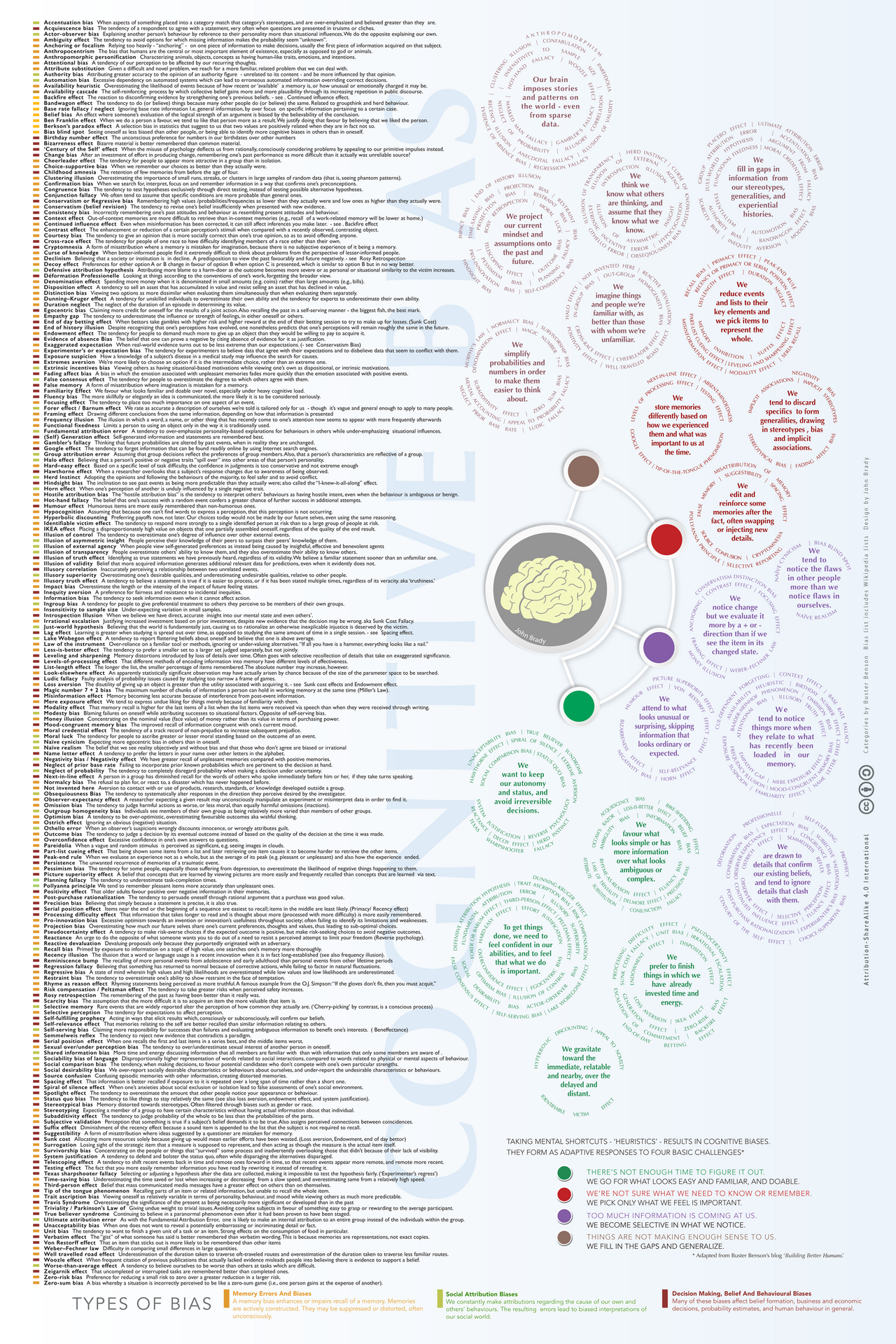
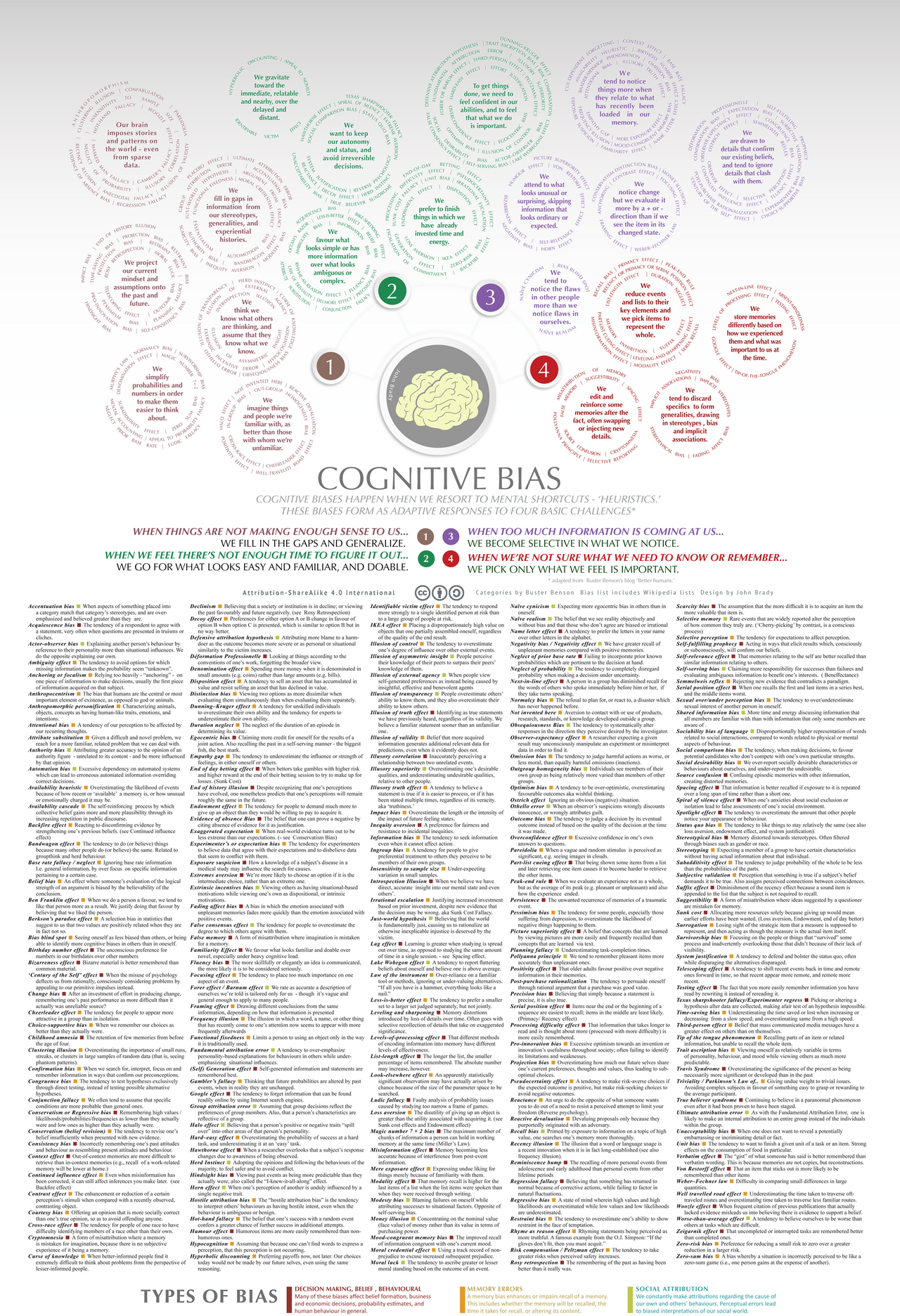
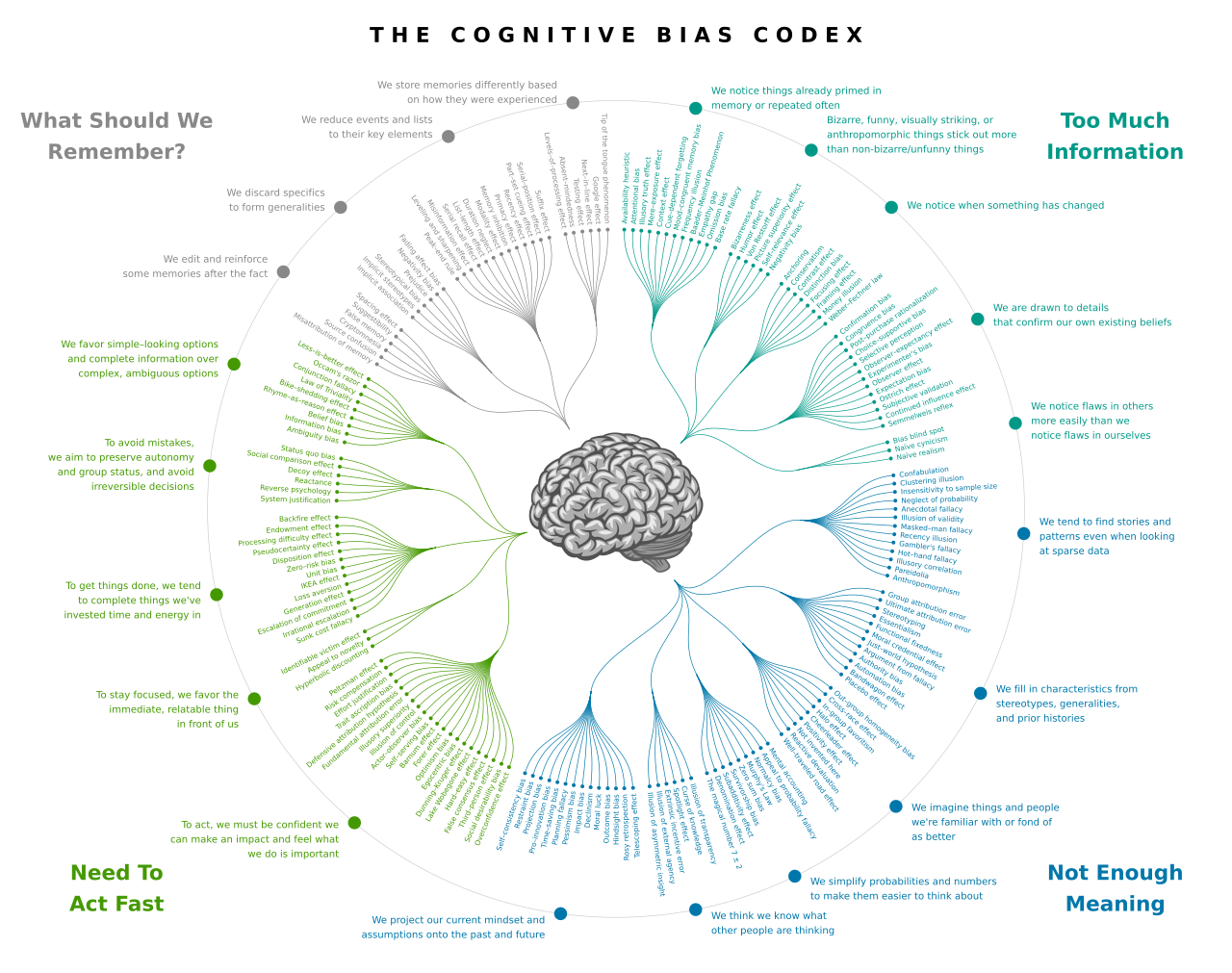
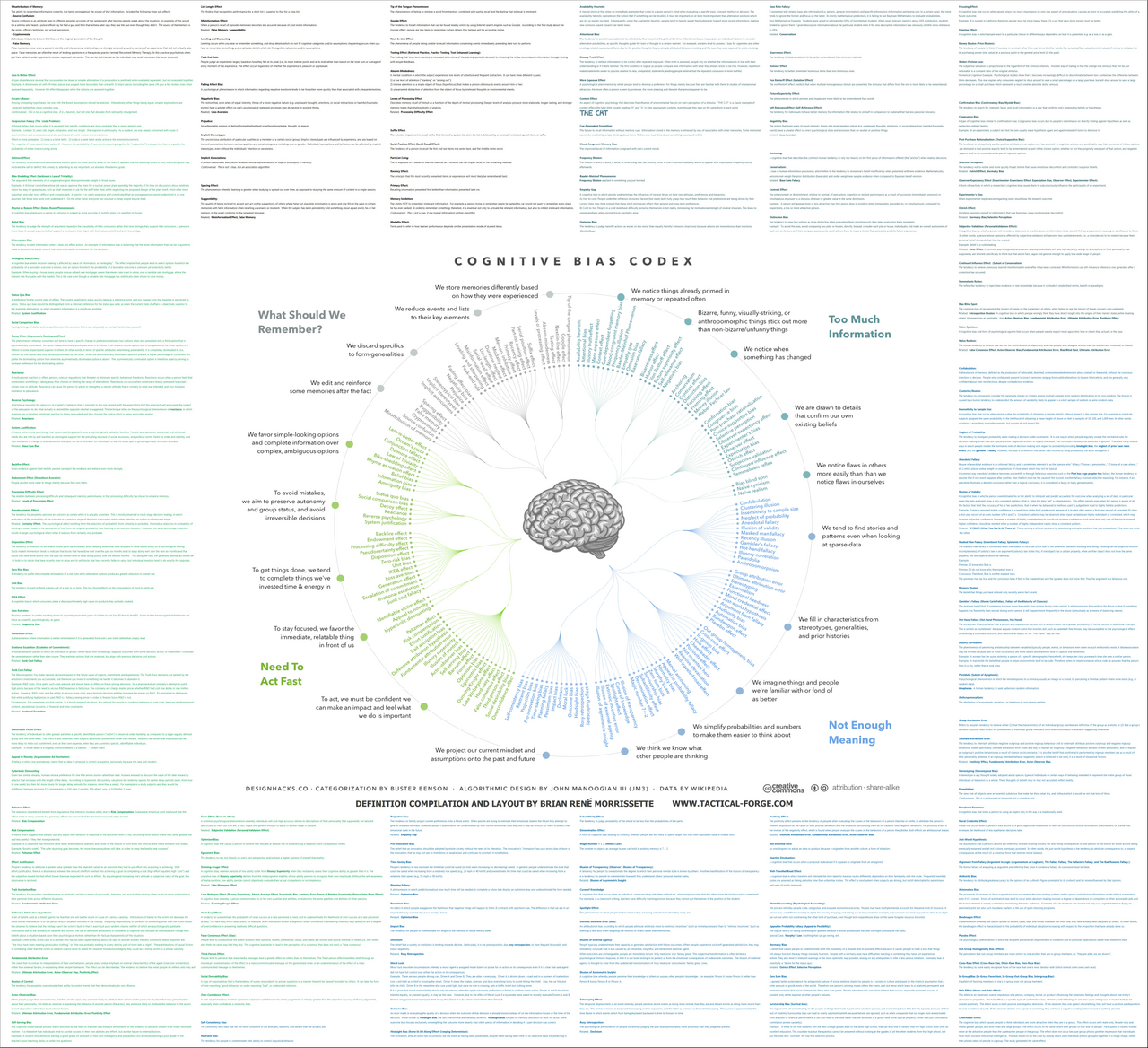
A cognitive bias is a systematic pattern of deviation from the norm or rationality in judgment. Individuals create their own subjective reality from their perception of input, and this construction, rather than objective input, may dictate behavior. Cognitive biases can lead to perceptual distortion, inaccurate judgment, illogical interpretation, and irrationality, though some are adaptive and may lead to more effective actions in certain contexts. While these biases may initially appear negative, they can enable faster decisions when timeliness is more valuable than accuracy, as illustrated by heuristics. Other biases arise as a by-product of human processing limitations, stemming from bounded rationality, embodied cognition, or limited information capacity. They can also make individuals more inclined to endorse pseudoscientific beliefs by requiring less evidence for claims that confirm preconceptions.
The concept was introduced by Amos Tversky and Daniel Kahneman in 1972, growing out of their experience with people’s difficulty reasoning intuitively with large magnitudes. Their 1974 paper outlined how people rely on mental shortcuts when making judgments under uncertainty. Experiments like the “Linda problem” demonstrated the conjunction fallacy, where respondents judged a more specific scenario as more likely because it seemed more representative of a given description. This research spread beyond psychology into medicine and political science. A subsequent “rationality war” unfolded between Gerd Gigerenzer and the Kahneman and Tversky school, debating whether biases are primarily defects or adaptive, ecologically rational behaviors. Gigerenzer argued that heuristics are rules of thumb that can help make accurate decisions, and that many behaviors labeled as biases might instead represent optimal strategies once the actual problems people face are understood. A middle ground, proposed by Martie Haselton and David Buss, acknowledges both the defect and adaptivity of biases, suggesting evolution favors a bias toward the least costly error. The study of cognitive biases has practical implications for clinical judgment, entrepreneurship, finance, and management.
- field
- Cognitive science, social psychology, behavioral economics
- known_for
- Systematic deviations from rationality in judgment and decision-making
- introduced_by
- Amos Tversky and Daniel Kahneman
- key_concepts
- Heuristics, conjunction fallacy, representativeness heuristic, availability heuristic, anchoring heuristic
- related_debate
- Rationality war between Gerd Gigerenzer and Kahneman/Tversky school
Lore & Background
A cognitive bias is a systematic pattern of deviation from norm or rationality in judgment, arising from how individuals construct their own subjective reality based on their perception of input rather than objective facts. This constructed reality, not the objective input, often dictates behavior, potentially leading to perceptual distortion, inaccurate judgment, illogical interpretation, and irrationality. However, some cognitive biases are adaptive, enabling more effective actions in certain contexts or allowing faster decisions when timeliness outweighs accuracy, as seen in heuristics. Others result from human processing limitations, such as bounded rationality, embodied cognition, or limited information-processing capacity. Biases can make individuals more inclined to endorse pseudoscientific beliefs by requiring less evidence for claims that confirm preconceptions. The concept was introduced by Amos Tversky and Daniel Kahneman, growing from their work on people's innumeracy and demonstrated through replicable ways judgments differ from rational choice theory. Their research on heuristics—mental shortcuts like representativeness, availability, and anchoring—showed how these efficient tools can introduce systematic errors. The "Linda problem" exemplifies the conjunction fallacy, where respondents incorrectly judged a more restrictive scenario as more likely because it seemed more representative. A debate persists between those viewing biases as cognitive defects and those like Gerd Gigerenzer, who argues they are adaptive rules of thumb or ecologically rational strategies, with some evidence suggesting many behaviors labeled as biases may represent optimal decision-making.
Reader's Guide
The study of cognitive biases has practical implications for clinical judgment, entrepreneurship, finance, and management. Many social institutions rely on individuals to make rational judgments, yet biases such as overconfidence, anchoring, and framing play substantial roles across these fields. Gerd Gigerenzer argues that heuristics should not lead us to conceive of human thinking as riddled with irrational cognitive biases, but rather as an adaptive tool. Advances in economics and cognitive neuroscience suggest that many behaviors previously labeled as biases might represent optimal decision-making strategies. A middle ground, put forward by Martie Haselton and David Buss, acknowledges both the defect and adaptivity of cognitive biases, with evolution favoring a bias toward the least costly error. Cognitive bias modification, introduced by Koster, Fox & MacLeod, focuses on reducing maladaptive cognitive patterns through computer-based attention training.
Did You Know?
- The 'Linda problem' illustrates the conjunction fallacy, where respondents chose a more restrictive option because it seemed more representative.
- Cognitive biases can make individuals more inclined to endorse pseudoscientific beliefs by requiring less evidence for claims that confirm their preconceptions.
- The list of cognitive biases has been identified over the last six decades of research in cognitive science, social psychology, and behavioral economics.
- Gerd Gigerenzer argues that cognitive biases are not biases but rules of thumb or 'gut feelings' that can help make accurate decisions.
Mental Shortcuts and the Linda Problem
When humans face uncertainty, they do not calculate probabilities from scratch. Instead, they lean on mental shortcuts—called heuristics—that let them arrive at quick estimates. The representativeness heuristic, for instance, leads people to judge how likely something is by how closely it matches a familiar archetype. The availability heuristic ties perceived likelihood to how easily an example springs to mind, while the anchoring heuristic causes initial reference points to disproportionately sway later estimates. These shortcuts are computationally cheap for the brain, yet they produce predictable, systematic errors. The classic Linda Problem captures this perfectly: participants told that Linda cares about discrimination and social justice were asked to choose between 'bank teller' and 'bank teller and active in the feminist movement.' A majority picked the second, more restrictive option, even though it is statistically less probable under any circumstances. This conjunction fallacy reveals how the representativeness heuristic can activate stereotypes and distort probability judgments, turning a simple logical comparison into a narrative-driven choice.
The Rationality War
The study of cognitive biases has been shaped by a fierce intellectual dispute often called the rationality war. On one side, Amos Tversky and Daniel Kahneman framed systematic judgment errors as genuine defects in human cognition—deviations from rational choice theory that experiments like the Linda Problem exposed. On the other side, Gerd Gigerenzer pushed back hard, arguing that what we label biases are often nothing more than rules of thumb or gut feelings that serve us well in the messy, time-pressured environments people actually inhabit. Gigerenzer contended that rationality should be understood as an adaptive tool rather than a set of formal logical or probability rules, and that once the real problems people face are properly understood, many of these behaviors look far less irrational. More recent work in economics and cognitive neuroscience has lent weight to this view, suggesting that behaviors once dismissed as biases may in fact be optimal decision-making strategies. A middle path proposed by Martie Haselton and David Buss acknowledges both the defect and the adaptivity, proposing that evolution favors the bias that minimizes the cost of being wrong.
Origins and Expansion of the Field
The concept of cognitive biases entered the academic conversation in 1972, when Amos Tversky and Daniel Kahneman began documenting what they called innumeracy—people's difficulty reasoning intuitively about large numbers and probabilities. Their landmark 1974 paper, Judgment under Uncertainty: Heuristics and Biases, laid out several replicable ways in which human judgment departs from the predictions of rational choice theory. Experiments like the Linda Problem became foundational, spawning entire research programs that quickly outgrew academic psychology. Within a few decades, the heuristics-and-biases framework had spread into medicine, political science, and beyond. Over the last six decades, a continually evolving catalogue of identified biases has accumulated across cognitive science, social psychology, and behavioral economics. The field now carries real-world weight, with practical implications for clinical judgment, entrepreneurship, finance, and management. Yet the very list of biases has long drawn criticism, with scholars questioning whether the emphasis on human error overshadows the adaptive value of the same mental patterns.
Adaptive Functions and Practical Applications
Although cognitive biases are often portrayed as flaws, a growing body of evidence suggests they can be genuinely useful. In contexts where speed matters more than precision, the quick estimates produced by heuristics allow people to act decisively without drowning in computation. Some biases also emerge as by-products of biological and cognitive constraints: bounded rationality limits the mental machinery available, embodied cognition ties judgment to an individual's physical and constitutional state, and finite information-processing capacity simply prevents exhaustive analysis. These constraints do not make the resulting judgments worthless; they make them efficient. On the downside, biases can lower the evidentiary bar for claims that confirm existing beliefs, nudging individuals toward pseudoscientific thinking and distorting perception. In response, researchers like Koster, Fox, and MacLeod introduced cognitive bias modification in 2009, a program that uses computer-based attention training and behavioral tasks to reduce maladaptive cognitive patterns. This practical turn underscores that understanding bias is not merely an academic exercise but a tool for improving judgment in medicine, business, and everyday life.
Gallery

Frequently Asked Questions
What exactly is a cognitive bias?
A cognitive bias is a consistent pattern in which a person's judgment systematically strays away from what would count as rational or norm-based reasoning. It arises because we construct our own subjective version of reality from sensory input, and that internally built picture—rather than the raw data—ends up steering our behavior.
Who introduced the concept of cognitive bias?
The framework was introduced by psychologists Amos Tversky and Daniel Kahneman. Their research identified specific heuristics such as anchoring, availability, and representativeness as the engines behind many of these systematic judgment errors.
What are Cognitive bias's 'powers' or key effects?
These biases can warp perception, produce inaccurate judgments, and drive illogical or outright irrational interpretations of events. That said, some biases are genuinely adaptive, enabling faster and more effective action in contexts where full deliberation would be too costly.
How does the 'story' of cognitive bias end, or where does the debate stand?
The field is still shaped by the so-called rationality war between Gerd Gigerenzer and the Kahneman-Tversky school. Gigerenzer contends many labeled 'biases' are actually smart ecological shortcuts, while the other camp treats them as genuine departures from sound reasoning.
Why is cognitive bias important to understand?
Because the concept threads through cognitive science, social psychology, and behavioral economics, grasping these predictable deviations helps explain why people consistently fall into the same judgment traps. Recognizing them is a practical first step toward more deliberate, less distorted decision-making.
More in Mental Health & Psychology 1-20
Spotted an error? Know more?
This is a living reference — every entry is fact-audited, and reader corrections feed straight into our audit queue. Suggest an edit · See this site's audit record