
Cognitive behavioral therapy
Psychotherapy combining cognitive and behavioral principles.

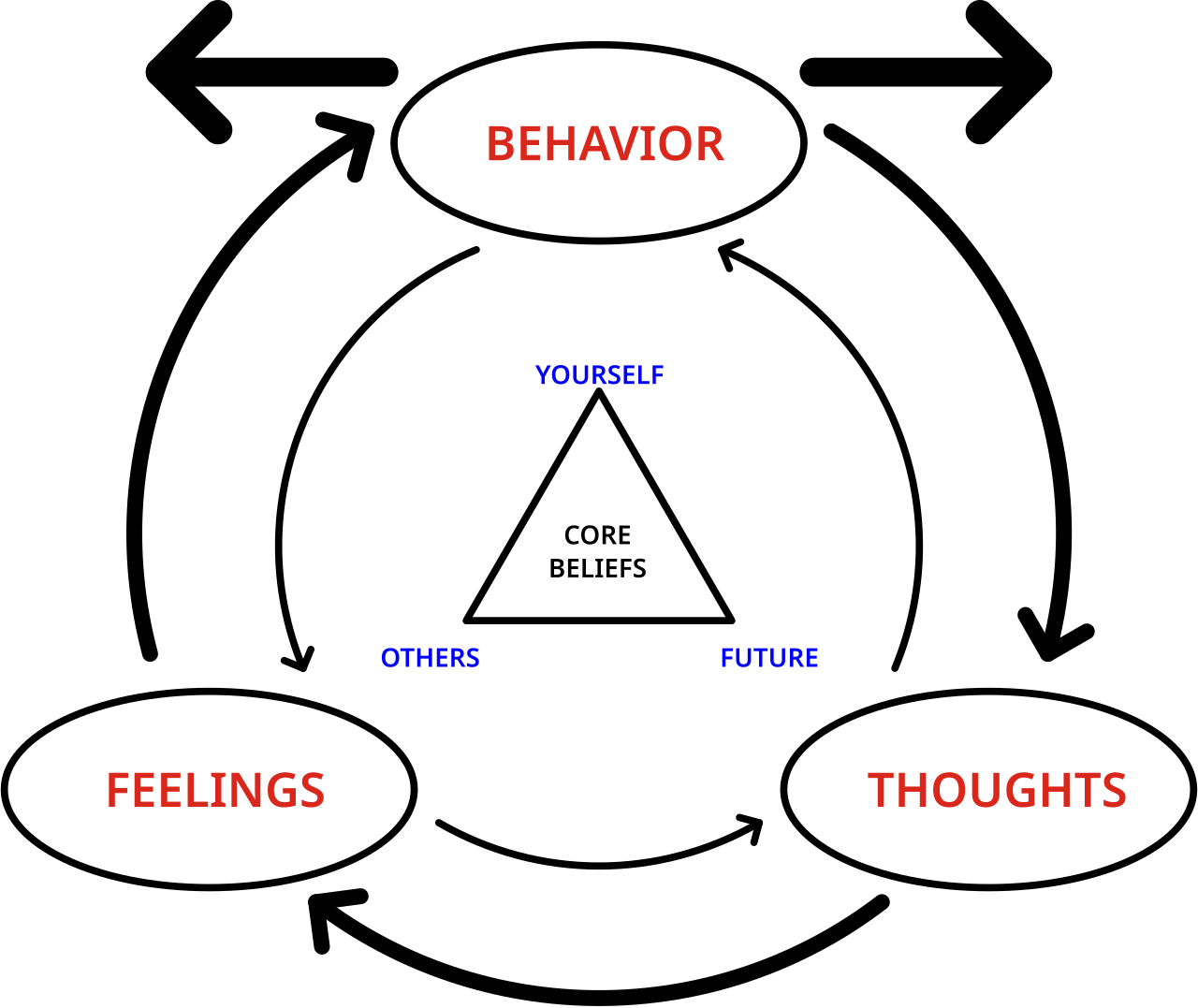
Urstadt · CC BY-SA 3.0
Cognitive behavioral therapy (CBT) is a type of psychotherapy that blends core ideas from cognitive psychology and behaviorism. Its goal is to ease symptoms of mental health conditions by questioning and changing a person’s core beliefs and assumptions, while also teaching them new, more helpful behaviors through practice and training. Though its philosophical roots can be traced back to ancient Stoicism, CBT developed in three distinct waves over the 1900s. Over time, the term came to cover a wide range of psychotherapies that focus on cognition.
The first wave began with behaviorism in the 1920s and led to behavioral therapy in the 1950s and 1960s. The second wave shifted attention to the role of thoughts in therapy, which resulted in Aaron Beck developing cognitive therapy in the 1950s and the creation of classic CBT when cognitive and behavioral methods were merged. The third wave arrived in the 1980s and 1990s, when ideas from Buddhism—especially mindfulness and acceptance—helped shape several new forms of CBT.
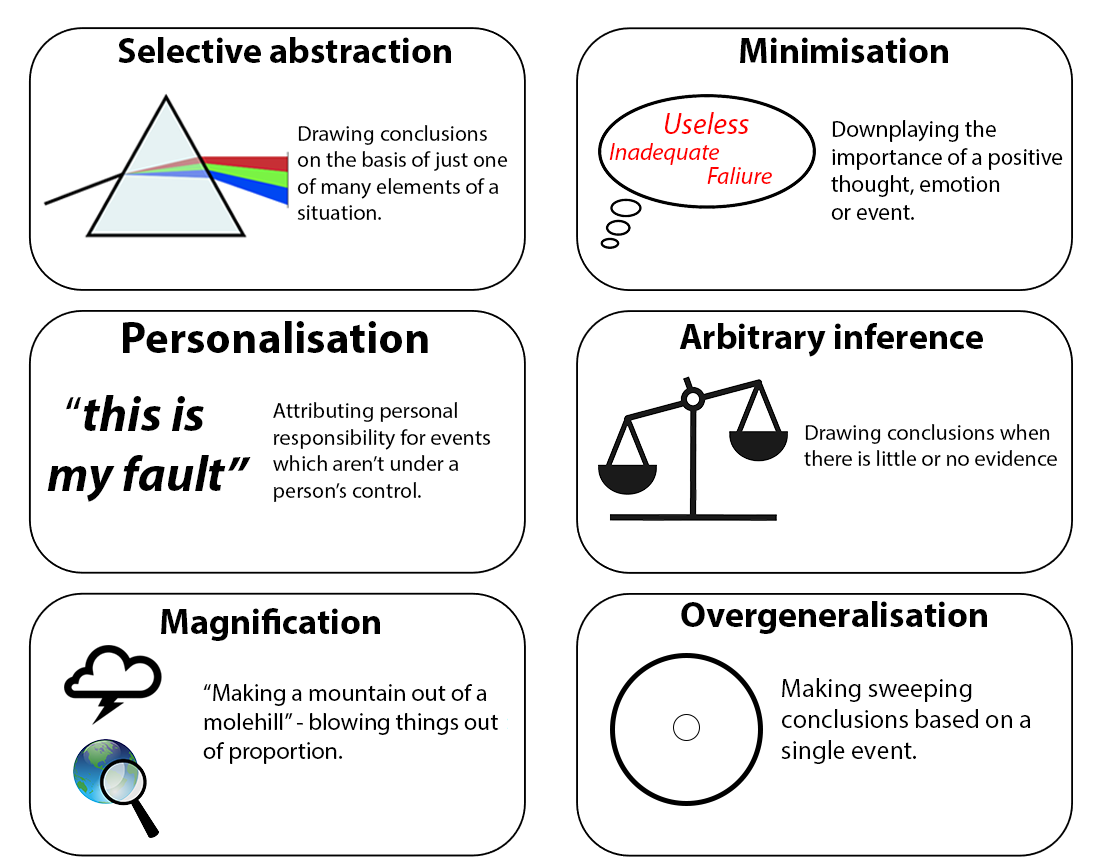
CBT is described as "problem-focused" and "action-oriented." The therapist helps the client find and practice effective cognitive and behavioral strategies to overcome specific obstacles and reduce symptoms. The approach is built on the idea that distorted thinking and unhelpful behaviors contribute to the development and persistence of many psychological disorders. Therapy works by challenging and changing these distortions—thoughts, beliefs, and attitudes—and the behaviors tied to them, aiming to improve emotional regulation and build coping skills.
CBT includes many specific therapies that treat defined mental health conditions using evidence-based methods. Examples include rational emotive behavior therapy, cognitive therapy, metacognitive therapy, metacognitive training, reality therapy/choice theory, cognitive processing therapy, eye movement desensitization and reprocessing (EMDR), and multimodal therapy. Mindfulness-influenced forms include dialectical behavior therapy, mindfulness-based cognitive therapy, acceptance and commitment therapy, and compassion-focused therapy.
Originally developed for depression, CBT is now used as an evidence-informed treatment for many mental health and medical conditions, such as obsessive-compulsive disorder, generalized anxiety disorder, substance use disorders, marital problems, attention deficit hyperactivity disorder, and eating disorders. Along with interpersonal psychotherapy (IPT), CBT is often recommended in treatment guidelines as a top psychosocial option. It is endorsed by the American Psychiatric Association, the American Psychological Association, and the British National Health Service. For children and adolescents, CBT is recommended as the first-line treatment for most psychological disorders, including aggression and conduct disorder.
Critics point out that CBT lacks double-blind tested research, has relatively high dropout rates, and tends to focus on symptoms rather than the underlying condition.
The modern roots of CBT go back to behavior therapy in the early 1900s, cognitive therapy in the late 1950s to early 1960s, and the later combination of the two. Philosophical forerunners include Stoicism—Aaron Beck’s original manual for treating depression noted that cognitive therapy’s philosophical origins lie with the Stoics. Albert Ellis was influenced by the Stoic philosopher Epictetus. John Stuart Mill also contributed through his creation of Associationism, which preceded classical conditioning and behavioral theory.
In the first wave, John B. Watson and Rosalie Rayner’s conditioning studies in 1920 were groundbreaking. Mary Cover Jones’ 1924 work on unlearning fears in children was an early behavioral therapy. These led to Joseph Wolpe’s behavioral therapy in the 1950s, which drew on Ivan Pavlov’s work on learning and conditioning. Wolpe and Watson influenced Hans Eysenck and Arnold Lazarus to develop new techniques based on classical conditioning. During the 1950s and 1960s, behavioral therapy became widely used by researchers in the United States, the United Kingdom, and South Africa, inspired by the behaviorist learning theories of Pavlov, Watson, and Clark L. Hull. In Britain, Wolpe applied animal experiments to systematic desensitization, a precursor to modern fear reduction techniques. Hans Eysenck presented behavior therapy as a constructive alternative. At the same time, B. F. Skinner and his associates worked on operant conditioning, though Skinner’s radical behaviorism avoided cognition. Julian Rotter in 1954 and Albert Bandura in 1969 contributed social learning theory, showing how cognition affects learning and behavior change. Claire Weekes also did work on anxiety disorders.
- field
- Psychotherapy
- known_for
- Combining cognitive and behavioral approaches to treat mental health conditions
- developed_in
- 20th century, with roots in behaviorism (1920s) and cognitive therapy (1950s)
Lore & Background
The modern roots of CBT trace to behavior therapy in the early 20th century, cognitive therapy in the late 1950s to early 1960s, and their subsequent merging. The first wave began with behaviorism in the 1920s and behavioral therapy in the 1950s–1960s, influenced by Ivan Pavlov, John B. Watson, and B. F. Skinner. The second wave emphasized cognitions, leading to Aaron Beck's cognitive therapy in the 1950s and the establishment of classical CBT. The third wave in the 1980s–1990s incorporated principles from Buddhism, especially mindfulness and acceptance, into new forms such as dialectical behavior therapy and acceptance and commitment therapy.
Reader's Guide
CBT is a problem-focused, action-oriented therapy that challenges cognitive distortions and maladaptive behaviors to improve emotional regulation and coping strategies. Originally designed to treat depression, it is now prescribed for many conditions including obsessive–compulsive disorder, generalized anxiety disorder, substance use disorders, and eating disorders. It is recommended by the American Psychiatric Association, the American Psychological Association, and the British National Health Service as a psychosocial treatment of choice. Criticism includes lack of double-blind tested research, relatively high drop-out rates, and a tendency to target symptoms rather than underlying conditions.
Did You Know?
- CBT has philosophical precursors in Stoicism, with Aaron Beck's treatment manual stating that the philosophical origins of cognitive therapy trace back to the Stoic philosophers.
- The third wave of CBT, in the 1980s and 1990s, incorporated principles from Buddhism, especially mindfulness and acceptance.
- CBT is recommended as the first line of treatment for the majority of psychological disorders in children and adolescents, including aggression and conduct disorder.
- Aaron Beck, who developed cognitive therapy in the 1950s, has been referred to as 'the father of cognitive behavioral therapy'.
The Three-Wave Evolution of CBT
Cognitive behavioral therapy did not emerge overnight. Its modern form crystallized through three distinct waves of development across the twentieth century. The first wave, rooted in behaviorism, took shape in the 1920s and matured into behavioral therapy during the 1950s and 1960s, drawing heavily on the conditioning research of Pavlov, Watson, and Hull. The second wave shifted attention inward, emphasizing the role of cognitions in the therapeutic process. Psychoanalyst Aaron Beck's cognitive therapy, developed in the 1950s, became the cornerstone of this shift, and its eventual merger with behavioral methods produced what we now recognize as classical CBT. The third wave, unfolding through the 1980s and 1990s, wove in principles from Buddhist traditions—particularly mindfulness and acceptance—giving rise to an expanded family of therapies. Over time, CBT evolved from a specific technique into a broad umbrella term encompassing virtually every cognitive-based psychotherapy in clinical practice.
Philosophical Roots and Pioneering Minds
Long before modern clinics existed, ancient Stoic philosophers were articulating ideas that would later underpin CBT. Aaron Beck himself acknowledged in his original depression treatment manual that the philosophical origins of cognitive therapy trace back to Stoicism, while Epictetus's writings left a clear imprint on Albert Ellis. John Stuart Mill's Associationism also served as a conceptual bridge toward classical conditioning and behavioral theory. In the clinical arena, John B. Watson and Rosalie Rayner's conditioning studies of 1920 opened the door, and Mary Cover Jones followed in 1924 with pioneering work on unlearning childhood fears. Joseph Wolpe then translated animal-experiment findings into systematic desensitization during the 1950s, laying groundwork for today's fear-reduction techniques. Hans Eysenck and Arnold Lazarus built further on Pavlovian learning, while B. F. Skinner's radical behaviorism and the social learning contributions of Julian Rotter and Albert Bandura each added layers. Alfred Adler's concept of basic mistakes and Abraham Low's focus on thought change also fed into the emerging cognitive framework.
A Problem-Focused Toolkit for the Mind
CBT is deliberately structured as a problem-focused, action-oriented form of psychotherapy. Rather than dwelling on past narratives, the therapist guides the client to identify specific obstacles and then practice concrete cognitive and behavioral strategies to alleviate symptoms. The underlying assumption is that thought distortions and maladaptive behaviors both contribute to the development and persistence of psychological disorders; by challenging and reshaping these patterns, the individual can improve emotional regulation and build practical coping skills. The CBT family is remarkably diverse. It encompasses rational emotive behavior therapy, metacognitive therapy, reality or choice theory, cognitive processing therapy, EMDR, and multimodal therapy, among others. The mindfulness-influenced third wave added dialectical behavior therapy, mindfulness-based cognitive therapy, acceptance and commitment therapy, and compassion-focused therapy. Though originally designed for depression, CBT is now prescribed for obsessive-compulsive disorder, generalized anxiety, substance use disorders, marital difficulties, ADHD, and eating disorders, making it one of the most broadly applied psychotherapeutic approaches in modern medicine.
Institutional Endorsement and Ongoing Debate
CBT enjoys a level of institutional backing that few psychotherapies can match. The American Psychiatric Association, the American Psychological Association, and the British National Health Service all recommend it as a treatment of choice. Alongside interpersonal psychotherapy, it appears in official treatment guidelines as a preferred psychosocial intervention. For children and adolescents, CBT is specifically recommended as the first-line treatment for the majority of psychological disorders, including aggression and conduct disorder. Yet the therapy is not without its critics. Skeptics have pointed to a relative scarcity of double-blind controlled research, relatively high patient drop-out rates, and a tendency to target surface-level symptoms rather than addressing whatever underlying condition may be generating them. These criticisms do not negate the therapy's widespread clinical utility, but they do underscore that CBT remains a living, evolving field in which methodological rigor and patient-centered outcomes continue to be actively debated.
Gallery



Frequently Asked Questions
Who is Cognitive Behavioral Therapy?
CBT is a psychotherapy approach that fuses the thinking-focused tools of cognitive psychology with the action-focused tools of behaviorism. It serves as an umbrella term for a whole family of cognitive-based therapeutic methods.
What are CBT's powers/role?
Its core ability is to help a person identify and restructure rigid beliefs and assumptions while simultaneously teaching more adaptive behavioral patterns. In practice, it targets the symptoms of a wide range of mental-health conditions rather than a single diagnosis.
How does CBT's story end?
The intended resolution is a measurable reduction in a patient's mental-health symptoms through cognitive reframing paired with new behavioral skills. Sessions are typically structured and time-limited, aiming for practical improvement rather than open-ended exploration.
Why is CBT important?
It became the dominant evidence-based framework in modern psychotherapy because it unites two major schools of thought into one workable treatment model. Its structured, goal-oriented format made it one of the most widely researched and clinically applied therapies of the 20th century.
When was CBT born?
Its roots stretch back to behaviorist work in the 1920s and the emergence of cognitive therapy in the 1950s. The label "CBT" itself crystallized as an umbrella term after three successive waves of development across the 20th century.
More in Mental Health & Psychology 1-20
Spotted an error? Know more?
This is a living reference — every entry is fact-audited, and reader corrections feed straight into our audit queue. Suggest an edit · See this site's audit record