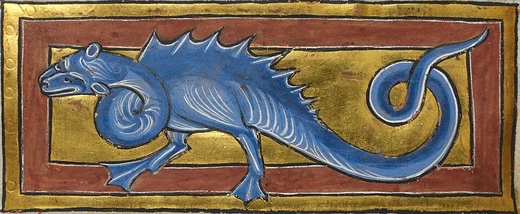
Hircocervus
A half-goat, half-stag creature used in philosophy and literature.
The hircocervus, also called the tragelaph or goat-stag, is a legendary creature imagined as a hybrid of a goat and a stag. It is notable for its use in ancient and medieval philosophy as an example of a non-existent but definable entity.
Quick Facts
- Alternate names
- tragelaph, goat-stag
- Etymology
- Latin hircus (billy goat) + cervus (stag); Greek tragos (billy goat) + elaphos (stag)
- First english appearance
- 1398 manuscript at the Bodleian Library
- Used by
- Plato
- Aristotle
- Boethius
- Diodorus Siculus
- Martin Luther
- Umberto Eco
- Italo Calvino
- Antonio Gramsci
Facts from the source article.
Origins
In Plato's Republic, Socrates compares his own image-making to painters who create goat-stags by combining features of different things. Aristotle, in De Interpretatione, used the fabulous goat-stag to illustrate that something can be describable even though it does not exist; his Greek term τραγέλαφος was rendered into Latin as hircocervus by Boethius. Aristotle later argued in the Posterior Analytics that while the word is definable, the species has no members and thus no definition. He also paired the tragelaphos with the Sphinx in the Physics to show that a non-existent creature has no spatial location. Diodorus Siculus, however, treated the tragelaphos as an existing animal, and Greek literature references other hybrids such as the hippelaphos.
In culture
Rabbinic literature discusses an animal called a koy, halfway between domesticated and wild quadrupeds, debating its legal status; scholars disagree whether the rabbis considered it real or a hypothetical example. Martin Luther used the term tragelaphus in his Theses Against the Antinomians to describe a law that only instructs without condemning, which he claimed does not actually exist. The Trusty Servant, a painting at Winchester College, was described as a hircocervus by Arthur Cleveland Coxe, though it contains parts of a man, a hog, and a donkey, not a goat. Umberto Eco's novel The Island of the Day Before and Italo Calvino's Invisible Cities both reference a hircocervus. Antonio Gramsci used the term to describe parliamentary alliances between socialist parties and pro-capitalist parties, calling such a union a historical monster devoid of will or particular aims.
More in Medieval European Legendary Creatures
Spotted an error? Know more?
Reader corrections go straight into our review queue. Suggest an edit · How this site is sourced