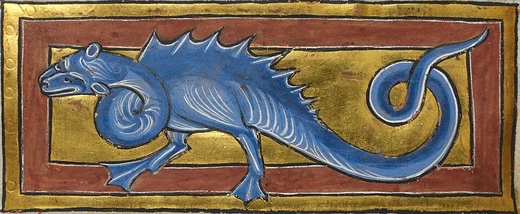
Bestiary
Medieval compendium of beasts with Christian moral lessons.
A bestiary is a collection of descriptions of animals, both real and imaginary, accompanied by stories and morals.[1] The word bestiary comes from the Latin “bestiarium,” meaning collection of beasts.[1] God's manifestation in every worldly element was a core belief for medieval Christians, and bestiaries placed primary emphasis on the religious significance of each creature.[2]
Quick Facts
- Origin
- 2nd-century Greek volume Physiologus
- Period of popularity
- Middle Ages (about 500–1500)
- Primary regions
- England and France
- Notable example
- Aberdeen Bestiary
- Key christian authors
- Saint Isidore of Seville, Saint Ambrose
Facts from the source article.
What happened
The earliest bestiary in its popularized form was an anonymous 2nd-century Greek volume called the Physiologus, which summarized ancient knowledge from authors such as Aristotle and Pliny the Elder.[2] During the Middle Ages, roughly spanning 500 to 1500, illuminated texts known as bestiaries enjoyed great popularity across northern Europe.[2] Compilers of bestiaries frequently assembled their material by merging earlier written sources and animal descriptions, including those from the Physiologus.[3] Alongside often biologically inaccurate physical traits, the Christian moral lessons each beast symbolized were included in the descriptions.[4]
No differentiation was made in the texts between creatures that actually existed and those that were imaginary.[5] During the medieval period, bestiaries supplied both subject matter for heraldic charges and stylistic inspiration for early heraldry.[6] Complete bestiary cycles appear in two illuminated Psalters: the Queen Mary Psalter and the Isabella Psalter.[7] Leonardo da Vinci, the Italian artist, created a bestiary of his own.[8]
What the cited sources add
The Siloe Arte y Bibliofilia account notes that the Westminster Abbey Bestiary originated in the 13th century and is a compendium of creatures both real and mythical.[1] The same source states that the Bestiary of Don Juan of Austria is notable for its unique content and reflects how animals were perceived and their symbolism.[1] The Aberdeen Bestiary adds that the hunger of the pelican signifies that the life of a hermit is modeled on the pelican, in that he lives on bread but does not seek to fill his stomach.[9] Some scholars, such as Pamela Gravestock, have written on the theory that medieval people focused on the importance of Christian morals these creatures represented, regardless of whether the animal existed.[10]
According to historian of science David C. Lindberg, medieval bestiaries served to instruct through morality and provide amusement via symbolism and allegory, not to transmit natural-world knowledge.[10] Both laypeople and members of religious orders such as monks and clerics made up the readership of bestiaries.[11]
References
- "Meaning and Relevance of Bestiaries - Siloe Arte y Bibliofilia", 2025-05-28. facts only, no text reused. siloe.es
- Wikipedia, "Bestiary" (CC BY-SA 4.0), which cites: James, "The Bestiary", History, 1931, p. 1–11 (original not read by us) en.wikipedia.org
- Wikipedia, "Bestiary" (CC BY-SA 4.0), which cites: Clark, "Beasts and Birds of the Middle Ages. The Bestiary and Its Legacy", Nation Books, 2005, p. 2–4 (original not read by us) en.wikipedia.org
- Wikipedia, "Bestiary" (CC BY-SA 4.0), which cites: "British Library", www.bl.uk (original not read by us) en.wikipedia.org
- Wikipedia, "Bestiary" (CC BY-SA 4.0), which cites: Henderson, "Medieval Beasts and Modern Cages: The Making of Meaning in Fables and Bestiaries", Publications of the Modern Language Association of America, January 1982, p. 40–49 (original not read by us) en.wikipedia.org
- Wikipedia, "Bestiary" (CC BY-SA 4.0), which cites: "A New Dictionary of Heraldry", Alphabooks/A&C Black, 1987, p. 342 (we also read that source) en.wikipedia.org
- Wikipedia, "Bestiary" (CC BY-SA 4.0), which cites: Stanton, "The Queen Mary Psalter: A Study of Affect and Audience", American Philosophical Society, 2001, p. 44ff (we also read that source) en.wikipedia.org
- Wikipedia, "Bestiary" (CC BY-SA 4.0), which cites: Cohen, "Animal Imagery in Renaissance Art", Renaissance Quarterly, 2014, p. 164–180; Evans, "Selections from the Bestiary of Leonardo da Vinci", The Journal of American Folklore, Oct–Dec 1951, p. 393–396 (original not read by us) en.wikipedia.org
- "Medieval Bestiary : Beasts : Pelican", bestiary.ca. facts only, no text reused. bestiary.ca
- Wikipedia, "Bestiary" (CC BY-SA 4.0), which cites: Lindberg, "The Beginnings of Western Science", University of Chicago Press, 1992, p. 354-356 (we also read that source) en.wikipedia.org
- Wikipedia, "Bestiary" (CC BY-SA 4.0), which cites: "Meaning and Relevance of Bestiaries - Siloe Arte y Bibliofilia", 2025-05-28; "Medieval Bestiary : Beasts : Pelican", bestiary.ca (we also read that source) en.wikipedia.org
Each numbered sentence above was checked against the source it cites before publication. Sentences citing Wikipedia adapt text from the English Wikipedia article Bestiary (contributors), used under CC BY-SA 4.0; this entry is available under the same licence. Other sources were used for facts only; no text or images are copied from them.
More in Medieval European Legendary Creatures
Spotted an error? Know more?
Reader corrections go straight into our review queue. Suggest an edit · How this site is sourced