Library of Congress
Oldest federal cultural institution and de facto national library of the United States.

Library of Congress Life · CC0
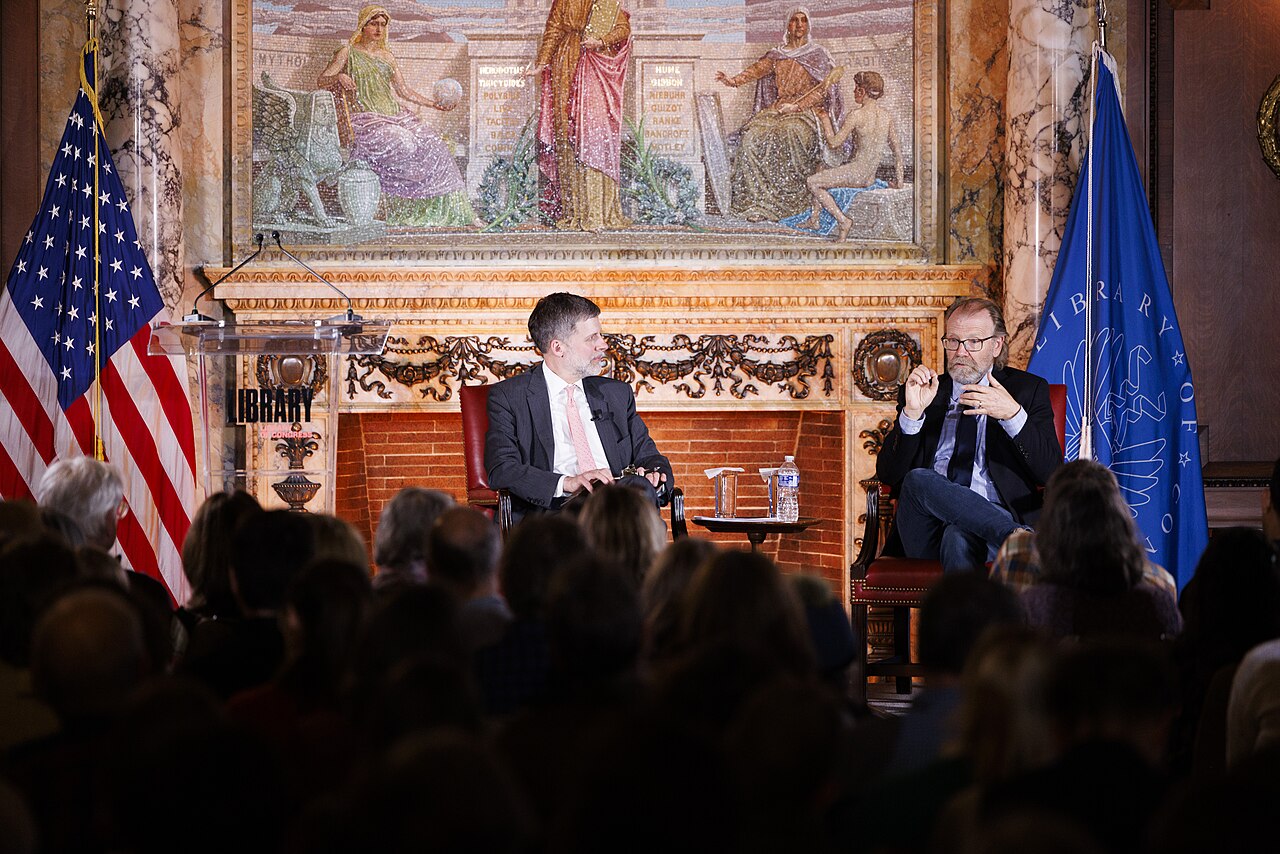
The Library of Congress (LOC) is a research library located in Washington, D.C. It functions as the library and research service for the United States Congress and effectively serves as the country's national library. The library also oversees copyright law through the United States Copyright Office and houses the Congressional Research Service.
Established in 1800, the LOC is the oldest federal cultural institution in the United States. Its main operations are spread across three buildings on Capitol Hill, next to the U.S. Capitol, with additional facilities including the National Audio-Visual Conservation Center in Culpeper, Virginia, and storage sites at Fort George G. Meade and Cabin Branch in Hyattsville, Maryland. The librarian of Congress oversees the library’s functions, while the architect of the Capitol maintains its buildings. One of the world’s largest libraries, it holds roughly 173 million items and employs more than 3,000 staff. Its collections are described as "universal, not limited by subject, format, or national boundary, and include research materials from all parts of the world and in more than 470 languages."
When Congress relocated to Washington in November 1800, a small congressional library was set up inside the Capitol. Most of this original collection was lost in 1814 when British forces burned Washington during the War of 1812. To rebuild, Congress accepted former president Thomas Jefferson’s offer to sell his entire personal library of 6,487 books. The collection grew slowly, but another major fire in 1851 destroyed two-thirds of Jefferson’s original books.
The library struggled with space shortages, understaffing, and insufficient funding until the American Civil War made legislative research more critical for a growing federal government. In 1870, the LOC gained the right to receive two copies of every copyrightable work printed in the United States, and it also expanded through acquisitions and donations. Between 1890 and 1897, a new building—now the Thomas Jefferson Building—was constructed. Two more buildings followed: the John Adams Building (opened in 1939) and the James Madison Memorial Building (opened in 1980).
The LOC’s Congressional Research Service offers objective, non-partisan research to Congress to aid in lawmaking. The library is open to the public for research, but only members of Congress, their staff, and library employees can borrow materials for use outside the library.
**History**
**1800–1851: Origin and Jefferson's contribution**
In 1783, James Madison, a Founding Father and later the nation’s fourth president, proposed creating a congressional library but could not gather enough support. After the American Revolutionary War, the Philadelphia Library Company and New York Society Library served as substitute congressional libraries when Congress met in those cities.
On April 24, 1800, the Library of Congress was established when President John Adams signed an act of Congress that allocated $5,000 "for the purchase of such books as may be necessary for the use of Congress...and for fitting up a suitable apartment for containing them." Books were ordered from London, resulting in a collection of 740 books and three maps housed in the new U.S. Capitol.
Adams’ successor, Thomas Jefferson, also shaped the library’s development. On January 26, 1802, Jefferson signed a bill that allowed the president to appoint the librarian of Congress and created a Joint Committee on the Library to oversee it. The law also extended borrowing privileges to the president and vice president.
In August 1814, British forces occupied Washington and, in retaliation for American acts in Canada, burned several federal buildings, including the Library of Congress. Over 3,000 volumes were destroyed. These volumes were kept in the Senate wing of the Capitol; one surviving volume was a government account book from 1810, taken by British Admiral George Cockburn as a souvenir and returned to the U.S. in 1940 by his family.
Within a month, Jefferson offered to sell his large personal library as a replacement. He had rebuilt his own collection after losing part of it to a fire. Congress accepted the offer in January 1815, appropriating $23,950 to purchase his 6,487 books. Some House members, including New Hampshire representative Daniel Webster, opposed the purchase, wanting to exclude "books of an atheistical, irreligious, and immoral tendency."
Jefferson’s collection, gathered over 50 years, covered many subjects and languages, including topics not usually found in a legislative library. He believed all subjects belonged in the Library of Congress, stating: "I do not know that it contains any branch of science which Congress would wish to exclude from their collection; there is, in fact, no subject to which a Member of Congress may not have occasion to refer."
Jefferson’s library was a working collection for a scholar, not for display. It doubled the size of the original library, transforming it from a specialist’s library into a more general one. He organized his books based on Francis Bacon’s classification of knowledge, grouping them into Memory, Reason, and Imagination with 44 subdivisions. The library used this system until the late 19th century, when librarian Herbert Putnam introduced the Library of Congress Classification, now applied to over 138 million items.
A February 24, 1824, report from the Committee of Ways and Means recommended a $5,000 appropriation for the Library of Congress, noting the need to improve its collections in "Law, Politics, Commerce, History, and Geography," which were crucial for Congress.
**1851–1865: Weakening**
On December 2...
- location
- Washington, D.C., with facilities in Virginia and Maryland
- type
- Research library and de facto national library
- key_functions
- Administers copyright law through the United States Copyright Office; houses the Congressional Research Service
Lore & Background
The Library of Congress is housed in three main buildings on Capitol Hill in Washington, D.C., adjacent to the U.S. Capitol: the Thomas Jefferson Building, the John Adams Building, and the James Madison Memorial Building. Additional facilities include the National Audio-Visual Conservation Center in Culpeper, Virginia, and storage sites at Fort George G. Meade and Cabin Branch in Hyattsville, Maryland. Its collections are universal, encompassing materials from all parts of the world in more than 470 languages, and are not limited by subject, format, or national boundary. The library holds approximately 173 million items and employs over 3,000 staff. It functions as the research service for Congress and administers copyright law through the United States Copyright Office. The Congressional Research Service provides objective, non-partisan research to assist Congress in legislation. The library is open to the public for research, but only members of Congress, their staff, and library employees may borrow materials for off-site use. Its defining characteristic is its origin as a small congressional library in the Capitol in 1800, which was largely destroyed in the 1814 burning of Washington. It was rebuilt by purchasing Thomas Jefferson’s personal collection of 6,487 books, which doubled the library’s size and shifted its scope from a specialist collection to a general one. A second major fire in 1851 destroyed two-thirds of Jefferson’s original books. The library gained the right in 1870 to receive two copies of every copyrightable work printed in the United States, and it also builds its collections through acquisitions and donations.
Reader's Guide
The Library of Congress is significant as the oldest federal cultural institution in the United States and serves as both the research arm of Congress and the de facto national library. Its collections are universal, covering all subjects and formats, and it administers copyright law through the United States Copyright Office. The library's Congressional Research Service provides objective non-partisan research to Congress. The library is open to the public for research, though only members of Congress, their staff, and library employees may borrow materials for use outside the library. Meade and Cabin Branch in Hyattsville, Maryland. The library's functions are overseen by the librarian of Congress, and its buildings are maintained by the architect of the Capitol.
From a Modest Start to Jefferson's Vision
James Madison first proposed a congressional library in 1783, but the idea lacked sufficient political backing. It was not until April 24, 1800, that President John Adams signed an act appropriating five thousand dollars for books and a dedicated room in the new Capitol. The initial collection was modest: 740 volumes and three maps ordered from London. That fragile beginning was nearly obliterated in August 1814, when British forces under Admiral George Cockburn burned the Senate wing of the Capitol, destroying over three thousand volumes. Cockburn even pocketed a surviving 1810 government account book as a personal memento, which his family returned in 1940. Within a month of the disaster, Thomas Jefferson offered to sell his entire personal library of 6,487 books, gathered over half a century. Congress accepted in January 1815 for $23,950, though Daniel Webster and others objected to works they deemed irreligious. Jefferson's collection, organized under Francis Bacon's tripartite scheme of Memory, Reason, and Imagination with 44 subdivisions, transformed the library from a narrow legislative reference into a broad, universal one—a framework the institution used until Herbert Putnam introduced the modern classification system in the late nineteenth century.
The 1851 Fire and a Conservative Era
On the night of December 24, 1851, a devastating fire consumed 35,000 volumes—roughly two-thirds of the entire collection and two-thirds of the books Jefferson had donated nearly four decades earlier. The destruction was so severe that Congress, in 1852, appropriated $168,700 solely to replace what had been lost, explicitly withholding funds for acquiring new materials. This marked the beginning of a conservative, austerity-driven period in the library's development, during which it struggled with chronic space shortages, understaffing, and inadequate funding. The institution had been in a similar vulnerable state before the Civil War, when the expanding federal government suddenly demanded far more legislative research. It was not until 1870 that the library received the right to deposit two copies of every copyrightable work printed in the United States, a provision that would become a cornerstone of its growth. Remarkably, by 2008, librarians had located replacements for all but 300 of the works documented in Jefferson's original 1815 transfer, a testament to the long, patient recovery that followed the flames.
Three Buildings and a Universal Collection
Today the Library of Congress occupies three grand structures on Capitol Hill adjacent to the U.S. Capitol: the Thomas Jefferson Building, constructed between 1890 and 1897; the John Adams Building, which opened in 1939; and the James Madison Memorial Building, added in 1980. Beyond these, the institution maintains the National Audio-Visual Conservation Center in Culpeper, Virginia, plus storage facilities at Fort George G. Meade and Cabin Branch in Hyattsville, Maryland. As the oldest federal cultural institution in the United States, founded in 1800, the library has grown into one of the largest in the world, holding approximately 173 million items and employing more than 3,000 staff. Its collections are described as universal—unrestricted by subject, format, or national boundary—spanning research materials from every part of the globe in over 470 languages. The library's physical plant is maintained by the architect of the Capitol, while its operational functions fall under the oversight of the librarian of Congress, a position whose appointment was established by law as early as 1802.
Serving Congress and the Public
Beyond its role as a repository, the Library of Congress performs critical governmental functions. Its Congressional Research Service delivers objective, non-partisan analysis to members of Congress to inform the legislative process, while the United States Copyright Office, housed within the library, administers the nation's copyright law. The institution is open to the public for research purposes, yet borrowing privileges for taking materials outside the building are restricted to members of Congress, their staff, and library employees—a distinction that underscores its primary obligation to the legislative branch. An 1802 law signed by Jefferson also extended borrowing rights to the president and vice president and created a Joint Committee on the Library to oversee operations. The library's de facto status as the national library of the United States, combined with its de jure role serving Congress, makes it a unique hybrid: part government service, part universal archive, and part public research institution. Its collections, now exceeding 173 million items across 470 languages, reflect that dual mandate.
Gallery
Frequently Asked Questions
What is the Library of Congress?
The Library of Congress is a research library based in Washington, D.C., that serves as the primary research arm for the U.S. Congress. It also functions as the de facto national library of the United States, making it the oldest federal cultural institution in the country.
More in Media And Publishing 1-24
Spotted an error? Know more?
This is a living reference — every entry is fact-audited, and reader corrections feed straight into our audit queue. Suggest an edit · See this site's audit record