San Bartolo (Maya site)
Last updated
Deep in northern Guatemala's Petén department, northeast of Tikal and about fifty miles from any town, lies the small Maya site of San Bartolo. Its renown comes from stunning Late-Preclassic murals, which show strong Olmec influence, and from some of the earliest known Maya writing.
Site
The Maya site includes an 85-foot pyramid named Las Ventanas, the Temple of Las Pinturas, an early royal tomb in the Tigrillo Complex, and a triadic complex in the Jabalí group some 500 meters east of the central Plaza. The pyramid was constructed from about 300 BC and completed around 50 AD. San Bartolo is often studied alongside the closely related site of Xultún.
Murals
In 2001, a team led by William Saturno discovered a room with murals in the base of a pyramid; carbon-dating placed them at 100 BC, making them the oldest known Maya murals. Excavation began in March 2003. The murals were stabilized and recorded photographically using a special technique; fallen fragments were reassembled and also photographed. Detailed reconstruction drawings were made by Heather Hurst, and the iconography was analyzed by Karl Taube.
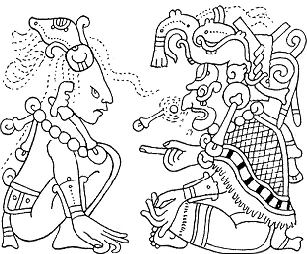
The murals on the northern and western walls of the chamber depict elements of Maya creation mythology reminiscent of the Popol Vuh and Yucatec cosmological traditions. The north wall shows two scenes: one in front of a mountain cave with persons on a large serpent and the maize god receiving or bequeathing a vine calabash; the other shows four babies with umbilical cords surrounding a split calabash from which a fifth, fully clothed male emerges, watched by a large deity.
The west wall has many scenes, including four successive images of trees with birds, kings with markings of the Hero Twin Hunahpu, and sacrifices of fish, deer, turkey, and blossoms, with a fifth tree added. The five trees compare to directional trees in the Codex Borgia and the Book of Chilam Balam of Chumayel; the birds represent the Principal Bird Deity. The first four kings perform penis piercing and blood sacrifice; the fifth figure, associated with the central tree of life, is the maize god. The directional representation may refer to the initial arrangement of the world.
Earliest Maya inscriptions
The earliest identifiably Maya inscriptions have been found at San Bartolo, dating to the 3rd century BC. A stone block text from around 300 BC may celebrate an upcoming time period ending celebration projected between 7.3.0.0.0 and 7.5.0.0.0 (295 to 256 BCE). This is the earliest Maya hieroglyphic text uncovered and arguably the earliest Mesoamerican Long Count calendar notation. In 2022, evidence for the earliest known calendar notation in the Maya region, the 260-day ritual date of '7 Deer,' was presented from mural fragments dating between 300 and 200 BCE.
More in Maya Mythology and Religion
Sources
Compiled from Wikipedia and the sources listed below. Text from Wikipedia is available under CC BY-SA 4.0; this entry is adapted from it.
- Wikipedia: San Bartolo (Maya site) (CC BY-SA 4.0).
Spotted an error? Know more?
Reader corrections go straight into our review queue. Suggest an edit · How this site is sourced