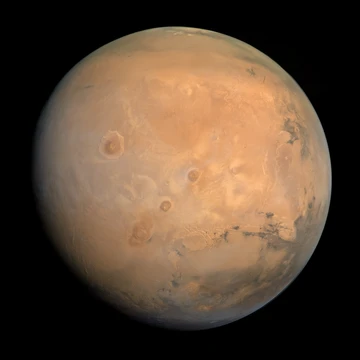
Arabia quadrangle
A boundary quadrangle between young plains and old highlands.
Last updated
It lies on the boundary between the young northern plains and the old southern highlands, covering 315° to 360° west longitude and 0° to 30° north latitude. The quadrangle contains part of the classic region Arabia, as well as parts of Terra Sabaea and Meridiani Planum.
Quick Facts
- Quadrangle designation
- MC-12 (Mars Chart-12)
- Longitude range
- 315° to 360° west
- Latitude range
- 0° to 30° north
- Notable regions within
- Arabia, Terra Sabaea, Meridiani Planum
Facts from the source article.
Layers
Many places in the Arabia quadrangle are shaped into layers that range from a few meters to tens of meters thick. Research by scientists at the California Institute of Technology suggests that ancient climate change on Mars, caused by regular variations in the planet's tilt (obliquity), may have produced these layered patterns. On Earth, similar astronomical forcing of climate results in ice-age cycles.
A study of layers in craters just outside the quadrangle boundary—though its findings likely apply to Arabia as well—measured average layer thicknesses of less than 4 meters in one crater and 20 meters in another. In Becquerel crater, each layer appears to have formed over roughly 100,000 years, with every 10 layers bundled into larger units; this 10-layer pattern is repeated at least 10 times, meaning each bundle took one million years to form. Mars's tilt varies by tens of degrees, unlike Earth's 2-degree variation stabilized by the Moon.
When obliquity is low, water and carbon dioxide migrate to the poles and freeze; when high, they move away. This shifting may alter atmospheric pressure and wind transport, while more water in the atmosphere could cause sand grains to stick and cement into layers. The thickness measurements were made using stereo topographic maps from the high-resolution camera on NASA's Mars Reconnaissance Orbiter.
Craters
Impact craters in the quadrangle typically have a rim with ejecta, unlike volcanic craters. Craters larger than 10 km in diameter usually possess a central peak from the rebound of the crater floor. Because impacts act like powerful explosions, they toss rocks from deep underground onto the surface, revealing what lies beneath. Some craters in Arabia are classified as pedestal craters, where the ejecta sits above the surrounding terrain as a raised platform.
This occurs when ejected material forms an erosion-resistant layer that protects the area, while softer material beyond is eroded away; some pedestals rise hundreds of meters above their surroundings. Pedestal craters were first observed during the Mariner missions. Based on years of HiRISE images, researchers believe over 200 new craters form on Mars each year.
Geological history
Studies reported in the journal Icarus suggest the area underwent several formation phases. A large basin, possibly from an impact, formed early in Martian history while Mars still had a magnetic field from movements in a liquid core; present-day Arabia retains remnant magnetism from that era. Sediments and water later entered the basin.
As Tharsis on the opposite side of Mars became massive, the Arabia area was pushed outward, bulging upward and increasing erosion that exposed old layers. Over the following 4 billion years, various geological processes modified the region. Central peaks and ejecta shapes indicate that parts of Arabia remain water enriched.
Dark slope streaks
Dark streaks are common on Mars, occurring on steep slopes of craters, troughs, and valleys. They initially appear dark and lighten with age, sometimes starting as a tiny spot and spreading for hundreds of meters, even traveling around obstacles like boulders. The streaks are believed to be avalanches of bright dust that expose a darker underlying layer, though several ideas have been advanced, including involvement of water or organisms.
Streaks appear in dust-covered areas; much of the Martian surface is covered with fine dust that settles from the atmosphere. Dust storms are frequent, especially when spring begins in the southern hemisphere, when Mars is 40% closer to the Sun due to its highly elliptical orbit. Every few years, global dust storms engulf the entire planet; when Mariner 9 arrived, nothing could be seen through such a storm.
Did You Know?
- The Arabia area contains outflow channels including Naktong Vallis, Locras Valles, Indus Vallis, Scamander Vallis, and Cusus Valles.
- Deformation bands, small faults with very small displacements that often precede large faults, were observed by the Mars Reconnaissance Orbiter in Capen Crater within the Arabia quadrangle.
- One study with the Planetary Fourier Spectrometer on Mars Express found possible methane in three areas of Mars, one of which was in Arabia.
More in Mars
Sources
Compiled from Wikipedia and the sources listed below. Text from Wikipedia is available under CC BY-SA 4.0; this entry is adapted from it.
- Wikipedia: Arabia quadrangle (CC BY-SA 4.0).
Spotted an error? Know more?
Reader corrections go straight into our review queue. Suggest an edit · How this site is sourced