Pêro da Covilhã
Portuguese diplomat and explorer who gathered intelligence on Indian Ocean trade routes.
Pêro da Covilhã (c. 1460 – after 1526), also known as Pero de Covilhã, was a Portuguese diplomat and explorer. Born in Covilhã in the Beira region, he spent his early years in Castile serving Don Juan de Guzmán, brother of the Duke of Medina Sidonia. When war broke out between Castile and Portugal, he returned home and served King Afonso V and later King John II, first as a groom and then as a squire. King John II sent him and Afonso de Paiva on a secret mission to learn about the spice trade and sea routes linking India to East Africa.
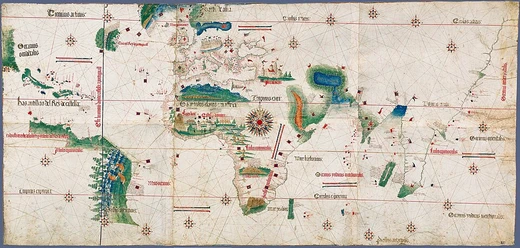
Disguised as an Arab merchant, Covilhã spent roughly two years traveling among Indian ports and the East African coast, studying monsoon winds, ocean currents, harbors, and spice markets while secretly recording his findings on a chart. After returning to Cairo in 1490 and learning of Paiva’s death, he gave his chart and report to Portuguese agents to take to Lisbon. His detailed account was eagerly read there, making Portugal the world’s best-informed center for global geography and trade routes.
Instead of going home, Covilhã traveled to Mecca as a Muslim pilgrim and then settled in the Christian kingdom of Ethiopia, where the emperor refused to let him leave. Though he never returned to Portugal, the intelligence and geographical knowledge he gathered reached Lisbon and filled key gaps in Portuguese understanding of the Indian Ocean, helping plan later voyages to India.
Covilhã was a low-born adventurer, a skilled swordsman, and a loyal servant to the crown. His fluency in Arabic and Castilian allowed him to carry out undercover work in Spain and secret negotiations in Morocco for King John II. These successes led the king to send him and Paiva on an overland exploration of the Near East, Asia, and Africa, with the specific tasks of finding where cinnamon and other spices came from and locating the legendary Prester John. At the same time, Bartolomeu Dias sailed by sea to find Prester John’s country, the southern end of Africa, and the ocean route to India.
The expedition began at Santarém on May 7, 1487. Covilhã and Paiva were briefed by the Bishop of Tangiers and two Jewish mathematicians, Rodrigo and Moisés, who were part of the commission that advised the Portuguese government to reject Christopher Columbus’s proposals. They received a letter of introduction for all countries and a navigational map of the Middle East and Indian Ocean, likely based on Fra Mauro’s work. From Santarém they went through Barcelona to Naples, where the sons of Cosimo de’ Medici paid their bills.
Then they traveled to Rhodes, bought honey to pose as merchants in the Arab world, and sailed to Alexandria. After both fell ill with fever, they took a boat up the Nile to Cairo and then a caravan across the desert to the ports of El-Tor and Suakin. They crossed the Red Sea to Aden, where the monsoon season forced them to split up: Covilhã went to India, Paiva to Ethiopia. They agreed to meet again in Cairo.
Covilhã caught a trading dhow across the Indian Ocean to Calicut, the spice trade’s hub. By 1488 he was in Goa and later sailed north to Ormuz at the mouth of the Persian Gulf, another major hub. This reconnaissance let him collect and record details about sailing routes, winds, currents, ports, and politics. From Ormuz he sailed down the East African coast to Sofala, the farthest point of Arab navigation in the southern Indian Ocean. There he investigated whether it was possible to round Africa by sea and how best to navigate its east coast. By 1491 he had returned to Cairo, having scouted the main trade routes of the Indian Ocean.
In Cairo he learned that Paiva had died on the way to Ethiopia. Meanwhile, King John II had sent two Portuguese Jews—Rabbi Abraham of Beja and José Sapateiro, a shoemaker from Lamego—with letters for Covilhã and Paiva containing further instructions. The king ordered both men to return to Lisbon, but only after they had seen and found out about Prester John. Through José Sapateiro, Covilhã replied with an account of his travels in India and Africa, his observations on the cinnamon, black pepper, and clove trade in Calicut, and advice on the ocean route to India. He recommended that the Portuguese sail south along the coast of Africa and the seas of Guinea. The first goal in the eastern ocean, he added, should be Madagascar; from there one could reach Calicut.
José returned to Portugal with this information, while Covilhã, accompanied by Abraham of Beja, again visited Aden and Ormuz. At Ormuz he left the rabbi and went to Jeddah, Arabia’s main port, and even traveled to Mecca and Medina, as he later told Francisco Álvares. Finally, via Mount Sinai, El-Tor, and across the Red Sea, he reached Zeila, then struck inland to the court of Prester John in Ethiopia. There Emperor Eskender received him honorably, granting him lands and lordships, but refused to let him leave. His successors also denied Covilhã permission to depart. According to James Bruce, Covilhã kept up a correspondence with the king in Portugal.
Quick Facts
- Born
- 1460
- Birthplace
- Covilhã, Kingdom of Portugal
- Died
- After 1526
- Place of death
- Ethiopia
- Occupation
- Explorer
- spy
- diplomat
Facts from the source article.
Ethiopia
After José returned to Portugal, Covilhã and Abraham of Beja went back to Aden and Ormuz. At Ormuz, Covilhã parted ways with the rabbi and traveled to Jeddah, Arabia’s main port. Years later, he told Francisco Álvares that he had even made his way into Mecca and Medina. From there he crossed the Red Sea via Mount Sinai and El-Tor, reached Zeila, and then headed inland to the court of Prester John in Ethiopia.
Emperor Eskender welcomed him warmly, granting him land and titles, but refused to let him leave. Later rulers also avoided giving him permission. James Bruce wrote that Covilhã kept up a correspondence with Portugal’s king, calling Ethiopia heavily populated and full of powerful, wealthy cities. In 1507, a priest named João Gomes, sent by Tristão da Cunha, arrived in Ethiopia from Socotra and joined him.
When Rodrigo de Lima’s Portuguese embassy—which included the Ethiopian ambassador Mateus and missionary Francisco Álvares—reached Ethiopia in 1520, Covilhã wept with joy at seeing countrymen after forty years away from Portugal and over thirty as a state prisoner in Ethiopia. Álvares, who claimed to know him well, praised his vivid storytelling and his command of every spoken language among Christians, Muslims, and Gentiles. Covilhã served as the embassy’s interpreter. Though well treated, he remained in Ethiopia for the rest of his life.
Legacy
Pêro da Covilhã journeyed across much of the known medieval world, reaching what are now Spain, Morocco, Italy, Greece, Egypt, Sudan, Yemen, Saudi Arabia, India, Mozambique, Iran, Eritrea, and Ethiopia. His travels, combined with Bartolomeu Dias’s maritime feats, helped clear the path for later Portuguese ventures, most notably Vasco da Gama’s 1497 sea route to India. The ongoing Portuguese presence brought Jesuit missionaries to Ethiopia, though their efforts to convert locals to Catholicism had uneven results.
More in Maritime History of Portugal
Spotted an error? Know more?
Reader corrections go straight into our review queue. Suggest an edit · How this site is sourced