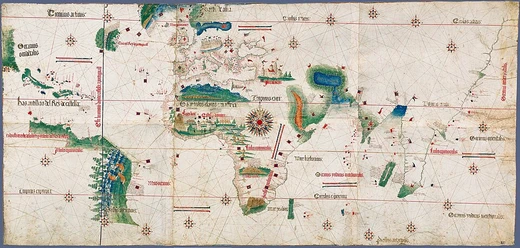
4th Portuguese India Armada (Gama, 1502)
Punitive expedition that attacked Calicut and established early Portuguese presence in India.
The 4th Portuguese India Armada was a fleet that sailed from Lisbon in February 1502, assembled on the order of King Manuel I and placed under the command of Vasco da Gama. It was Gama's second voyage to India and was designed as a punitive expedition targeting Calicut to avenge defeats of the 2nd Armada two years earlier. The armada established a Portuguese factory in present-day Mozambique, made contact with Sofala, and extorted tribute from Kilwa before attacking Calicut shipping.
Quick Facts
- Commander
- Vasco da Gama
- Departure from lisbon
- February 10, 1502
- Number of ships
- 20
- Vice-admiral
- Vicente Sodré
- Third squadron commander
- Estêvão da Gama
- Principal mission
- to settle scores with the Zamorin of Calicut
Facts from the source article.
Did You Know?
- The Second India Armada, commanded by Pedro Álvares Cabral, had arrived in Portugal in summer 1501 in terrible shape, with ship and human losses and failed mission objectives.
- The 3rd India Armada under João da Nova had already departed before news of the hostile turn in the Indian Ocean reached Portugal.
- The armada planned to use its first squadron to set up a naval blockade in Calicut harbor while the second squadron under Vicente Sodré patrolled the Gulf of Aden.
Appointment of Gama
The command of the 4th Armada was initially offered to Pedro Álvares Cabral. Factions in the Portuguese court and the Casa da India opposed Cabral's appointment, arguing that his 'incompetence' had created the unhappy situation. Cabral had his own political supporters, so the king tried to compromise by offering Cabral the position of captain-major but with the condition that his command would not be absolute: at least one squadron would be under Vicente Sodré, an uncle of Vasco da Gama and a leading opponent of Cabral.
Cabral withdrew his name, and Manuel I immediately appointed Vasco da Gama as captain-major. Some accounts suggest the initial offer to Cabral was a pro forma gesture, with onerous conditions introduced knowing Cabral would find them unacceptable; the conditions were revealed just before departure, lending credence to this theory. Chronicler Gaspar Correia tells a different story: King Manuel summoned Gama three days before departure, expressing disappointment in Cabral's 'dubious fortune' but noting a promise to Cabral.
Gama then produced a royal letter from 1500 promising him a determining role in any future India expedition and demanded command. Hearing of the king's quandary, Cabral voluntarily withdrew his name.
The Fleet
Originally envisaged as two squadrons—15 ships under the admiral to head to India and 5 under the vice-admiral to patrol the mouth of the Red Sea—the fleet was rearranged into three squadrons because not all ships were ready by the launch date. The first two squadrons (10 under Vasco da Gama and 5 under Vicente Sodré) departed at once, while the five remaining ships formed a third squadron under Estêvão da Gama, with instructions to catch up later.
The exact composition of the squadrons differs in various accounts; the list of captains is based on chroniclers such as João de Barros, Damião de Gois, Castanheda, and others, while ship names come from Gaspar Correia's Lendas da Índia and are considered unreliable. In Correia's account, neither Sodré brother commands his own ship; Vicente Sodré is carried as a passenger on Gama's flagship. The chronicles report that the fleet carried pre-fabricated lumber and fittings to assemble a new caravel upon arrival in East Africa.
Outward Journey
On February 10, 1502, the first two squadrons of the 4th Armada set out from Lisbon. Late in February, the fleet anchored in Senegal at either Porto de Ale or Bezeguiche to take water. One chronicle reports that Fernan d'Atouguia, captain of the Leitoa Nova, fell ill and died there; Gama transferred Pedro Afonso de Aguiar to that ship and elevated Pêro de Mendonça to Aguiar's old ship. In early March, the armada sailed southwest from Africa, possibly making a brief watering stop at Cape St. Augustine in Brazil before heading across the south Atlantic. On April 1, 1502, the third squadron under Estêvão da Gama finally departed from Lisbon. In May, Estêvão da Gama's third squadron reportedly spotted an island in the south Atlantic but did not stop to investigate. On June 7, 1502, the third squadron was caught in a terrible storm around the Cape and split into two groups.
Gama in India
In mid-August 1502, the 4th Armada arrived near the port of Dabul, north of Goa, in the waters of the Muslim sultan Adil Shah of Bijapur. The fighting ships hoisted lateen sails and loaded cannon, but no one challenged them, so they coasted south. Vasco da Gama ordered an attack on Onor, and Portuguese landing crews plundered and set fire to the ships and docks. The next day, the armada arrived at the mouth of the river leading to Bhatkal. Perceiving hostile gestures from shore, Gama dispatched Estêvão da Gama upriver, where an embassy from the raja of Batecala requested an audience. The raja offered to submit, and Vasco da Gama agreed to leave Batecala in peace in return for a yearly tribute of 1,000 bags of plain rice and 500 bags of quality rice, the exclusion of Arab merchants, no pepper trade at the port, and no ships traveling between Batecala and Calicut.
More in Maritime History of Portugal
Spotted an error? Know more?
Reader corrections go straight into our review queue. Suggest an edit · How this site is sourced