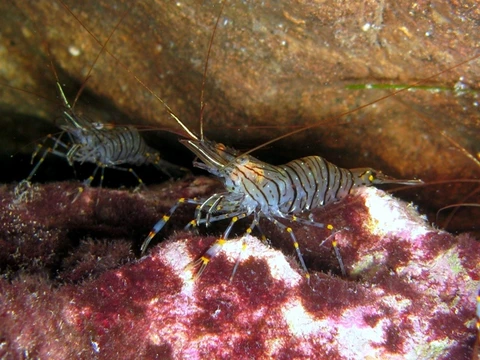
Macrobrachium
A genus of freshwater prawns with enlarged second pereiopods.

Macrobrachium is a genus of freshwater prawns and shrimps. Its most distinctive feature is the greatly enlarged second pair of pereiopods, especially in males. The genus has a worldwide distribution across tropical freshwater and estuarine habitats in both the Old and New Worlds. Its taxonomy is complicated: species often look alike due to shared ancestral traits (plesiomorphy), yet individuals within a single species can vary widely (polymorphism). This has led to the discovery of cryptic species, identified only through genetic analysis and morphometry.
Several Macrobrachium species are commercially important, particularly the larger ones in the M. rosenbergii group. These are both caught and farmed globally. Escapees from aquaculture have established breeding populations in the wild, though their ecological effects remain poorly studied.
Beyond their economic value, these crustaceans provide important ecosystem services. A study in the Senegal River basin showed that large dams, which block the reproduction and migration of riverine species like Macrobrachium, have been linked to increased schistosomiasis. The disease is caused by Schistosoma flatworms carried by snails, and Macrobrachium prawns are voracious predators of snails at all life stages. By suppressing snail populations, these prawns help control the disease. Restoring Macrobrachium populations in dammed areas could benefit an estimated 300 million people—one-third to one-half of those currently at risk.
Quick Facts
- Taxon
- Macrobrachium
- Type Species
- Macrobrachium americanum
- Type Species Authority
- Bate, 1868
Facts from the source article.
Lore & Background
The genus Macrobrachium has a difficult taxonomic history due to morphological conservation between its species (plesiomorphy) and variations within a single species (polymorphism). This has led to the discovery of cryptic species that were only revealed through genetic analysis and morphometry. The genus is cosmopolitan, occurring in tropical freshwater and estuarine ecosystems across both the Old and New Worlds.
Many species are of high commercial value, particularly the larger ones from the M. rosenbergii species group. Escapees from aquaculture operations have established breeding populations, though their ecological impact is little studied. Beyond commerce, these crustaceans provide ecosystem services: a study in the Senegal River basin found that large dams inhibit the reproduction and migration of Macrobrachium spp., and because these prawns are voracious predators of snails in all life stages, damming has been linked to marked increases in human schistosomiasis around dammed areas.
Reader's Guide
Macrobrachium is significant primarily for its commercial value, with larger species like those in the M. rosenbergii group being both shrimped and cultivated worldwide. However, the genus also plays an important ecological role as a predator of snails, which are intermediate hosts for Schistosoma flatworms that cause schistosomiasis. A study in the Senegal River basin demonstrated that large dams, by inhibiting the reproduction and migration of Macrobrachium spp., have been implicated in the spread of schistosomiasis. The article notes that restoration of Macrobrachium populations could benefit around 300 million people, representing one third to one half of the at-risk population. Despite this potential, the ecological impact of escaped aquaculture populations remains little studied. The genus also presents taxonomic challenges due to morphological conservation and polymorphism, leading to the discovery of cryptic species through genetic analysis and morphometry.
Did You Know?
- The second pair of pereiopods is extremely enlarged, at least in males.
- Cryptic species within Macrobrachium were only revealed through genetic analysis and morphometry.
- A study in the Senegal River basin linked damming to increased schistosomiasis due to reduced Macrobrachium predation on snails.
More in Marine Shrimp 1-24
Spotted an error? Know more?
Reader corrections go straight into our review queue. Suggest an edit · How this site is sourced