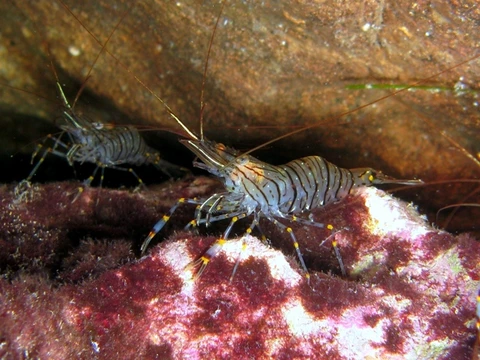
Palaemon adspersus
Baltic prawn, fished in Denmark, lives in eelgrass beds.
Last updated

Julius Fürst · via Wikipedia: Palaemon adspersus · Public domain
A plain yellowish-grey body and a maximum length of 70 mm characterize the shrimp species Palaemon adspersus.[1] The lower half of its rostrum is marked with noticeable pigment spots.[1]
Scientific classification
- KingdomAnimalia
- PhylumArthropoda
- CladePancrustacea
- ClassMalacostraca
- OrderDecapoda
- SuborderPleocyemata
- InfraorderCaridea
- FamilyPalaemonidae
- GenusPalaemon
- SpeciesPalaemon adspersus
Named by Rathke, 1837
Close relatives
Other species of Palaemon with a Codexery entry.
- Palaemon affinis Palaemon affinis
- Palaemon cummingi Palaemon cummingi
- Palaemon macrodactylus Palaemon macrodactylus
- Palaemon serenus Palaemon serenus
- Palaemon serratus Palaemon serratus
Sources: Wikipedia taxobox: Palaemon adspersus (CC BY-SA 4.0) · order, family and genus agree with WoRMS AphiaID 107613 (CC BY 4.0)
How big is it?
Largest length in the source, 0.07 m, next to a 1.8 m person.
Diagram: drawn by Codexery, schematic shapes to scale (not a likeness). Length: Wikipedia: Palaemon adspersus
Where the palaemon adspersus has been recorded
Each dot is a place where the species has been observed and reported (3,258 records, half-degree grid) — not a modelled range. 97 inland records left out (institution coordinates).
Map: drawn by Codexery. Data: GBIF occurrence search (records CC0 / CC BY) · Natural Earth basemap (public domain) · place coordinates: Wikipedia (CC BY-SA 4.0)
Quick Facts
- Maximum length
- 70 mm (2.8 in)
- Common name
- Baltic prawn
- Habitat
- Zostera beds
- Salinity tolerance
- as low as 5‰
- Body color
- plain yellowish-grey
- Distinctive feature
- rostrum bears spots of pigment on its lower half
Facts from the source article.
Key facts and history
The species later became known as Leander squilla when more genera were split from Linnaeus' Cancer.[2] In 1897, Mary Jane Rathbun realized that Pierre André Latreille had designated Cancer squilla as the type species for the genus Palaemon in 1810.[2] The resulting nomenclatural confusion was resolved by an ICZN ruling that made Palaemon adspersus the type species of Palaemon.[2] The species is uncommon over most of north-western Europe but supports a significant fishery in the Danish Straits.[3]
In the 1758 and 1761 editions of Systema Naturae, Carl Linnaeus gave this species the name Cancer squilla.[2] Because of that designation, the group previously called Leander was renamed Palaemon, and the former Palaemon was reassigned to Macrobrachium.[2] Lipke Holthuis asked the ICZN in 1958 to set aside the name Cancer squilla, since it had been incorrectly applied to Palaemon elegans.[4] The ICZN accepted the petition, so the oldest valid name for this shrimp became Palaemon adspersus Rathke, 1837.[4]
In Danish waters, P. adspersus is found mainly in Zostera eelgrass habitats.[3]
What the cited sources add
The 1994 book "The brackish-water fauna of northwestern Europe" documents the species' distribution, salinity tolerance, and association with eelgrass beds in Denmark.[3][5] The 2010 book "Freshwater prawns" contains the taxonomic history details about Linnaeus' original description and the subsequent genus reassignments.[2][6] According to the 1995 "Handbook of the marine fauna of north-west Europe", the species attains a length of up to 70 mm and has a uniform yellowish-grey coloration.[1][7] That same handbook reports that the rostrum's lower edge carries distinctive pigment spots.[1][7]
References
- Wikipedia, "Palaemon adspersus" (CC BY-SA 4.0), which cites: "Handbook of the marine fauna of north-west Europe", Oxford University Press, 1995, p. 409–412 (we also read that source) en.wikipedia.org
- Wikipedia, "Palaemon adspersus" (CC BY-SA 4.0), which cites: Lipke Holthuis & Peter K. L. Ng, "Freshwater Prawns: Biology and Farming", John Wiley and Sons, 2009, p. 12–17 (we also read that source) en.wikipedia.org
- Wikipedia, "Palaemon adspersus" (CC BY-SA 4.0), which cites: Richard Stephen Kent Barnes, "The brackish-water fauna of northwestern Europe: an identification guide to brackish-water habitats, ecology, and macrofauna for field workers, naturalists, and students", Cambridge Universi; Richard Stephen Kent Barnes, "The brackish-water fauna of northwestern Europe: an identification guide to brackish-water habitats, ecology, and macrofauna for field workers, naturalists, and students", Cambridge Universi; Richard Stephen Kent Barnes, "The brackish-water fauna of northwestern Europe: an identificatio en.wikipedia.org
- Wikipedia, "Palaemon adspersus" (CC BY-SA 4.0), which cites: L. B. Holthuis, "Proposed use of the plenary powers (a) to suppress the specific name "squilla" Linnaeus, 1758, as published in the combination "Cancer squilla", and (b) to substitute the name "Palaemon adspersus" Rathke (original not read by us) en.wikipedia.org
- Open Library record, ISBN 9780521455565 ("The brackish-water fauna of northwestern Europe"). CC0 (metadata); book content not read. openlibrary.org
- Open Library record, ISBN 9781405148610 ("Freshwater prawns"). CC0 (metadata); book content not read. openlibrary.org
- Open Library record, ISBN 9780198540557 ("Handbook of the marine fauna of north-west Europe"). CC0 (metadata); book content not read. openlibrary.org
Each numbered sentence above was checked against the source it cites before publication. Sentences citing Wikipedia adapt text from the English Wikipedia article Palaemon adspersus (contributors), used under CC BY-SA 4.0; this entry is available under the same licence. Other sources were used for facts only; no text or images are copied from them.
More in Marine Shrimp
Sources
Compiled from Wikipedia and the sources listed below. Text from Wikipedia is available under CC BY-SA 4.0; this entry is adapted from it.
- Wikipedia: Palaemon adspersus (CC BY-SA 4.0).
- Classification: the source article's taxobox; order, family and genus checked against WoRMS, the World Register of Marine Species (CC BY 4.0).
- Occurrence records: GBIF (CC0 / CC BY). Basemap: Natural Earth (public domain).
- Word definitions: the , each quoted from its Wikipedia article.
Spotted an error? Know more?
Reader corrections go straight into our review queue. Suggest an edit · How this site is sourced