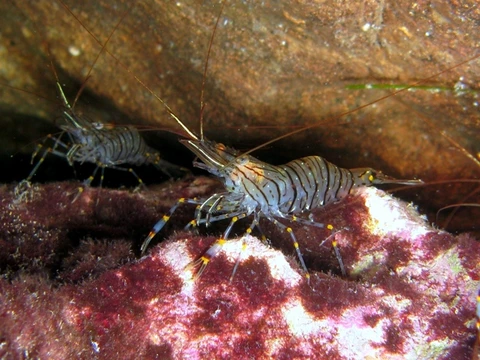
Processa edulis
Nocturnal caridean shrimp that changes color and inhabits seagrass beds.
Last updated
Males range from 12 to 34 mm in length, while females measure 25 to 52 mm.[1][2] The caridean shrimp known as nika shrimp, Processa edulis, lives in shallow Atlantic and Mediterranean waters.[3] During daylight hours it conceals itself, and after dark it forages for food within seagrass beds and eelgrass flats.[3]
Scientific classification
- KingdomAnimalia
- PhylumArthropoda
- CladePancrustacea
- ClassMalacostraca
- OrderDecapoda
- SuborderPleocyemata
- InfraorderCaridea
- FamilyProcessidae
- GenusProcessa
- SpeciesProcessa edulis
Named by (Risso, 1816)
Sources: Wikipedia taxobox: Processa edulis (CC BY-SA 4.0) · order, family and genus agree with WoRMS AphiaID 107683 (CC BY 4.0)
Where the processa edulis has been recorded
Each dot is a place where the species has been observed and reported (2,711 records, half-degree grid) — not a modelled range. 50 inland records left out (institution coordinates).
Map: drawn by Codexery. Data: GBIF occurrence search (records CC0 / CC BY) · Natural Earth basemap (public domain)
Quick Facts
- Species
- edulis
Facts from the source article.
Key facts and history
A tooth and a point tip the short rostrum, which does not reach past the eyes.[1] Astaxanthin and its esters cause the shrimp’s color change from white by day to pink or red with tiny white spots at night.[1] Nematodes, polychaetes, amphipods, isopods, ostracods, decapod larvae, foraminifera, molluscs, and fish eggs are among the small invertebrates it consumes.[4][2]
What the cited sources add
The DORIS account notes that about ten other Processa species exist in Europe.[2] The species is parasitized by two epicaridean isopods: the branchial bopyrid Urobopyrus processae and the abdominal bopyrid Pliophryxus philonika.[2] The DORIS account states that Processa edulis was heavily affected by oil from the Amoco Cadiz spill that impregnated the sand.[2] The proposed common name "crevette-autruche" (ostrich shrimp) refers to the genus's habit of burrowing head-first into sand using the last maxillipeds and front legs.[2]
The Latin name Processa means "that advances forward," possibly referring to its forward-burrowing behavior, and edulis means "edible".[2]
References
- Wikipedia, "Processa edulis" (CC BY-SA 4.0), which cites: Noel, Pierre, "Processa edulis (Risso, 1816)", DORIS, 20 April 2014; Noël, "Comparative study of carotenoids from two parasitic isopoda, Urobopyrus processae and Pliophryxus philonika with those from their host, Processa edulis (Crustacea, Caridea)", Comparative Biochemistry and Physiolog (we also read that source) en.wikipedia.org
- Noel, Pierre, "Processa edulis (Risso, 1816)", DORIS, 20 April 2014. facts only, no text reused. doris.ffessm.fr
- Wikipedia, "Processa edulis" (CC BY-SA 4.0), which cites: Myers, "Processa edulis – nika shrimp", The Animal Diversity Web (online) (we also read that source) en.wikipedia.org
- Wikipedia, "Processa edulis" (CC BY-SA 4.0), which cites: Noel, Pierre, "Processa edulis (Risso, 1816)", DORIS, 20 April 2014; Guerao, "Feeding habits of the prawns Processa edulis and Palaemon adspersus (Crustacea, Decapoda, Caridea) in Alfacs Bay, Ebro Delta (NW Mediterranean)", Miscellania Zoologica, January 1993, p. 115–122; Noel, Pierre, "Processa edulis (Risso, 1816)", DORIS, 20 April 2014; Labat, Jean-Philippe, "Cinetical study of size structure and biological cycle of a Mediterranean population of Processa edulis (Decapoda, Caridea)", Scientia Marina, 1986, p. 168–176 (we also read tha en.wikipedia.org
Each numbered sentence above was checked against the source it cites before publication. Sentences citing Wikipedia adapt text from the English Wikipedia article Processa edulis (contributors), used under CC BY-SA 4.0; this entry is available under the same licence. Other sources were used for facts only; no text or images are copied from them.
More in Marine Shrimp
Sources
Compiled from Wikipedia and the sources listed below. Text from Wikipedia is available under CC BY-SA 4.0; this entry is adapted from it.
- Wikipedia: Processa edulis (CC BY-SA 4.0).
- Classification: the source article's taxobox; order, family and genus checked against WoRMS, the World Register of Marine Species (CC BY 4.0).
- Occurrence records: GBIF (CC0 / CC BY). Basemap: Natural Earth (public domain).
- Word definitions: the , each quoted from its Wikipedia article.
Spotted an error? Know more?
Reader corrections go straight into our review queue. Suggest an edit · How this site is sourced