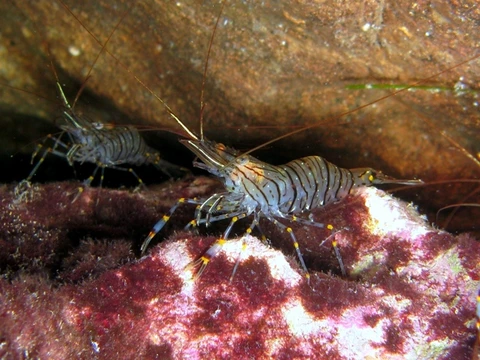
Periclimenes yucatanicus
A Caribbean cleaner shrimp that lives among sea anemone tentacles.
Last updated

Jessica Rosenkrantz · via Wikipedia: Spotted cleaner shrimp · CC BY-SA 4.0
This shrimp's body is see-through and decorated with brown and white saddle-like patterns.[1] Bold red, purple, and white stripes adorn its chelae and legs.[1]
Scientific classification
- KingdomAnimalia
- PhylumArthropoda
- CladePancrustacea
- ClassMalacostraca
- OrderDecapoda
- SuborderPleocyemata
- InfraorderCaridea
- FamilyPalaemonidae
- GenusPericlimenes
- SpeciesPericlimenes yucatanicus
Named by (Ives, 1891)
Close relatives
Other species of Periclimenes with a Codexery entry.
- Periclimenes dardanicola Periclimenes dardanicola
- Periclimenes pholeter Periclimenes pholeter
Sources: Wikipedia taxobox: Spotted cleaner shrimp (CC BY-SA 4.0) · order, family and genus agree with WoRMS AphiaID 421713 (CC BY 4.0)
How big is it?
Largest length in the source, 0.03 m, next to a 1.8 m person.
Diagram: drawn by Codexery, schematic shapes to scale (not a likeness). Length: Wikipedia: Spotted cleaner shrimp
Where the periclimenes yucatanicus has been recorded
Each dot is a place where the species has been observed and reported (707 records, half-degree grid) — not a modelled range. 7 inland records left out (institution coordinates).
Map: drawn by Codexery. Data: GBIF occurrence search (records CC0 / CC BY) · Natural Earth basemap (public domain) · place coordinates: Wikipedia (CC BY-SA 4.0)
Quick Facts
- Common name
- Spotted cleaner shrimp
- Maximum length
- 2.5 cm (1 in)
- Distribution
- Caribbean Sea, southern Florida, the Bahamas, as far south as Colombia
- Breeding season
- Summer
- Egg brooding months
- July and August
Facts from the source article.
Key facts and history
It lives at depths down to about 24 m.[2] When a fish approaches, the shrimp emerges from the anemone tentacles and removes external parasites.[3] It even enters fish mouths and cleans behind gill covers.[3] This shrimp's range extends from southern Florida and the Bahamas through the Caribbean Sea, reaching as far south as Colombia.[2]
Summer is the breeding season, and during July and August females have been observed carrying eggs beneath their abdomens.[4] Once the eggs hatch, the larvae go through multiple planktonic phases prior to settling on the ocean floor.[4] The shrimp forms a close symbiotic relationship with sea anemones, including Condylactis gigantea and Lebrunia danae.[5] Observations have recorded as many as six individual shrimps living together on a single sea anemone.[5]
To lure nearby reef fish, the shrimp waves its antennae back and forth.[3]
What the cited sources add
The Tropical Reefs guide lists the shrimp's size as 0.75 to 1 inch.[6] That source gives its depth range as 1 to 18 m.[6] The same source records its distribution as the Caribbean, Bahamas, and South Florida.[6]
References
- Wikipedia, "Spotted cleaner shrimp" (CC BY-SA 4.0), which cites: "Spotted cleaner shrimp (Periclimenes yucatanicus)", Interactive Guide to Caribbean Diving; Colin, "Marine Invertebrates and Plants of the Living Reef", T.F.H. Publications, 1978, p. 338 (we also read that source) en.wikipedia.org
- Wikipedia, "Spotted cleaner shrimp" (CC BY-SA 4.0), which cites: Colin, "Marine Invertebrates and Plants of the Living Reef", T.F.H. Publications, 1978, p. 338; Charpin, Florent, "Spotted cleaner shrimp", Tropical Reefs (we also read that source) en.wikipedia.org
- Wikipedia, "Spotted cleaner shrimp" (CC BY-SA 4.0), which cites: "Spotted cleaner shrimp (Periclimenes yucatanicus)", Interactive Guide to Caribbean Diving; Colin, "Marine Invertebrates and Plants of the Living Reef", T.F.H. Publications, 1978, p. 338; "Periclimenes yucatanicus Spotted Cleaner Shrimp"; Ernest H. Williams, Jr. & Lucy B. Williams, "First report of Periclimenes yucatanicus (Ives) (Decapoda, Palaemonidae) in association with a corallimorpharian anemone", Crustaceana, 1982, p. 318–319; Colin, "Marine Invertebrates and Plants of the Living Reef", T.F.H. Publications, 1978, p. 338 (w en.wikipedia.org
- Wikipedia, "Spotted cleaner shrimp" (CC BY-SA 4.0), which cites: Colin, "Marine Invertebrates and Plants of the Living Reef", T.F.H. Publications, 1978, p. 338; Dorit, "Zoology", Saunders College Publishing, 1991, p. 734 (we also read that source) en.wikipedia.org
- Wikipedia, "Spotted cleaner shrimp" (CC BY-SA 4.0), which cites: Ernest H. Williams, Jr. & Lucy B. Williams, "First report of Periclimenes yucatanicus (Ives) (Decapoda, Palaemonidae) in association with a corallimorpharian anemone", Crustaceana, 1982, p. 318–319 (original not read by us) en.wikipedia.org
- Charpin, Florent, "Spotted cleaner shrimp", Tropical Reefs. facts only, no text reused. reefguide.org
Each numbered sentence above was checked against the source it cites before publication. Sentences citing Wikipedia adapt text from the English Wikipedia article Spotted cleaner shrimp (contributors), used under CC BY-SA 4.0; this entry is available under the same licence. Other sources were used for facts only; no text or images are copied from them.
More in Marine Shrimp
Sources
Compiled from Wikipedia and the sources listed below. Text from Wikipedia is available under CC BY-SA 4.0; this entry is adapted from it.
- Wikipedia: Spotted cleaner shrimp (CC BY-SA 4.0).
- Classification: the source article's taxobox; order, family and genus checked against WoRMS, the World Register of Marine Species (CC BY 4.0).
- Occurrence records: GBIF (CC0 / CC BY). Basemap: Natural Earth (public domain).
- Word definitions: the Codexery glossary, each quoted from its Wikipedia article.
Spotted an error? Know more?
Reader corrections go straight into our review queue. Suggest an edit · How this site is sourced