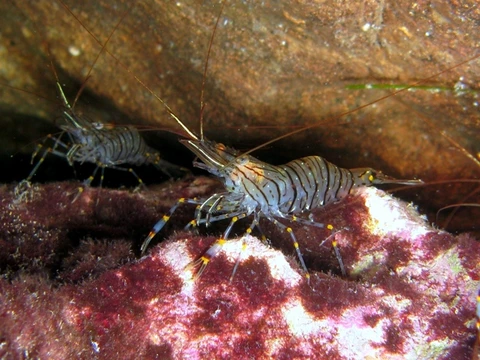
Stenopus hispidus
A pan-tropical cleaner shrimp with banded red-and-white coloration.
Last updated

Alexander Vasenin · via Wikipedia: Stenopus hispidus · CC BY-SA 3.0
This species reaches a total length of 60 mm and has striking red and white banding on its carapace, abdomen, and third pereiopod.[1][2] This crustacean, which resembles a shrimp, is a member of the infraorder Stenopodidea.[1]
Scientific classification
- KingdomAnimalia
- PhylumArthropoda
- CladePancrustacea
- ClassMalacostraca
- OrderDecapoda
- SuborderPleocyemata
- FamilyStenopodidae
- GenusStenopus
- SpeciesStenopus hispidus
Named by (Olivier, 1811)
Close relatives
Other species of Stenopus with a Codexery entry.
- Stenopus pyrsonotus Stenopus pyrsonotus
- Stenopus scutellatus Stenopus scutellatus
Sources: Wikipedia taxobox: Stenopus hispidus (CC BY-SA 4.0) · order, family and genus agree with WoRMS AphiaID 210370 (CC BY 4.0)
How big is it?
Largest length in the source, 0.06 m, next to a 1.8 m person.
Diagram: drawn by Codexery, schematic shapes to scale (not a likeness). Length: Wikipedia: Stenopus hispidus
Where the stenopus hispidus has been recorded
Each dot is a place where the species has been observed and reported (7,961 records, half-degree grid) — not a modelled range. 62 inland records left out (institution coordinates).
Map: drawn by Codexery. Data: GBIF occurrence search (records CC0 / CC BY) · Natural Earth basemap (public domain)
Key facts and history
The geographic range of Stenopus hispidus spans tropical regions worldwide and also reaches certain temperate zones.[3] White coloration is seen on the antennae and the remaining pereiopods, while spines cover the abdomen, carapace, and third pereiopods.[2] This shrimp inhabits coral reefs, living below the intertidal zone at depths reaching 210 m.[4]
What the cited sources add
The 2009 Texas A&M University Press volume "Gulf of Mexico Origin, Waters, and Biota" documents the species' pan-tropical distribution and its presence in the Gulf of Mexico.[5][3][6] The 2002 Dover Publications book "Seashore Life of Florida and the Caribbean" describes the banded colour pattern and spiny body of S. hispidus.[7][2][4] The 2004 CSIRO guide "Marine Decapod Crustacea of Southern Australia" reports a total length of 60 mm, describes the red-and-white banding and white antennae, and notes the spination on the abdomen, carapace, and third pereiopods.[8][1][2]
References
- Wikipedia, "Stenopus hispidus" (CC BY-SA 4.0), which cites: "Marine Decapod Crustacea of Southern Australia: a Guide to Identification", CSIRO Publishing, 2004, p. 145–149 (we also read that source) en.wikipedia.org
- Wikipedia, "Stenopus hispidus" (CC BY-SA 4.0), which cites: Gilbert L. Voss, "Seashore Life of Florida and the Caribbean", Courier Dover Publications, 2002, p. 78–123; "Marine Decapod Crustacea of Southern Australia: a Guide to Identification", CSIRO Publishing, 2004, p. 145–149; "Marine Decapod Crustacea of Southern Australia: a Guide to Identification", CSIRO Publishing, 2004, p. 145–149; Gilbert L. Voss, "Seashore Life of Florida and the Caribbean", Courier Dover Publications, 2002, p. 78–123 (we also read that source) en.wikipedia.org
- Wikipedia, "Stenopus hispidus" (CC BY-SA 4.0), which cites: Darryl L. Felder, "Gulf of Mexico Origin, Waters, and Biota: Biodiversity", Texas A&M University Press, 2009, p. 1019–1104 (we also read that source) en.wikipedia.org
- Wikipedia, "Stenopus hispidus" (CC BY-SA 4.0), which cites: "Marine Decapod Crustacea of Southern Australia: a Guide to Identification", CSIRO Publishing, 2004, p. 145–149; Gilbert L. Voss, "Seashore Life of Florida and the Caribbean", Courier Dover Publications, 2002, p. 78–123; Gilbert L. Voss, "Seashore Life of Florida and the Caribbean", Courier Dover Publications, 2002, p. 78–123; "The Sea Shore Ecology of Hong Kong", Hong Kong University Press, 1983, p. 253–300 (we also read that source) en.wikipedia.org
- Open Library record, ISBN 9781603440943 ("Gulf of Mexico origin, waters, and biota"). CC0 (metadata); book content not read. openlibrary.org
- Wikipedia, "Stenopus hispidus" (CC BY-SA 4.0), which cites: "Stenopus hispidus (Olivier, 1811) banded coral shrimp", SeaLifeBase, March 23, 2010; Darryl L. Felder, "Gulf of Mexico Origin, Waters, and Biota: Biodiversity", Texas A&M University Press, 2009, p. 1019–1104 (we also read that source) en.wikipedia.org
- Open Library record, ISBN 9780486420684 ("Seashore Life of Florida and the Caribbean"). CC0 (metadata); book content not read. openlibrary.org
- Open Library record, ISBN 9780643069060 ("Marine decapod Crustacea of southern Australia"). CC0 (metadata); book content not read. openlibrary.org
Each numbered sentence above was checked against the source it cites before publication. Sentences citing Wikipedia adapt text from the English Wikipedia article Stenopus hispidus (contributors), used under CC BY-SA 4.0; this entry is available under the same licence. Other sources were used for facts only; no text or images are copied from them.
More in Marine Shrimp
Sources
Compiled from Wikipedia and the sources listed below. Text from Wikipedia is available under CC BY-SA 4.0; this entry is adapted from it.
- Wikipedia: Stenopus hispidus (CC BY-SA 4.0).
- Classification: the source article's taxobox; order, family and genus checked against WoRMS, the World Register of Marine Species (CC BY 4.0).
- Occurrence records: GBIF (CC0 / CC BY). Basemap: Natural Earth (public domain).
- Word definitions: the , each quoted from its Wikipedia article.
Spotted an error? Know more?
Reader corrections go straight into our review queue. Suggest an edit · How this site is sourced