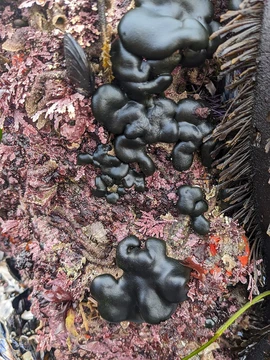
Caulerpa lentillifera
Last updated
In the Asia-Pacific region, the ulvophyte green alga Caulerpa lentillifera is found along coastlines.[1] Because of its soft, succulent texture, C. lentillifera is a preferred edible Caulerpa species.[1]
Scientific classification
- CladeEukaryota
- CladeArchaeplastida
- CladeViridiplantae
- ClassUlvophyceae
- OrderBryopsidales
- FamilyCaulerpaceae
- GenusCaulerpa
- SpeciesCaulerpa lentillifera
Named by J.Agardh, 1837
Close relatives
Other species of Caulerpa with a Codexery entry.
- Caulerpa racemosa Caulerpa racemosa
- Caulerpa brachypus Caulerpa brachypus
- Caulerpa cupressoides Caulerpa cupressoides
- Caulerpa prolifera Caulerpa prolifera
- Caulerpa sedoides Caulerpa sedoides
- Caulerpa serrulata Caulerpa serrulata
- Caulerpa sertularioides Caulerpa sertularioides
- Caulerpa webbiana Caulerpa webbiana
Sources: Wikipedia taxobox: Caulerpa lentillifera (CC BY-SA 4.0) · order, family and genus agree with WoRMS AphiaID 211475 (CC BY 4.0)
How big is it?
Largest length in the source, 0.3 m, next to a 1.8 m person.
Diagram: drawn by Codexery, schematic shapes to scale (not a likeness). Length: Wikipedia: Caulerpa lentillifera
Where the caulerpa lentillifera has been recorded
Each dot is a place where the species has been observed and reported (702 records, half-degree grid) — not a modelled range. 39 inland records left out (institution coordinates).
Map: drawn by Codexery. Data: GBIF occurrence search (records CC0 / CC BY) · Natural Earth basemap (public domain)
Quick Facts
- Species
- lentillifera
Facts from the source article.
Key facts and history
The PROSEA account notes that C. lentillifera is widely distributed in tropical areas of the Indian and Pacific Oceans.[2] It is generally found growing on sandy to muddy substrates on reef flats not exposed during low tides.[2] In the wild, C. lentillifera is highly seasonal, with peak production during the sunny dry months.[2] The PROSEA source states that in the Philippines, cultivation occurs in about 400 ha of ponds in Mactan, Cebu Province.[2]
Production there is estimated at no less than 4000 t fresh weight per year, with more than 90% produced during dry months.[2] Japan initiated commercial farming of this seaweed in 1986, using the warm waters of Okinawa Province.[2]
What the cited sources add
The PROSEA account describes C. lentillifera as mainly used in a raw vegetable salad.[2] It notes that C. lentillifera is a potential source of protein and shows haemagglutinic activity.[2] The PROSEA source reports that in Japan, fresh fronds of C. lentillifera are packed in 100-200 g packages.[2] It also states that sexual reproduction of C. lentillifera is believed to be similar to that of other Caulerpa, but has not yet been observed in South-East Asia.[2]
The PROSEA account adds that C. lentillifera is affected by salinity levels lower than 30‰.[2] It notes that bleaching of Caulerpa spp. might be the result of reproduction, as all contents are used in the production of motile reproductive cells.[2]
References
- Wikipedia, "Caulerpa lentillifera" (CC BY-SA 4.0), which cites: "Sea grapes - green caviar", Authentic World Food (original not read by us) en.wikipedia.org
- Trono, "Caulerpa lentillifera (PROSEA)", Pl@ntUse. facts only, no text reused. uses.plantnet-project.org
Each numbered sentence above was checked against the source it cites before publication. Sentences citing Wikipedia adapt text from the English Wikipedia article Caulerpa lentillifera (contributors), used under CC BY-SA 4.0; this entry is available under the same licence. Other sources were used for facts only; no text or images are copied from them.
More in Marine Green Macroalgae
Sources
Compiled from Wikipedia and the sources listed below. Text from Wikipedia is available under CC BY-SA 4.0; this entry is adapted from it.
- Wikipedia: Caulerpa lentillifera (CC BY-SA 4.0).
- Classification: the source article's taxobox; order, family and genus checked against WoRMS, the World Register of Marine Species (CC BY 4.0).
- Occurrence records: GBIF (CC0 / CC BY). Basemap: Natural Earth (public domain).
Spotted an error? Know more?
Reader corrections go straight into our review queue. Suggest an edit · How this site is sourced