Rhynchactis
A deep-sea anglerfish genus lacking a bioluminescent lure.
Last updated
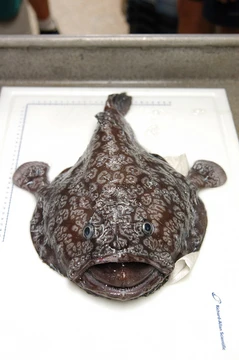
Rhynchactis is a genus of deep-sea anglerfish belonging to the family Gigantactinidae. Three species are recognized, and they occur across the world’s oceans at depths exceeding 400 meters.
What sets this genus apart from nearly all other deep-sea anglerfishes is the absence of a bioluminescent lure, or esca, at the tip of the illicium—the modified dorsal fin ray that functions like a fishing rod. Additionally, the mouth contains almost no teeth, and the inner surfaces of both jaws are lined with numerous white glands found nowhere else in the group. These features point to a highly specialized feeding strategy, though its exact nature remains unknown.
Biology and ecology
As in other deep-sea anglerfishes, sexual dimorphism is extreme: adult females reach a standard length of 11 to 13 centimeters, while males are much smaller and lack an illicium entirely. Unlike some anglerfish families, however, males do not appear to become permanently parasitic on females. Reproduction is oviparous, and the larvae have a rounded body shape with enlarged pectoral fins.
Taxonomy and phylogeny
The genus was first described by British ichthyologist Charles Tate Regan in 1925, based on a single metamorphosed female collected by the research vessel Dana in the western central Atlantic. He named the type species Rhynchactis leptonema, drawing the generic name from the Greek rhynchos (“snout”) and aktis (“ray”), and the specific epithet from leptos (“thin”) and nema (“thread”). In 1998, Erik Bertelsen and Theodore Pietsch revised the genus, recognizing two additional species: R. macrothrix (from Greek makros for “long” and thrix for “hair”) and R. microthrix (from mikros for “small” and thrix for “hair”), both names referring to features of the illicium. Within its family, Rhynchactis is considered the more derived genus, showing secondary reductions in bones, fin rays, and teeth.
Distribution and habitat
The three currently recognized species are R. leptonema, R. macrothrix, and R. microthrix. Specimens have been caught between 32°N and 12°S latitude in the Atlantic, Indian, and Pacific Oceans. R. leptonema is known from the western central Atlantic and off Hawaii; R. macrothrix has been collected near Bermuda and Madagascar; and the single known R. microthrix specimen came from the western Indian Ocean. The genus occurs from depths of at least 400 meters down to 900–1,000 meters.
Scientific classification
- KingdomAnimalia
- PhylumChordata
- ClassActinopterygii
- DivisionTeleostei
- OrderLophiiformes
- FamilyGigantactinidae
- GenusRhynchactis
Named by Regan, 1925
Sources: Wikipedia taxobox: Rhynchactis (CC BY-SA 4.0)
Lore & Background
The genus Rhynchactis was coined by British ichthyologist Regan, who described its first species, R. leptonema, in a 1925 issue of Annals and Magazine of Natural History. The generic name derives from Greek rhynchos ('snout') and aktis ('ray'), while the specific epithet comes from leptos ('thin') and nema ('thread').
Regan based his account on a single metamorphosed female collected by the research vessel Dana in the western central Atlantic. In 1998, Erik Bertelsen and Theodore Pietsch published a revision recognizing two new species: R. macrothrix and R. microthrix, with epithets from Greek makros ('long'), mikros ('small'), and thrix ('hairs'), referring to characteristics of the illicium. Rhynchactis is considered the more derived genus in its family, exhibiting secondary reduction of many morphological elements such as bones, fin rays, and teeth.
Description
Metamorphosed female Rhynchactis are slender and streamlined, with a relatively small head comprising about a quarter of the standard length. The illicium originates at the front of the blunt head and exceeds the length of the body, but unlike most other deep-sea anglerfishes it does not bear a bioluminescent esca at the tip. The upper jaw extends past the lower; dentition is greatly reduced, especially in larger females, consisting of only 0–2 tiny, curved teeth on each side at the tip of the upper jaw, and sometimes fine teeth in the lower jaw. Uniquely, the inside of both jaws are densely covered by white, papilla-like glands, each containing a short, pigmented tube at the center lined by glandular cells.
The skin is dark brown to black, smooth in small fish and becoming densely covered by tiny spines in females over 11 cm long. Adult males are much smaller than females and lack an illicium; their eyes are minute while the olfactory organs are highly developed, measuring 8–10% of the standard length. There is no evidence that males become permanently parasitic on females.
More in Marine Fish Genera
Sources
Compiled from Wikipedia and the sources listed below. Text from Wikipedia is available under CC BY-SA 4.0; this entry is adapted from it.
- Wikipedia: Rhynchactis (CC BY-SA 4.0).
- Word definitions: the Codexery glossary, each quoted from its Wikipedia article.
Spotted an error? Know more?
Reader corrections go straight into our review queue. Suggest an edit · How this site is sourced