Sebastolobus
Deep-water Pacific rockfishes with venomous spines and lobed pectoral rays.
Last updated

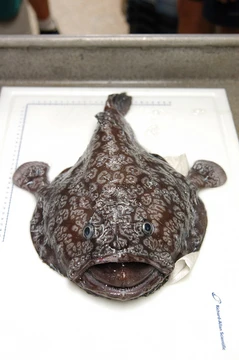
Victor Simon, NOAA/NMFS/NWFSC/FRAMD/MF · via Wikipedia: Sebastolobus · Public domain
Sebastolobus, known as thornyheads, is a genus of marine ray-finned fish in the rockfish subfamily Sebastinae, part of the Scorpaenidae family. These fish live in deep waters across the northern and eastern Pacific Ocean.
The genus was established in 1881 by American ichthyologist Theodore Gill. Its type species, Sebastes macrochir, was originally described in 1877 by Albert Günther, with a type locality of Japan. The name Sebastolobus combines Sebastes (the original genus) with lobus, meaning "lobed," referring to the lower pectoral fin rays being widened into tongue-shaped lobes. This genus is the type for the tribe Sebastolobini, one of two tribes within Sebastinae.
Three species are currently recognized. Thornyheads have moderately compressed bodies and relatively large heads, armed with eight pairs of robust spines along the top. Their eyes are large, and a horizontal suborbital ridge carries another eight to ten strong spines. The jaws contain many conical teeth, and teeth are also present on the roof of the mouth.
The single dorsal fin is notched behind the spiny section, which has 15 to 17 robust, venom-bearing spines, followed by 8 to 11 soft rays. The anal fin has three spines and four to six soft rays. The caudal fin has a straight edge. Maximum lengths range from 39 cm total length in S. altevelis to 80 cm standard length in S. alascanus.
These fish are demersal, living over soft substrates. They are found in both the eastern and western northern Pacific Ocean, with vagrants reaching as far south as Costa Rica. Unlike rockfishes in the genus Sebastes, thornyheads are oviparous, with females extruding gelatinous egg masses.
Scientific classification
- KingdomAnimalia
- PhylumChordata
- ClassActinopterygii
- DivisionTeleostei
- OrderPerciformes
- FamilyScorpaenidae
- GenusSebastolobus
Named by T. N. Gill, 1881
Sources: Wikipedia taxobox: Sebastolobus (CC BY-SA 4.0)
Quick Facts
- Genus author
- Theodore Gill
- Year described
- 1881
- Type species
- Sebastes macrochir
- Type species author
- Albert Günther
- Type species year
- 1877
- Type locality
- Japan
- Recognized species
- 3
- Max length range
- 39 cm (1 ft 3 in) TL (S. altevelis) to 80 cm (2 ft 7 in) SL (S. alascanus)
Facts from the source article.
Lore & Background
The genus Sebastolobus was first described by American ichthyologist Theodore Gill in 1881, with Sebastes macrochir as the type species—a fish originally described by Albert Günther in 1877 from Japan. The generic name combines Sebastes (the original genus of the type species) with lobus, meaning 'lobed,' referring to the lower rays of the pectoral fins being widened into tongue-shaped lobes. Sebastolobus is the type genus of the tribe Sebastolobini, one of two tribes within the subfamily Sebastinae.
Thornyheads have moderately compressed bodies and a relatively large head armed with eight pairs of robust spines along its top. The eyes are large, and a horizontal suborbital ridge bears another 8–10 strong spines. Numerous conical teeth are present on the jaws and on the roof of the mouth.
The single dorsal fin is incised toward the rear of the spiny portion, containing 15 to 17 robust, venom-bearing spines followed by 8 to 11 soft rays. The anal fin has three spines and between four and six soft rays, and the caudal fin is straight-edged. Maximum lengths vary from 39 cm total length in S. altevelis to 80 cm standard length in S. alascanus.
These fishes are demersal, found over soft substrates in the northern Pacific Ocean on both eastern and western sides, with vagrants extending as far south as Costa Rica. Unlike the rockfishes of the genus Sebastes, Sebastolobus species are oviparous, with females extruding gelatinous egg masses.
More in Marine Fish Genera
Sources
Compiled from Wikipedia and the sources listed below. Text from Wikipedia is available under CC BY-SA 4.0; this entry is adapted from it.
- Wikipedia: Sebastolobus (CC BY-SA 4.0).
- Word definitions: the Codexery glossary, each quoted from its Wikipedia article.
Spotted an error? Know more?
Reader corrections go straight into our review queue. Suggest an edit · How this site is sourced