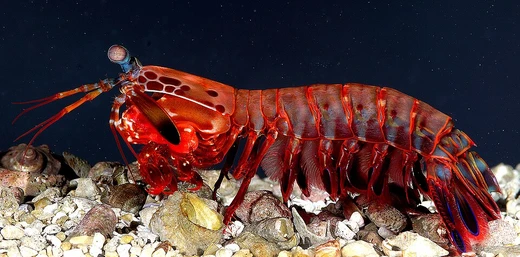
Odontodactylus scyllarus
A colourful, powerful stomatopod with the fastest recorded punch of any living animal.

The peacock mantis shrimp—also called the harlequin, painted, clown, or rainbow mantis shrimp, as well as the peacock odontodactyl, thumb splitter, or simply mantis shrimp—is a large stomatopod from the family Odontodactylidae. It lives on the epipelagic seabed across the Indo-Pacific, from the Marianas to East Africa and as far south as northern KwaZulu-Natal in South Africa. It is one of about 480 mantis shrimp species, all known for their raptorial claws, extraordinary vision, and unusual interactions with other marine life. In the marine aquarium trade, it is both prized for its beauty and regarded as a dangerous pest.
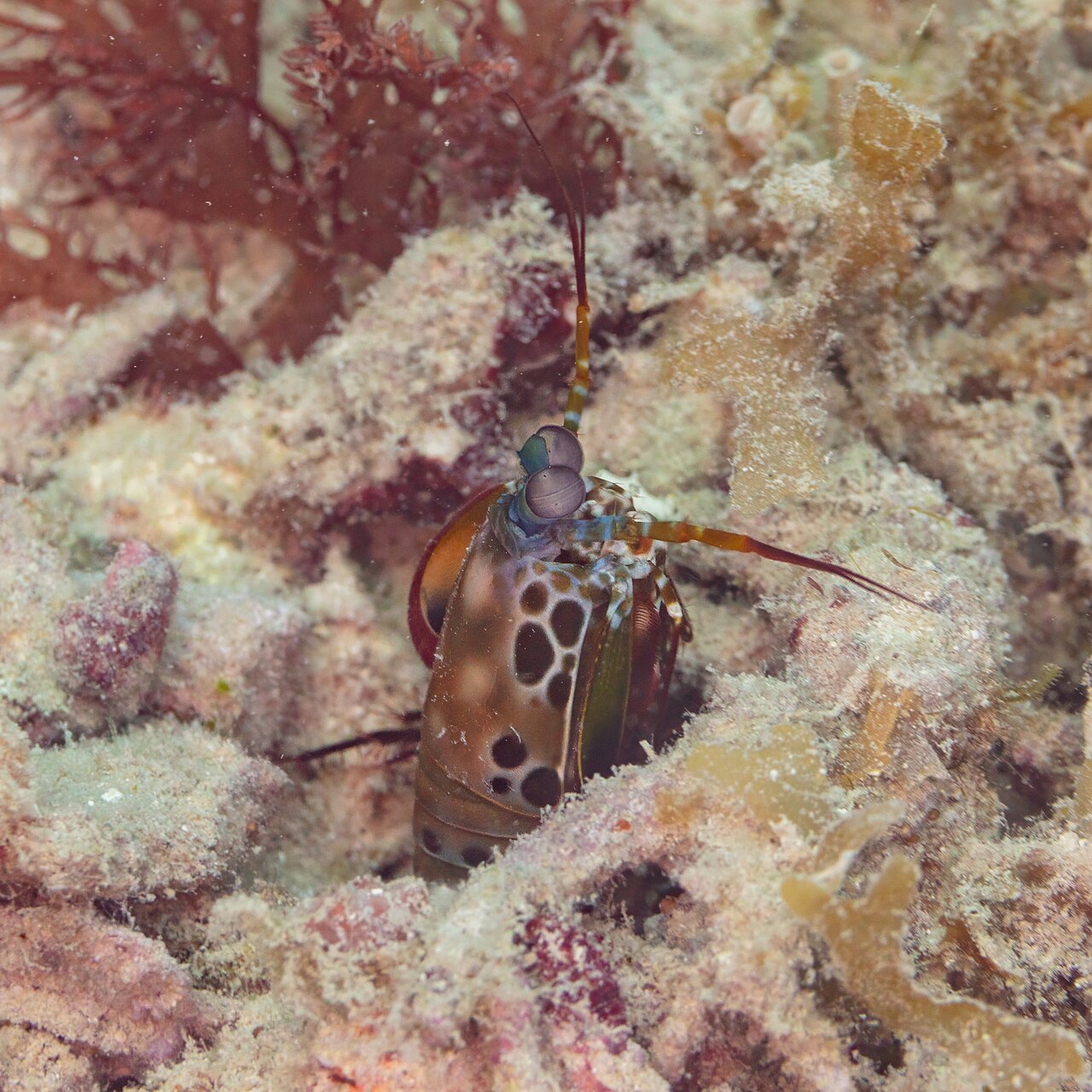
This species is among the larger and more colorful mantis shrimps, growing from 3 to 18 centimeters. Its body is mostly green, with orange legs and leopard-like spots on the front part of the carapace. Its ability to see circularly polarized light has prompted research into whether its eye mechanisms could be copied to improve reading CDs and other optical storage devices.
The genus name Odontodactylus comes from the Ancient Greek words for "tooth" and "finger." The species name scyllarus derives from the Ancient Greek word for "hermit crab."
One key predatory feature is the dactyl club, a hammer-like appendage. This is the most electron-dense part of the stomatopod exoskeleton and works like a spring-loaded weapon. In cross-section, the club has three regions: the impact region, the periodic region, and the striated region. Each region's mechanical properties relate to its mineralization level. Calcium concentration drops step-like from the impact region to the periodic region, while phosphate decreases gradually. Carbon and magnesium increase in the same area, so the impact region is mostly calcium phosphate, while the rest of the club mixes calcium phosphate and calcium carbonate. The impact region is mainly hydroxyapatite, with a higher crystallinity than bovine bone, which helps absorb impact. This structure is five times thicker than other appendages, increasing solidity at the point of contact.
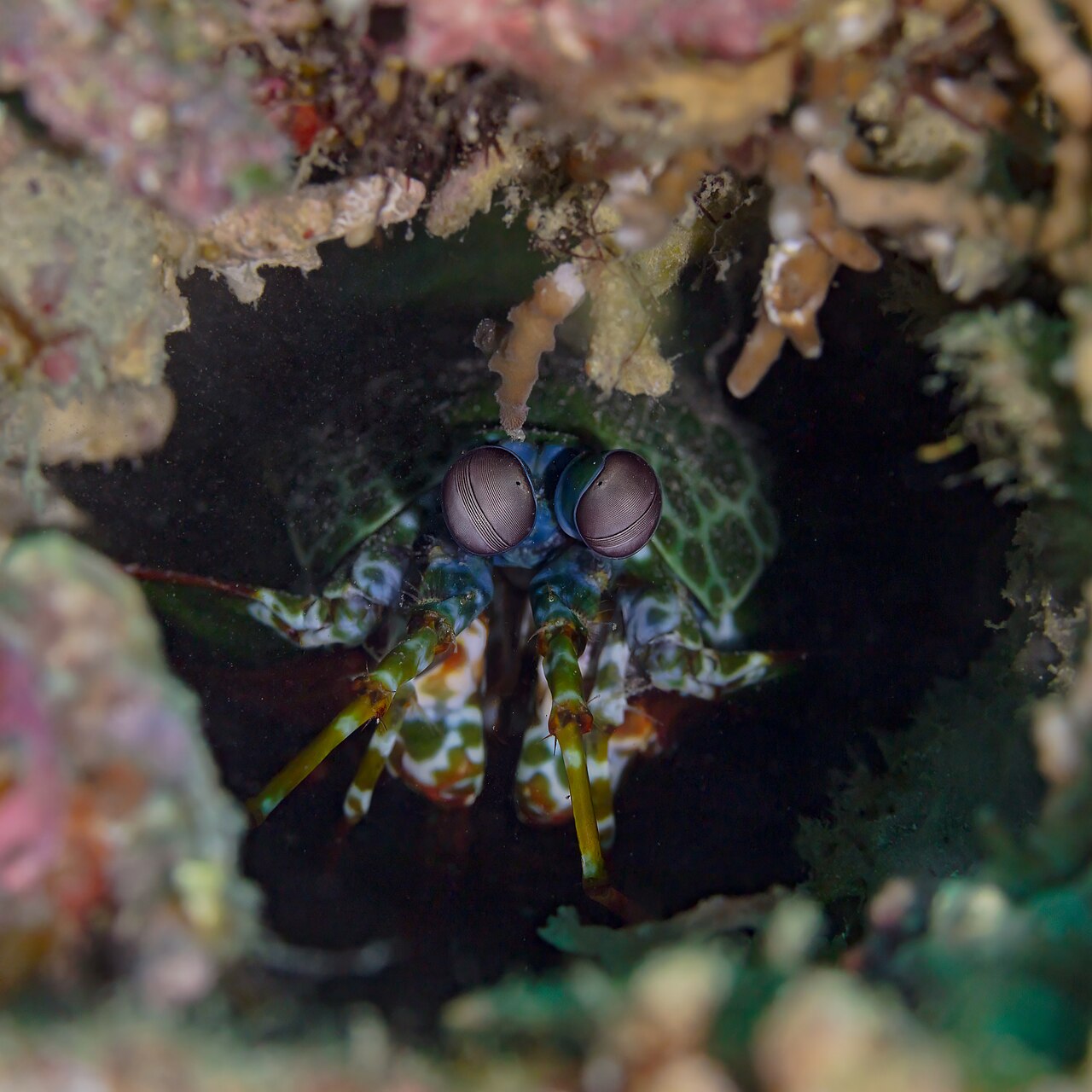
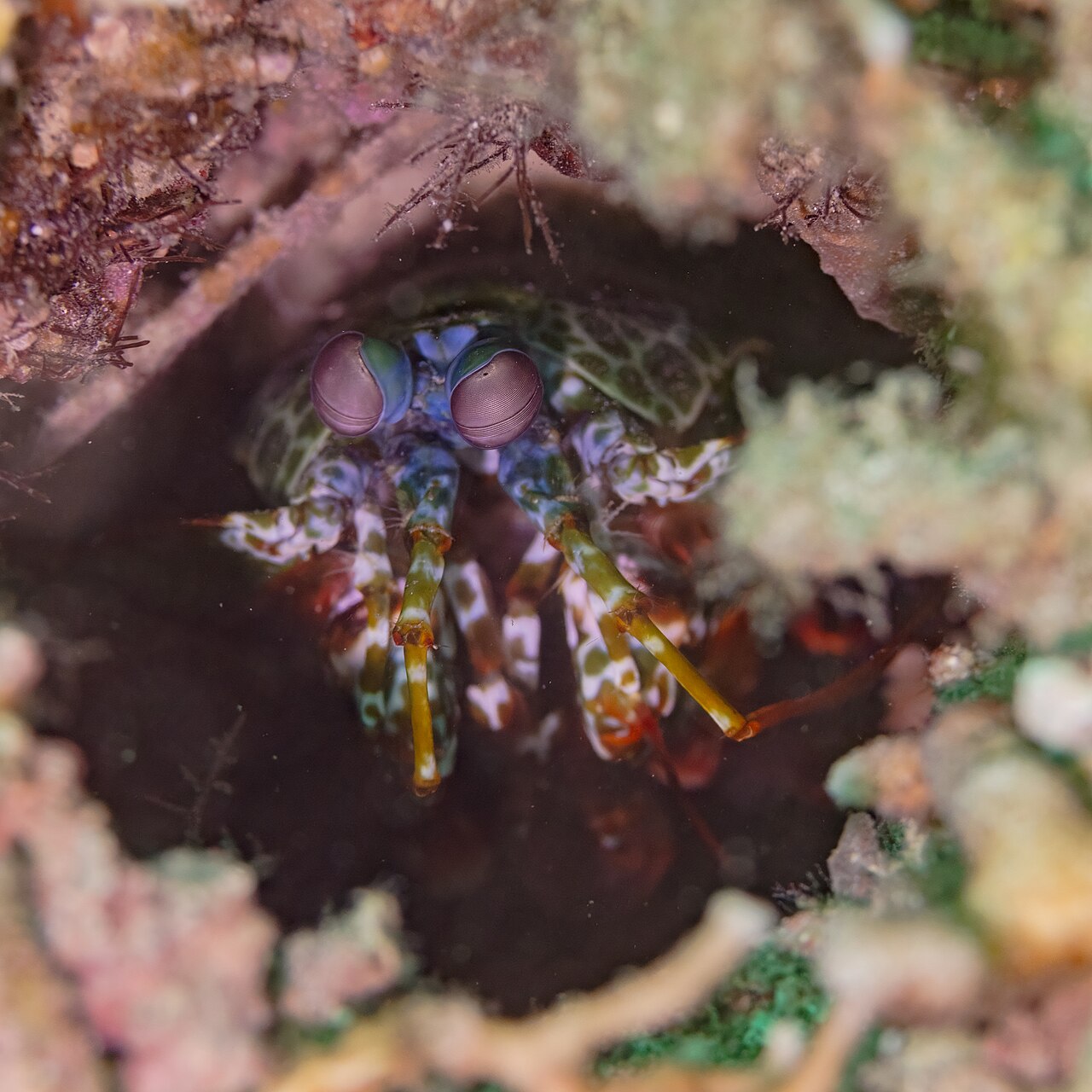
The eyes have 12 types of photoreceptors—more than any other animal. These allow the shrimp to distinguish color and both linear and circular polarized light. Stomatopods live in colorful coral reefs. Each eye has ventral and dorsal regions separated by a midband containing six rows of ommatidia.
Quick Facts
- Size range
- 3–18 cm / 0.098–0.591 ft
- Depth range
- 3–40 m / 9.84–131 ft
- Punch speed
- over 50 mph (over 20 m/s)
- Punch acceleration
- over 100,000 m/s² (more than 10,000 g)
- Punch force
- 340 lb / 154 kg-f
- Number of photoreceptor types
- 12
Facts from the source article.
Lore & Background
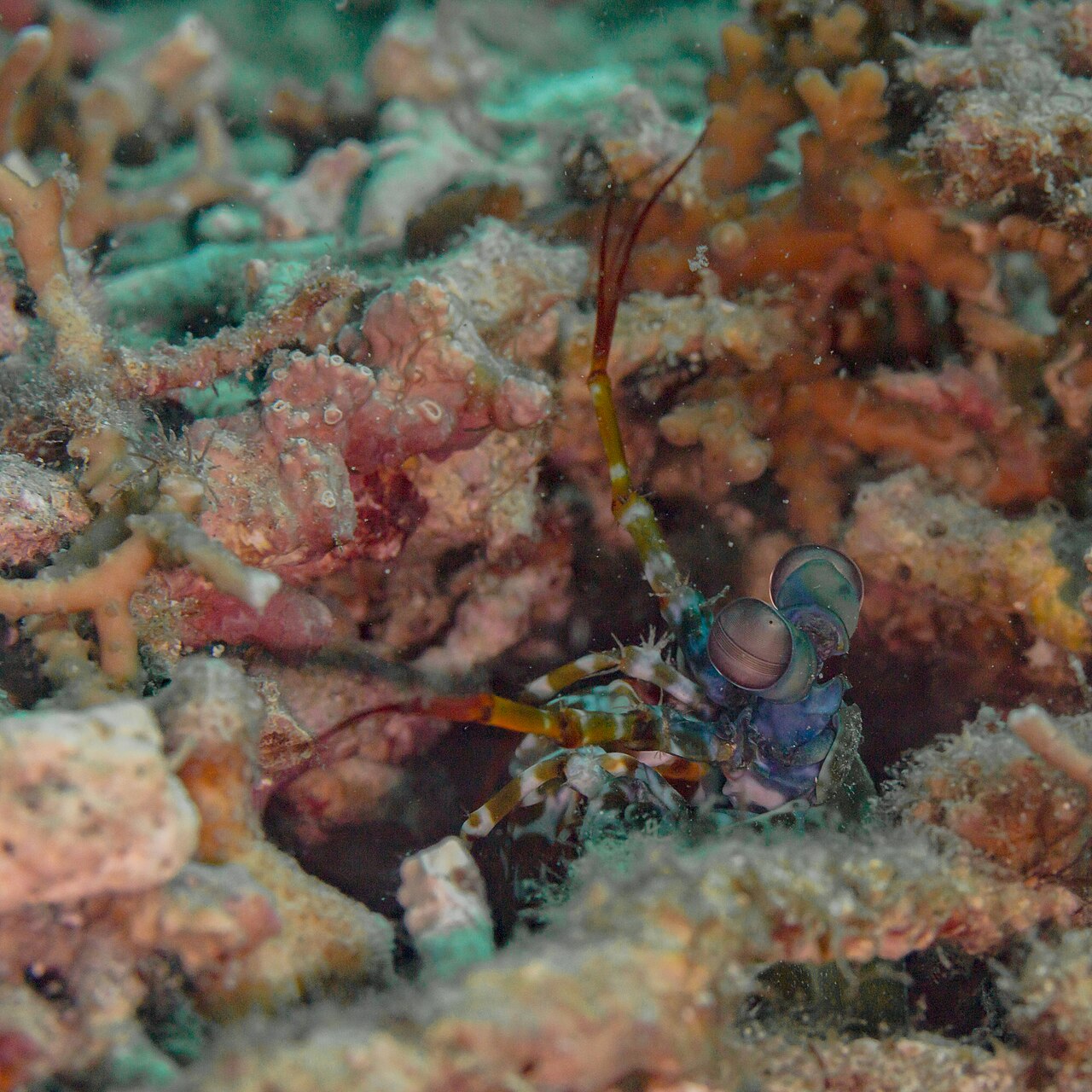
Odontodactylus scyllarus is a burrower, constructing U-shaped holes in loose substrate near the bases of coral reefs in water ranging from 3 to 40 m deep in the benthic zone. It is a smasher, with club-shaped raptorial appendages. An agile and active intertidal and sub-intertidal predator, it prefers gastropods, crustaceans (preferably crabs), and bivalves (including scallops such as Annachlamys flabellata), and will repeatedly deliver blunt force to the exoskeleton of its prey until it can gain access to the underlying soft tissue for consumption.
The dactyl club is a hammer-like appendage and the most electron-dense region of the stomatopod exoskeleton. Mechanically, it is a spring-loaded weapon. From a transverse cross-section, the club can be divided into three regions: the impact region, the periodic region, and the striated region. The impact region is mainly composed of hydroxyapatite with a higher degree of crystallinity than that found in bovine bone, which lessens the brunt of impact. The speed of a raptorial appendage's strike causes cavitation bubbles to form; when those bubbles pop they release a large amount of heat, temporarily raising temperatures and weakening the armor of prey.
Their eyes possess 12 types of photoreceptors, the largest number in any animal, allowing them to distinguish color and linear and circular polarized light. The eyes are made up of ventral and dorsal regions separated by a midband containing 6 rows of ommatidia; rows 1–4 involve color processing while rows 5–6 involve circular and linear polarized light. The ability to see circularly polarised light has led to studies to determine if the mechanisms by which their eyes operate can be replicated for use in reading CDs and similar optical storage devices.
Reader's Guide
Odontodactylus scyllarus is notable for its exceptional vision and its powerful, spring-loaded dactyl club, which delivers the fastest recorded punch of any living animal. The strike accelerates at over 100,000 m/s² (more than 10,000 g) and reaches speeds over 20 m/s, with each strike packing 340 lb-f of force. The impact region of the club is composed of highly crystalline hydroxyapatite, laminated in a manner highly resistant to fracturing, and its composition is being investigated for potential bionic use in material engineering. The eyes, with 12 types of photoreceptors, enable the animal to distinguish both linear and circular polarized light, a capability that has inspired research into replicating the mechanisms for optical storage devices such as CDs. In the marine aquarium trade, the species is both prized for its attractiveness and considered a dangerous pest; some of the largest specimens can break aquarium glass by striking it and can damage live rock by burrowing. Live rock with mantis shrimp burrows is considered useful by some in the trade and is often collected, and it is not uncommon for a piece of live rock to convey a live mantis shrimp into an aquarium, where it may feed on fish, shrimps, and other inhabitants. They are notoriously difficult to re-catch once established in a well-stocked tank.
The Spring-Loaded Fist of the Deep
The peacock mantis shrimp's dactyl club represents one of the most extraordinary mechanical structures in the animal kingdom. Functioning as a spring-loaded weapon, this hammer-like appendage is the most electron-dense region of the entire stomatopod exoskeleton. A transverse cross-section reveals three distinct zones—the impact region, the periodic region, and the striated region—each with mechanical properties tied to its degree of mineralization. The impact zone is dominated by hydroxyapatite with a crystallinity exceeding that of bovine bone, while the remaining sections blend calcium phosphate with calcium carbonate. This structure is roughly five times thicker than comparable appendages elsewhere on the body. The result is a strike exceeding 80 km/h, the fastest punch recorded in any living animal, delivering over 1,500 newtons of force with accelerations comparable to a .22 LR bullet. The sheer velocity generates cavitation bubbles whose collapse releases intense heat, softening prey armor. Researchers are now studying this laminated hydroxyapatite architecture for bionic applications in material engineering.
Twelve-Channel Vision in a World of Color
No other animal on Earth possesses more than twelve types of photoreceptors, yet the peacock mantis shrimp carries exactly that number, granting it a visual toolkit of remarkable breadth. Its eyes are organized into ventral and dorsal regions divided by a central midband containing six rows of ommatidia. The first four rows handle color processing, while rows five and six are dedicated to detecting both circular and linear polarized light. This extraordinary sensitivity allows the stomatopod to navigate the chromatically rich environments of coral reefs with precision. The capacity to perceive circularly polarized light has attracted particular scientific interest: researchers have explored whether the underlying optical mechanisms could be replicated to improve the reading of CDs and similar optical storage media. For a creature that spends its life among the vivid hues of Indo-Pacific reef systems, this multi-channel visual system is not merely impressive—it is essential for foraging, communication, and survival in a habitat saturated with color.
Life in the Reef's Loose Substrate
The peacock mantis shrimp is a dedicated burrower, excavating U-shaped tunnels in the loose sediment found at the bases of coral reefs. Its range spans the epipelagic seabed of the Indo-Pacific, stretching from the Mariana Islands across to East Africa and southward to Northern KwaZulu Natal in South Africa. It inhabits the benthic zone at depths between three and forty metres. As a smasher type among roughly 480 known mantis shrimp species, this agile predator favors hard-shelled prey—gastropods, crabs, and bivalves such as the scallop Annachlamys flabellata. Rather than slicing, it repeatedly hammers the exoskeleton of its target until the underlying soft tissue is exposed and can be consumed. Adults range from three to eighteen centimetres in length, displaying a primarily green body with orange legs and distinctive leopard-like spotting on the anterior carapace. The genus name itself, drawn from Ancient Greek, combines the words for tooth and finger, while the species epithet references a hermit crab, a nod to the creature's burrowing lifestyle in reef substrate.
Beloved and Feared in the Saltwater Tank
In the marine aquarium trade, the peacock mantis shrimp occupies a uniquely contradictory position. Its vivid green-and-orange coloration and leopard-spotted carapace make it a highly sought-after centerpiece for saltwater enthusiasts. Yet the same traits that make it visually stunning also make it a formidable and often unwelcome tenant. As a voracious predator, it will readily consume fish, shrimp, and other desirable tank inhabitants. The largest specimens have been documented shattering ordinary glass aquariums with a single strike, and they will burrow aggressively into live rock, damaging coral in the process. Ironically, live rock bearing the telltale burrows of a mantis shrimp is itself a commodity in the trade, frequently collected and sold. This creates a persistent risk: a seemingly innocuous piece of reef rock may harbor a live specimen that, once established in a well-stocked tank, becomes notoriously difficult to recapture. For aquarists, the peacock mantis shrimp is simultaneously a prize and a menace—a creature whose beauty and destructiveness are inseparable.
Gallery


More in Mantis Shrimp
Spotted an error? Know more?
Reader corrections go straight into our review queue. Suggest an edit · How this site is sourced