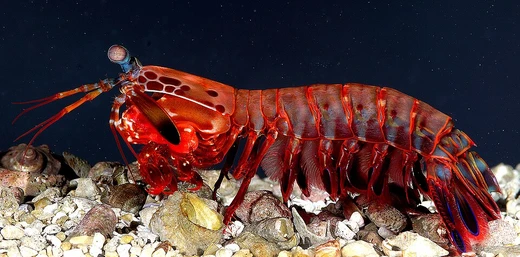
Squilla empusa
A burrowing mantis shrimp of the western Atlantic.
Squilla empusa is a mantis shrimp that lives in coastal waters of the western Atlantic. It digs and occupies a burrow in soft sediment, emerging mainly at night to hunt fish and other invertebrates. Adults reach about 30 cm in length.
Its head has stalked compound eyes that move independently to scan the area. The head and thorax are fused into a cephalothorax, covered by a shield-like carapace. The thorax has eight segments, each with a pair of appendages. The first pair are slender and used for grooming. The second pair are large raptorial claws that slash and spear prey. The third, fourth, and fifth pairs are flattened at the tip; these maxillipeds move food to the mouth. The sixth, seventh, and eighth pairs are simple walking legs called pereiopods. The abdomen has six segments. The front five each have a pair of biramous (branched) pleopods, or swimming legs, which also bear filamentous gills. The sixth segment has a pair of large uropods that, with the flexible, six-spiked telson, form a broad tailfan.
This species is reported from the U.S. eastern seaboard, from Cape Cod to the Gulf of Mexico, as well as from Brazil and the Mediterranean Sea. It lives in a U-shaped burrow in soft sediment, from the intertidal zone down to about 150 m depth.
In summer, the burrow is a tube with typically two openings connected by a horizontal tunnel 15 to 50 cm below the sediment surface. The horizontal section usually has two bends and a diameter up to 10 cm, depending on the occupant. In the northern part of its range, the shrimp digs a vertical winter burrow up to 4.1 m deep. At that depth, oxygen drops and temperature rises, which may allow it to survive where winter water temperatures would otherwise be too low.
Two main burrowing methods are used. Vigorous fanning of the pleopods suspends sediment particles, and the resulting current pushes the plume backward past the telson. This can create a depression the animal’s own size in two minutes. It then turns and uses its maxillipeds to form a basket, carrying lumps of sediment away from the excavation—a slower but sustainable process. Further digging creates the typical tunnel with one or more openings, often remodeled within hours. The shrimp can dig to 20 cm in less than an hour. Inside the burrow, it sometimes uses its maxillipeds to create a water current.
Quick Facts
- Maximum length
- about 30 cm / 1 ft
- Depth range
- intertidal zone to about 150 m (500 ft)
- Geographic range
- eastern seaboard of the United States (Cape Cod to Gulf of Mexico), Brazil, and the Mediterranean Sea
- Burrow depth (summer)
- 15 to 50 cm (1 ft 8 in) below sediment surface
- Number of abdominal segments
- 6
- Number of thoracic segments
- 8
Facts from the source article.
Lore & Background
Squilla empusa has a head and thorax fused into a cephalothorax protected by a shield-like carapace. The head bears stalked compound eyes that can move separately to scan the surroundings. The thorax has eight segments, each bearing a pair of appendages: the front pair are slender and used for grooming; the second pair are large, raptorial claws that can slash and spear prey; the third, fourth and fifth pairs (maxillipeds) have flattened terminal segments and are used to move food to the mouth; the sixth, seventh and eighth pairs are unspecialised walking legs (pereiopods). The abdomen has six segments, the front five each bearing a pair of biramous pleopods (swimming legs) with filamentous gills. The sixth segment bears a pair of large uropods which, together with the flexible, six-spiked telson, forms a broad tailfan.
This species lives in a U-shaped burrow in soft sediment. The summer burrow is a tube with typically two openings connected by a horizontal tunnel some 15 to 50 cm below the surface, normally with two bends and a diameter of up to 10 cm. In the more northerly parts of its range, it excavates a vertical burrow in winter up to 4.1 m deep, where the oxygen content of the water decreases and the temperature rises—an adaptation that may allow it to survive where winter water temperatures would otherwise be too low. Two main burrowing methods are used: a vigorous fanning action of the pleopods that suspends sediment and pushes it backwards past the telson, and a slower process using the maxillipeds to carry lumps of sediment away. Squilla empusa can dig to a depth of 20 cm in less than an hour and frequently remodels its burrow. It is territorial and defends its burrow from other mantis shrimps.
Squilla empusa is mainly nocturnal and feeds on fish, shrimps, crabs, krill, worms, molluscs and other mantis shrimps. The raptorial claws are unfolded with great rapidity to spear, slash and immobilise prey, which is brought back inside the burrow when caught.
Reader's Guide
Squilla empusa is notable for its burrowing behaviour and its ability to adapt to seasonal temperature changes in the northern part of its range. Its summer burrow is a shallow U-shaped tunnel, but in winter it digs a vertical burrow up to 4.1 m deep, where the water is warmer and lower in oxygen—a behavioural adaptation that may allow it to survive in locations where winter water temperatures would otherwise be lethal. The species uses two distinct burrowing methods: a rapid fanning of the pleopods to suspend sediment, and a slower, sustainable method of carrying sediment with its maxillipeds. It can dig to 20 cm in under an hour and frequently remodels its burrow. As a nocturnal predator, it feeds on a wide variety of prey including fish, shrimps, crabs, krill, worms, molluscs and other mantis shrimps, using its raptorial claws to spear, slash and immobilise prey before bringing it back to the burrow. Its territorial nature and defensive behaviour toward other mantis shrimps further characterise its ecological role in soft-sediment habitats from the intertidal zone to depths of about 150 m.
More in Mantis Shrimp
Spotted an error? Know more?
Reader corrections go straight into our review queue. Suggest an edit · How this site is sourced