Ptolemaeus (lunar crater)
Ancient lunar walled plain near the Moon's center.
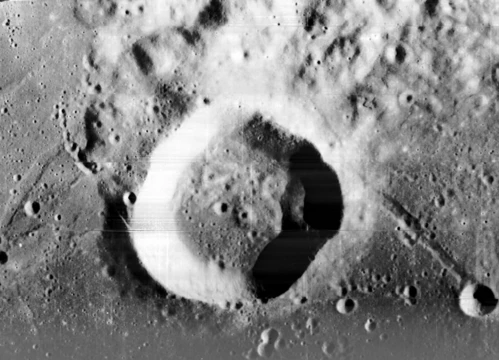
Ptolemaeus is an ancient lunar impact crater located near the center of the Moon's near side. It is named for Claudius Ptolemy, the Greco-Roman writer, mathematician, astronomer, geographer and astrologer. The crater measures approximately 154 kilometers in diameter and has been described as a magnificent lake whose surface at sunrise or sunset is occasionally seen all roughened with ridges like waves.
Quick Facts
- Diameter
- 154 km / 95.7 mi
- Depth
- 2.4 km / 7,874 ft
- Colong
- 3
- Formation
- Pre-Nectarian
- Eponym
- Claudius Ptolemaeus
Facts from the source article.
Description
Ptolemaeus connects to Alphonsus to the south-southwest through a rough, uneven stretch, and together with Arzachel further south they create a noticeable line of craters. Albategnius lies to the southeast, while the distinct, smaller Herschel sits to the north. The crater stands out best when the Sun is low, during the first and last quarter; under a full Moon, with light coming from directly overhead, its details fade. Its outer wall is low and uneven, heavily battered and marked by many smaller impacts. Though roughly circular, the rim has a clear polygonal shape, with its highest point, Ptolemaeus Gamma, reaching 2.9 kilometers on the northwest side. There is no central peak, no ray system, and the floor has been covered by lava, giving it the look of a walled plain. The floor is relatively dark and holds several ghost craters—old rims now barely visible as low ridges, only seen in slanting light. Smaller craters are scattered across it, most notably Ammonius in the northeast. On both sides, long, irregular cracks run roughly parallel to each other, forming valley-like features that extend from the direction of Mare Imbrium to the north-northwest.
More in Lunar Craters
Spotted an error? Know more?
Reader corrections go straight into our review queue. Suggest an edit · How this site is sourced