Hertzsprung (crater)
A large far-side lunar impact basin with a central mascon.
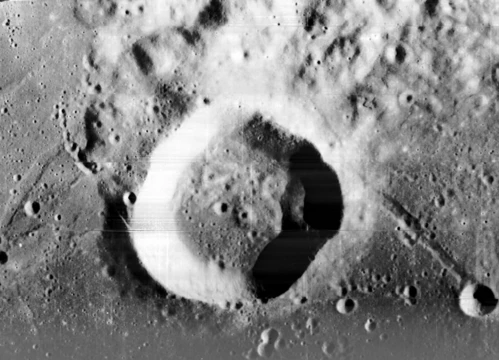
Hertzsprung is an enormous lunar impact basin located on the far side of the Moon, beyond the western limb. It is larger than several of the lunar mare areas on the near side and lies in the northwestern fringe of the Mare Orientale impact basin's blast radius. The crater dates to the Nectarian period and contains a central mass concentration (mascon) first identified by Doppler tracking of the Lunar Prospector spacecraft.
Quick Facts
- Diameter
- 570 km / 354 mi
- Depth
- 5.31 km / 3.3 mi
- Colong
- 140
- Formation
- Nectarian
- Eponym
- Ejnar Hertzsprung
Facts from the source article.
2022 Long March 3C third stage impact
In early 2022, a tracking mistake was corrected when it was revealed that the third stage of a Long March 3C rocket from the 2014 Chang'e 5 T1 mission was set to hit the Moon near this crater. The impact occurred on March 4 at 12:25:58 UTC, at roughly 5.18 degrees north and 233.55 degrees east. The event highlighted the difficulty of monitoring small objects in deep space. Also destroyed was the attached Manfred Memorial Moon Mission, a private probe from LuxSpace. By June 2022, NASA had photographed the resulting crater. Unlike earlier rocket body impacts, which left single large craters, this one produced a double-lobed shape. The crater was located near Hertzsprung D at 5.226 degrees north, 234.486 degrees east, at an elevation of 1,863 meters. During the Artemis II mission in April 2026, astronauts saw the Hertzsprung impact basin and its surroundings with their own eyes.
More in Lunar Craters
Spotted an error? Know more?
Reader corrections go straight into our review queue. Suggest an edit · How this site is sourced