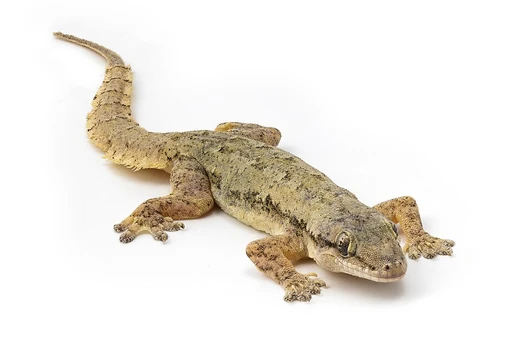
Marine iguana
The only extant lizard that forages in the sea.

The marine iguana (Amblyrhynchus cristatus) is a lizard species that lives only on the Galápagos Islands, which belong to Ecuador. It is also called the sea iguana, saltwater iguana, or Galápagos marine iguana. Among all living lizards, it is unique as a marine reptile that can feed in the ocean, where it gets almost all its food from algae. It is the only existing lizard that regularly spends time in a marine setting. Large males can dive to reach this food, while females and smaller males eat during low tide in the intertidal zone. These iguanas mostly live in colonies on rocky shores, where they bask after being in the cold water or intertidal area, but they also turn up in marshes, mangrove swamps, and beaches. Large males defend territories for a short time, but smaller males use other breeding methods. After mating, the female digs a nest hole in the soil, lays her eggs, and leaves them to hatch on their own a few months later. Their appearance varies across different islands, and several subspecies are recognized. Though still relatively numerous and locally abundant, this protected species is considered threatened, mainly because of El Niño cycles, introduced predators, and chance events like oil spills.
The marine iguana was first described in 1825 by Thomas Bell, who named it Amblyrhynchus cristatus. He noted several of its distinctive traits but mistakenly thought the specimen came from Mexico, a location now known to be wrong. Its genus name, Amblyrhynchus, comes from Greek words: "Ambly-" from "amblus," meaning "blunt," and "rhynchus," meaning "snout." The species name "cristatus" is Latin for "crested," referring to the low spine crest along its back. Amblyrhynchus is a monotypic genus, containing only this one species.
Researchers think that Galápagos land iguanas (genus Conolophus) and marine iguanas evolved from a common ancestor after arriving on the islands from Central or South America, likely by rafting. Together, these land and marine iguanas form a clade, with their closest relatives being the Ctenosaura iguanas of Mexico and Central America. One study using mtDNA estimated that marine iguanas split from land iguanas between 5 and 15 million years ago, which is older than any current Galápagos island. This led to the idea that the ancestral species lived on parts of the volcanic archipelago that are now underwater. However, a later study using both mtDNA and nDNA suggests the split happened about 4.5 million years ago, close to the age of the oldest existing islands, Española and San Cristóbal. Despite being separated for millions of years and placed in different genera, marine iguanas and Galápagos land iguanas can still breed with each other. They have hybridized where their ranges overlap, producing a so-called hybrid iguana. This is very rare and has only been seen a few times on South Plaza, a tiny island where the usually separate breeding territories and seasons of the two species overlap. These hybrids have intermediate features, stay on land, and are infertile.
Different marine iguana populations fall into three main clades: western islands, northeastern islands, and southeastern islands. These can be split further, with each subclade generally matching iguanas from one or two main islands, except on San Cristóbal, which has two subclades (northeastern and southwestern). Even the oldest split among marine iguana populations is quite recent—no more than 230,000 years and likely less than 50,000 years. Occasionally, an individual reaches another island, leading to hybridization between different marine iguana populations. There is one confirmed record of a marine iguana outside the Galápagos: in 2014, one appeared on Isla de la Plata near the Ecuadorian mainland.
Traditionally, seven or eight subspecies have been recognized, listed alphabetically: A. c. albemarlensis (Isabela Island), A. c. ater (Pinzón Island, not always recognized), A. c. cristatus (Fernandina Island), A. c. hassi (Santa Cruz Island), A. c. mertensi (San Cristóbal and Santiago Islands), A. c. nanus (Genovesa Island), A. c. sielmanni (Pinta Island), and A. c. venustissimus (Española Island and adjacent tiny Gardner Island). In 2017, the first comprehensive taxonomic review in over 50 years used morphological and genetic evidence to reach a different result, recognizing five new subspecies (three from small islands not previously assigned to any subspecies): A. c. cristatus (Isabela and Fernandina Islands, with albemarlensis and ater as junior synonyms), A. c. godzilla (northeastern San Cristóbal Island, named after the character Godzilla), A. c. hassi (Santa Cruz Island and smaller adjacent islands like Baltra), A. c. hayampi (Marchena Island), A. c. jeffreysi (Wolf Island, Darwin Island, and Roca Redonda), A. c. mertensi (southwestern San Cristóbal Island), A. c. nanus (Genovesa Island), A. c. sielmanni (Pinta Island), A. c. trillmichi (Santa Fé Island), A. c. venustissimus (Española Island, including adjacent tiny Gardner Island, and Floreana Island), and A. c. wikelskii (Santiago Island and smaller adjacent islands like Rábida).
- Scientific name
- Amblyrhynchus cristatus
- First described
- 1825 by Thomas Bell
- Habitat
- Galápagos Islands (Ecuador)
- Diet
- Algae (almost exclusively)
- Conservation status
- Threatened (protected species)
- Subspecies
- Seven to eleven recognized (depending on taxonomy)
Lore & Background
Marine iguanas vary in appearance between the different islands and several subspecies are recognized. Large males are able to dive to find algae, while females and smaller males feed during low tide in the intertidal zone. They mainly live in colonies on rocky shores where they bask after visiting the relatively cold water or intertidal zone, but can also be seen in marshes, mangrove swamps and beaches. Large males defend territories for a short period, but smaller males have other breeding strategies. After mating, the female digs a nest hole in the soil where she lays her eggs, leaving them to hatch on their own a few months later. Researchers theorize that Galapagos land iguanas (genus Conolophus) and marine iguanas evolved from a common ancestor since arriving on the islands from Central or South America, presumably by rafting. Based on a study that relied on mtDNA, the marine iguana was estimated to have diverged from land iguanas some 5-15 million years ago, which is older than any of the extant Galápagos islands. However, a more recent study that included both mtDNA and nDNA indicates that the two split about 4.5 million years ago. The marine iguana and Galápagos land iguana remain mutually fertile and have been known to hybridize where their ranges overlap, resulting in the so-called hybrid iguana, which is very rare and has only been documented a few times on South Plaza. Early visitors to the Galápagos Islands considered the marine iguanas ugly and disgusting. Adults have a row of spines extending from the nape, along the back to the tail. Dark tones allow the lizards to rapidly absorb heat to minimize the period of lethargy after emerging from the water.
Reader's Guide
The marine iguana is significant as the only extant lizard that spends time in a marine environment, representing a unique evolutionary adaptation among reptiles. Its ability to forage in the sea for algae, which make up almost all of its diet, distinguishes it from all other modern lizards. The species is endemic to the Galápagos Islands, and its evolution is closely tied to the volcanic archipelago's history. Researchers theorize that marine iguanas and Galápagos land iguanas evolved from a common ancestor that arrived from Central or South America, presumably by rafting. The divergence between the two is estimated at between 4.5 and 15 million years ago, depending on the study. The different marine iguana populations fall into three main clades: western islands, northeastern islands and southeastern islands, with further subclades generally matching one or two primary islands. Although relatively large numbers remain and it is locally abundant, this protected species is considered threatened, primarily from El Niño cycles, introduced predators and chance events like oil spills. The marine iguana's appearance varies between islands, with males of the southern islands being the most colourful, with bright pinkish-red and turquoise markings, while those of the northern islands are almost all blackish.
Did You Know?
- Marine iguanas are the only extant lizard that spends time in a marine environment.
- They feed almost exclusively on algae, with large males diving to find it while females and smaller males feed during low tide.
- The marine iguana and Galápagos land iguana can hybridize, though this is very rare and has only been documented a few times on South Plaza.
Taxonomy, Naming, and Global Spread
Laurenti, establishing a taxonomic group that has since become one of the most recognizable in the lizard world. The name itself traces back to the Taino word iwana, a reminder that these animals were known long before European taxonomy codified them. Today, two species are formally recognized within the genus: the green iguana, found broadly across tropical Mexico, Central America, South America, and the Caribbean, and the Lesser Antillean iguana, restricted to the Lesser Antilles. Genetic analyses, however, have raised the possibility that what we call the green iguana is actually a complex of multiple closely related species, some recently described, though the Reptile Database still lumps them together as subspecies. The genus's fame has carried it far beyond its native range. As a popular pet, non-native iguanas have been introduced to Ishigaki Island, the Florida Peninsula, Hawaii, Singapore, Thailand, Taiwan, and even to islands within the Lesser Antilles where native iguana populations already exist. Several other genera in the same family also carry iguana in their common names, further blurring the public's understanding of the group.
Anatomy and Sensory World
Iguanas are substantial lizards, reaching 1.2 to 2.0 meters in length including their tails. Their bodies display a mosaic of scale types: large, round tuberculate scales dot the lateral neck among smaller overlapping ones, while the dorsal trunk bears thicker, more tightly packed scales than the ventral sides. A prominent dewlap hangs beneath the throat, and a row of elongated scales runs from the midline of the neck down to the tail. On each cheek sits a large, round subtympanic shield, above which the tympanum, the eardrum, is positioned. The Lesser Antillean iguana notably lacks this shield. Vision is a dominant sense. Iguanas can discern shapes, shadows, colors, and movement from considerable distances, helping them navigate dense forests, locate vegetation, and exchange visual signals with conspecifics. Their coloration also serves as camouflage, helping them evade larger predators. Beneath the skin, iguanas possess a three-chambered heart with two atria and one ventricle, connected to two aortae. Their muscles appear pale because they are dominated by fast-twitch, glycolytic type A fibers that are poorly vascularized and low in myoglobin. This design favors short bursts of speed but is inefficient for sustained movement, as these fibers rely on anaerobic respiration.
Herbivorous Adaptations and Feeding Mechanics
Iguanas are strictly herbivorous, feeding exclusively on vegetation and foliage. This dietary specialization has driven remarkable modifications to their skulls. Compared with carnivorous or omnivorous reptiles of similar size, herbivorous lizards need a proportionally greater bite force to acquire, process, and digest plant matter. The iguana skull reflects this demand: it is taller and wider, the snout is shorter, and the overall body is larger. These structural changes allow the skull to house more powerful jaw muscles and to withstand the stronger forces generated during feeding. The teeth themselves are acrodontal, meaning they sit on top of the jaw bone and project upward rather than being embedded within it. They are small and serrated, an adaptation suited to grasping and shearing plant material rather than tearing flesh. Together, the reinforced skull architecture and the specialized tooth morphology form a highly efficient plant-processing system, one that distinguishes iguanas from their more carnivorous relatives and underpins their ecological role as browsers in tropical forests.
Reproduction, Courtship, and Life Cycle
Iguana reproduction follows a promiscuous, polygynandrous mating system peaking during the dry season, so offspring hatch in the wet season when food is plentiful. Females command large territories and dig several nests, while males compete for access to them, marking territory with a pheromone from femoral pores on the dorsal side of their hind limbs. Courtship displays include head bobbing, extending and retracting the dewlap, nuzzling and biting a female's neck, and occasional color changes. Once a female selects a mate, the male straddles her and bites her shoulder to hold her, sometimes leaving scars. Males, like other squamates, possess two hemipenes, one inserted into the female's cloacal vent during copulation. Females can store sperm from previous mates for several years to fertilize future clutches. Clutch size depends on body size and environmental conditions: up to 71 eggs in Iguana iguana, 30 in Iguana delicatissima, and 35 in the only reported hybrid female. In some circumstances, iguanas can even produce hatchlings without mating. Eggs are laid in underground nests, reaching depths of 1.65 meters in the Lesser Antillean iguana, with hatchlings emerging after more than 85 days of incubation. This low level of parental intervention classifies iguanas as r-strategists.
Frequently Asked Questions
What is a marine iguana?
The marine iguana (Amblyrhynchus cristatus) is a species of iguana native exclusively to the Galápagos Islands in Ecuador, first formally described in 1825 by Thomas Bell.
What makes the marine iguana unique among lizards?
It is the only living lizard species that actively forages in a marine environment, diving into the ocean to feed on algae. No other extant lizard shares this saltwater foraging behavior.
Where do marine iguanas live?
Marine iguanas are found only on the Galápagos Islands off the coast of Ecuador. Depending on the taxonomic framework used, their population is divided into seven to eleven distinct subspecies across different islands.
What do marine iguanas eat?
Their diet consists almost entirely of algae, which they scrape from underwater rocks during foraging dives into the sea.
What is the marine iguana's conservation status?
The species is classified as Threatened and is a protected species, meaning it faces significant risks to its survival in the wild.
More in Lizards And Snakes 1-17
Spotted an error? Know more?
This is a living reference — every entry is fact-audited, and reader corrections feed straight into our audit queue. Suggest an edit · See this site's audit record