
Moby-Dick

Herman Melville · Public domain
Herman Melville’s 1851 novel *Moby-Dick; or, The Whale* follows the sailor Ishmael as he recounts Captain Ahab’s obsessive hunt for the white sperm whale that tore off his leg on an earlier voyage. Ahab commands the whaling ship *Pequod* on this quest for vengeance. The book was a commercial failure and out of print when Melville died in 1891, despite being a work of the American Renaissance. Its reputation as a Great American Novel emerged only in the 20th century, after the author’s 1919 birth centennial. William Faulkner said he wished he had written it, and D. H. Lawrence called it “the greatest book of the sea ever written.” The opening line, “Call me Ishmael,” is among the most famous in world literature.
Melville began writing in February 1850 and finished 18 months later, a year behind schedule. He drew on his own experience as a common sailor from 1841 to 1844, including time on whalers, and on extensive reading of whaling literature. The white whale is based on a notoriously elusive albino whale named Mocha Dick, and the ending mirrors the 1820 sinking of the whaleship *Essex*. The novel mixes realistic descriptions of sailing, whale hunting, and oil extraction with explorations of class, good and evil, and God’s existence. Its literary influences include Shakespeare, Thomas Carlyle, Sir Thomas Browne, and the Bible. Melville uses songs, poetry, catalogs, and Shakespearean stage directions and soliloquies alongside narrative prose.
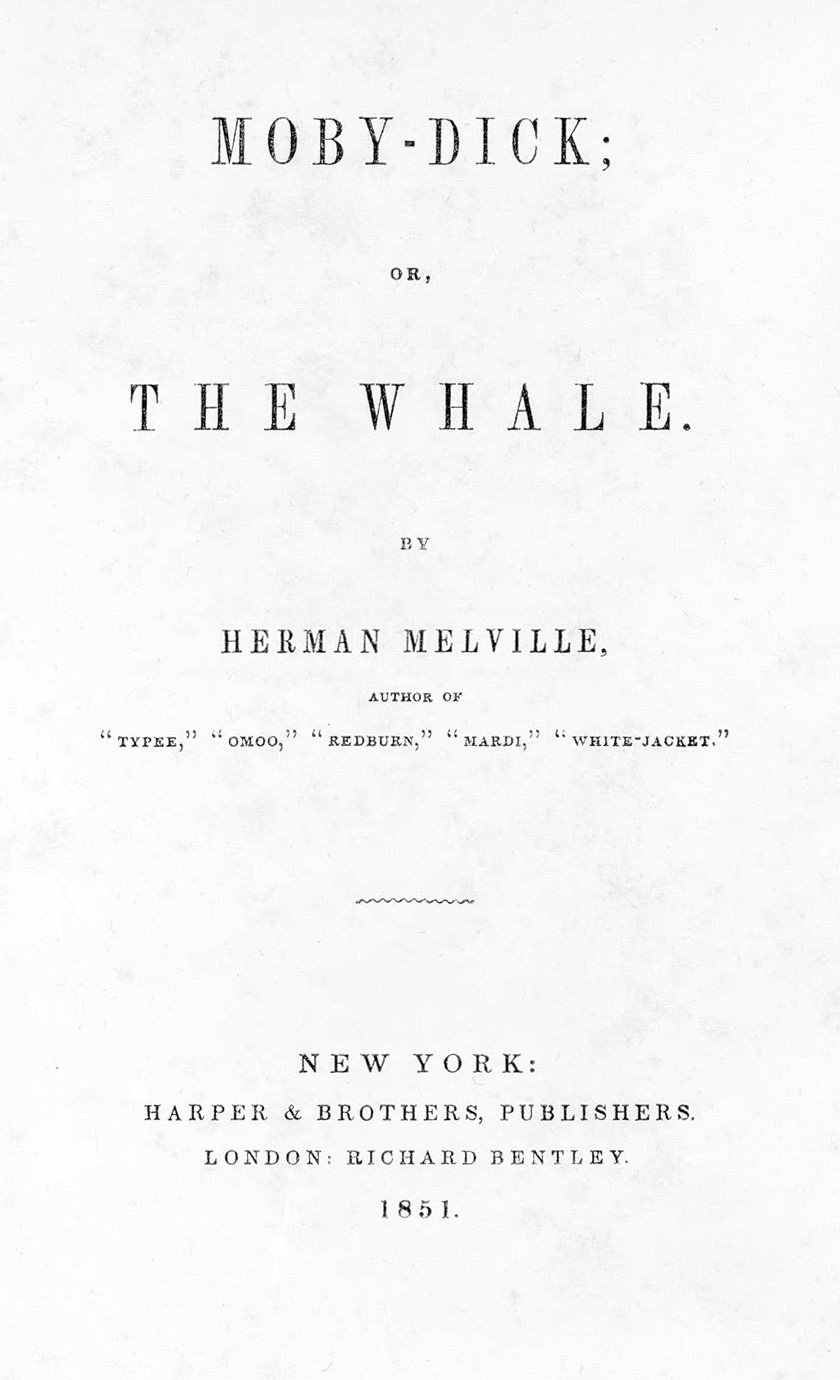
In August 1850, with the manuscript perhaps half done, Melville met Nathaniel Hawthorne and was deeply impressed by his *Mosses from an Old Manse*, which he compared to Shakespeare in ambition. This encounter may have inspired him to revise and deepen the book, which is dedicated to Hawthorne. The novel was first published in London in October 1851 as *The Whale* in three volumes, then in New York in November as a single volume under the definitive title *Moby-Dick; or, The Whale*. The London publisher, Richard Bentley, censored or changed sensitive passages; Melville also made revisions, including a last-minute title change for the New York edition. In both editions, the whale appears in the text as “Moby Dick” without a hyphen. British reviews were largely favorable, though some objected that the narrator seemed to have died with the ship, since the British edition lacked the epilogue revealing Ishmael’s survival. American reviewers were more hostile.
The plot begins in December, when Ishmael travels from Manhattan to New Bedford to join a whaling voyage. At a crowded inn, he shares a bed with Queequeg, a tattooed Polynesian harpooneer and son of a king from Rokovoko. They attend Father Mapple’s sermon on Jonah, then head to Nantucket. Ishmael signs onto the *Pequod* under Quaker owners Bildad and Peleg. Peleg calls Captain Ahab a “grand, ungodly, god-like man” with “his humanities.” Queequeg joins the crew, and a man named Elijah warns of a dire fate. Shadowy figures board the ship, and on Christmas Day the *Pequod* departs.
Ishmael discusses cetology and introduces the crew: chief mate Starbuck, a realist Nantucket Quaker; cheerful second mate Stubb from Cape Cod; third mate Flask; and harpooners Queequeg, the Indian Tashtego, and the African Daggoo. Ahab appears on the quarterdeck with a leg prosthesis made from a whale’s jawbone. He nails a doubloon to the mast as a reward for the first man to sight Moby Dick. Ahab’s vow of vengeance captivates Ishmael, despite Starbuck’s objection that the voyage is for profit. The *Pequod* sails toward the Azores, then southwest along South America, crossing to the Indian Ocean via the Cape of Good Hope. Tashtego sights a sperm whale, and the shadowy figures are revealed as Ahab’s special crew, led by the Parsee Fedallah. The ship makes “gams” with other vessels: the *Goney* cannot answer about Moby Dick, and the *Town-Ho* reveals a story of divine judgment involving the whale.
Stubb kills a sperm whale, and the cook Fleece preaches to the sharks feeding on the carcass. Queequeg mounts the whale, tied to Ishmael by a monkey-rope. Stubb and Flask kill a right whale, and its head is fastened opposite the sperm whale’s head. Ishmael compares the two heads philosophically: the right whale is Lockean and stoic, the sperm whale Kantean and platonic. Tashtego nearly drowns in the sperm whale’s head but is rescued by Queequeg. Pip, a young black cabin-boy, leaps from a whale boat in terror twice; the second time he is abandoned at sea and goes insane. The crew processes whale parts: liquefying spermaceti, boiling blubber, decanting oil into casks. Ahab interprets the doubloon’s symbolism as representing his energy, firmness, and victory. In a gam with the *Samuel Enderby*, its captain says he lost an arm to Moby Dick but bears no grudge. Queequeg falls ill, the carpenter makes a coffin, but Queequeg recovers and uses it as a seachest. Ahab has the blacksmith forge a special harpoon tempered in his own blood.
- author
- Herman Melville
- genre
- Epic novel
- nationality
- American
- known_for
- The story of Captain Ahab's quest for the white whale Moby Dick
Quick Facts
- Border
- no
- Author
- Herman Melville
- Country
- United States
- Language
- English
- Genre
- Adventure fiction · epic · sea story · encyclopedic novel
- Publisher
- Richard Bentley (United Kingdom) / Harper & Brothers (United States)
- Release Date
- October 18, 1851 (United Kingdom) / November 14, 1851 (United States)
- Dewey
- 813.3
- Congress
- PZ3.M498 Mo3
- Wikisource
- Moby-Dick (1851) US edition
- Pages
- 635 (U.S. edition)
Facts from the source article.
Lore & Background
The detailed and realistic descriptions of sailing, whale hunting and of extracting whale oil, as well as life aboard ship among a culturally diverse crew, are mixed with exploration of class and social status, good and evil, and the existence of God. The book's literary influences include Shakespeare, Thomas Carlyle, Sir Thomas Browne and the Bible. This encounter may have inspired him to revise and deepen Moby-Dick, which is dedicated to Hawthorne, 'in token of my admiration for his genius'.
Reader's Guide
The London publisher, Richard Bentley, censored or changed sensitive passages; Melville made revisions as well, including a last-minute change of the title for the New York edition. The whale, however, appears in the text of both editions as 'Moby Dick', without the hyphen. Reviewers in Britain were largely favorable, though some objected that the tale seemed to be told by a narrator who perished with the ship, as the British edition lacked the epilogue recounting Ishmael's survival. American reviewers were more hostile. William Faulkner said he wished he had written the book himself, and D. H. Lawrence called it 'one of the strangest and most wonderful books in the world' and 'the greatest book of the sea ever written'. Its opening sentence, 'Call me Ishmael', is among world literature's most famous.
Did You Know?
- The white whale is modeled on a notoriously hard-to-catch albino whale named Mocha Dick.
- The British edition lacked the epilogue recounting Ishmael's survival, leading some reviewers to object that the tale seemed told by a narrator who perished.
Early Cinematic Interpretations (1926–1956)
The novel first crossed onto the silver screen in 1926 with The Sea Beast, a silent picture in which John Barrymore portrayed Ahab as a heroic figure complete with a fiancée and a villainous brother—details that stretch well beyond Melville's text. That version was remade in 1930 as Moby Dick, this time giving Ahab a triumphant ending where he slays the whale and returns to the arms of his beloved, played by Joan Bennett. The most celebrated early adaptation arrived in 1956, when John Huston directed a version starring Gregory Peck as the obsessive captain, with a screenplay penned by Ray Bradbury. That same year, a Japanese novel called The Whale God won the Akutagawa Prize and was later adapted into a tokusatsu film by Daiei Film, pitting an enormous North Pacific right whale against vengeful whalers in a plot clearly echoing Melville's narrative. These early decades established the template: Ahab as the driving force, the whale as the ultimate adversary, and the Pequod's voyage as the stage for human obsession.
Animated and Children's Adaptations
Moby-Dick proved remarkably adaptable to animation and family-oriented storytelling. In 1984, the animated feature Samson & Sally: Song of the Whales (released elsewhere as The Secret of Moby Dick) told the story from the perspective of a young white whale searching for the legendary Moby-Dick, with the Pequod's sinking narrated by the whale's mother. A 1986 animated film, Dot and the Whale, had its heroine questing for Moby Dick to aid a beached whale. The 1996 Canadian short The Adventures of Moby Dick reimagined the whale as a young creature who lost his mother off Massachusetts in 1841 and was befriended by an orphan boy named Ishmael aboard the Pequod. Television brought the story to even younger viewers: a 1957 Woody Woodpecker episode sent Woody aboard the Peapod to chase a pink whale, while a 1962 Tom and Jerry cartoon had Tom lashed to a whale's side in an Ahab-like fashion. Hanna-Barbera's 1967 series Moby Dick and Mighty Mightor paired the whale with two rescued boys for lighthearted adventures.
International and Diverse Reinterpretations
Beyond Hollywood, Moby-Dick inspired a remarkable range of international and genre-bending adaptations. A 1999 Russian paint-on-glass animation directed by Natalya Orlova, with a screenplay by Brian Sibley and Rod Steiger voicing Ahab, placed third at the 5th Open Russian Festival of Animated Film and later appeared on DVD in a World Literary Classics series. In 2007, French director Philippe Ramos crafted Capitaine Achab, a film tracing Ahab's early life up to his first encounter with the whale. The 2011 film Age of the Dragons transposed the story into a fantasy setting where Danny Glover plays a fire-maimed Ahab hunting a great white dragon rather than a whale. The 2018 sci-fi film Beyond White Space wove references to the novel, its characters, and the real people involved in its publication into a science-fiction narrative. Even the 2015 Ron Howard film In the Heart of the Sea, while not a direct adaptation, dramatized the 1820 sinking of the whaling ship Essex—the real event that seeded Melville's imagination.
Television Parodies and Cultural Saturation
By the 1990s, Moby-Dick had permeated popular culture to the point where it became a ready-made template for parody. A 1991 Beetlejuice episode titled Moby Richard had the character Moby Dick refuse to let Beetlejuice rewrite the classic, only for Ahab to possess BJ and lead a revenge quest through Sandworm Land. Animaniacs contributed the 1993 segment Moby or Not Moby, where the Warner siblings defend the whale from Ahab and perform a parody of The Drunken Sailor called Captain Ahab, You're a Dummy. The New Pink Panther Show aired Moby Pink in 1993, featuring the Pink Panther aboard a fishing scow captained by a peg-legged sailor hunting Skippy, the great off-white whale. Earlier, a 1964 Voyage to the Bottom of the Sea episode presented a marine biologist obsessed with finding the whale that killed his son, while a Flintstones episode sent Fred and friends after a whaleasaurus. These references demonstrate how deeply the novel's imagery had embedded itself in the American television landscape.
Gallery



Frequently Asked Questions
What is the basic plot of Moby-Dick?
A sailor named Ishmael signs on to the whaling vessel Pequod, where he witnesses Captain Ahab's single-minded, vengeful hunt for the white whale. The commercial whaling expedition gradually transforms into a doomed, personal crusade that consumes the entire crew.
How does the story of Moby-Dick end?
The whale ultimately destroys the Pequod, killing nearly every member of the crew. Ishmael alone survives, clinging to a coffin that functions as a makeshift life raft.
More in Literary Novels And Classics 1-15
Spotted an error? Know more?
This is a living reference — every entry is fact-audited, and reader corrections feed straight into our audit queue. Suggest an edit · See this site's audit record