Romance of the Three Kingdoms
A 14th-century novel blending history and fiction from China's Three Kingdoms.
Last updated

via Wikipedia: Romance of the Three Kingdoms · see source
The novel "Romance of the Three Kingdoms" is one of the Four Great Classic Novels of Chinese literature, with 800,000 words and nearly a thousand dramatic characters in 120 chapters.[1] Historical persons and occurrences are blended with invented dialogues, supernatural elements, and fictionalized events in this work.[2]
Making and release
The novel is traditionally attributed to Luo Guanzhong, a playwright who lived sometime between 1315 and 1400.[3] Luo Guanzhong wrote the Romance between the thirteenth and fourteenth century.[4] Mao also added Yang Shen's The Immortals by the River as the introductory poem.[5] The earliest known printed version, titled Sanguozhi Tongsu Yanyi, appeared in 1522 and included a preface from 1494.[3]
Tang dynasty poems and Yuan dynasty operas were additional sources incorporated into the novel.[6] Mao Lun and Mao Zonggang carried out a major revision of the text during the 1660s, condensing it into 120 chapters and shortening the title to Sanguozhi Yanyi.[7] The well-known opening statement about cycles of unity and division was inserted by the Maos into their 1679 revised edition.[8]
What the cited sources add
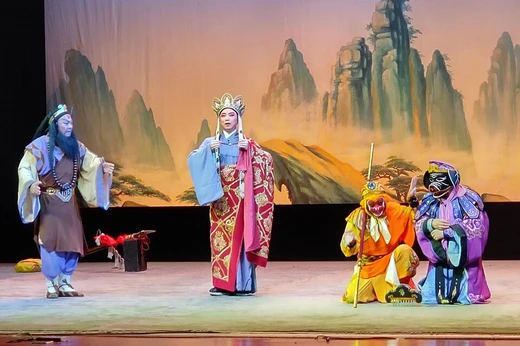
Ceccarelli states the book is famously referred to as 70% history and 30% fiction, encompassing the last years of the Han dynasty and the Three Kingdoms period.[4] The Digital Taiwan account states that printers of the Ming and Qing dynasties promoted the story with illustrated editions.[9] Ceccarelli observes that the novel's influence on popular culture in China is evident in various forms, including Beijing Opera.[4]
References
- Wikipedia, "Romance of the Three Kingdoms" (CC BY-SA 4.0), which cites: Roberts 1991, pg. 940; Kim, "(Review) Historical China film lives up to expectations", Korea JoongAng Daily, 11 July 2008; Shoji, "War as wisdom and gore", The Japan Times, 6 November 2008; Tran H., Takahashi S., & Jin C. (2025) Cross-Cultural Interpretations of Romance of the Three Kingdoms in Southeast Asia: A Review ISSN: 2187-4751 – The Asian C; Iamsa-ard, "The course of true loyalists never did run smooth: Critical discourse analysis of the Romance of the Three Kingdoms in Thai school textbooks", Cogent Arts & Humanit en.wikipedia.org
- Wikipedia, "Romance of the Three Kingdoms" (CC BY-SA 4.0), which cites: Plaks, "The Four Masterworks of the Ming Novel", Princeton University Press, 1987, p. 361–368 (original not read by us) en.wikipedia.org
- Wikipedia, "Romance of the Three Kingdoms" (CC BY-SA 4.0), which cites: "Encyclopedia of Literary Translation into English", Taylor & Francis, 1998, p. 1221–1222; Lo, "Romance of the Three Kingdoms", Tuttle, 2002, p. viii; Lo, "Romance of the Three Kingdoms", Tuttle, 2002, p. viii; Moss Roberts, "Afterword," in Luo, Three Kingdoms (Berkeley: University of California Press, 1991), pp. 937, 938, 964.; Moss Roberts, "Afterword," in Luo, Three Kingdoms (Berkeley: University of California Press, 1991), pp. 937, 938, 964. (we also read that source) en.wikipedia.org
- Ceccarelli, "The Romance of the Three Kingdoms, an Introduction", European Guanxi, 2022-04-18. facts only, no text reused. europeanguanxi.com
- Wikipedia, "Romance of the Three Kingdoms" (CC BY-SA 4.0), which cites: "The Immortals by the River (楊慎 臨江仙) 滚滚长江东逝水", Vincent's Calligraphy; Bojun Shen, translated by Kimberly Basio, "Studies of the Three Kingdoms in the New Century," in Besio and Tong, eds., Three Kingdoms and Chinese Culture, p. 15 (original not read by us) en.wikipedia.org
- Wikipedia, "Romance of the Three Kingdoms" (CC BY-SA 4.0), which cites: Roberts 1991, pp. 946–53. (original not read by us) en.wikipedia.org
- Wikipedia, "Romance of the Three Kingdoms" (CC BY-SA 4.0), which cites: Roberts 1991, pg. 980; Roberts 1991, pg. 965; Roberts 1991, pp. 967–971 (original not read by us) en.wikipedia.org
- Wikipedia, "Romance of the Three Kingdoms" (CC BY-SA 4.0), which cites: Hegel 2002, p. ix (original not read by us) en.wikipedia.org
- "A Thousand, Thousand Churning Waves- The Legendary Red Cliff Heritage", Digital Taiwan, January 2011. facts only, no text reused. culture.teldap.tw
Each numbered sentence above was checked against the source it cites before publication. Sentences citing Wikipedia adapt text from the English Wikipedia article Romance of the Three Kingdoms (contributors), used under CC BY-SA 4.0; this entry is available under the same licence. Other sources were used for facts only; no text or images are copied from them.
More in Literary Novels And Classics
Sources
Compiled from Wikipedia and the sources listed below. Text from Wikipedia is available under CC BY-SA 4.0; this entry is adapted from it.
- Wikipedia: Romance of the Three Kingdoms (CC BY-SA 4.0).
Spotted an error? Know more?
Reader corrections go straight into our review queue. Suggest an edit · How this site is sourced